

Class: Senior Secondary School 1 (SS1 / SSS 1)
Term: Second Term
Week: 6
Age: 15 years
Duration: 45 minutes
Subject: Printing Craft
Curriculum Theme: Trade
Previous Lesson: Technical Workshop In Printing Industry: Machine Room And Binding Finishing Room.
Topic: PRINT MAKING
Subject Matter: Definition of print making, Types of print making, Relief printing, Screen printing, Intaglio printing, Planography, Common materials and tools
Specific Objectives
By the end of the lesson, pupils should be able to:
Cognitive Domain:
- Define print making.
- State and describe the different types of print making.
- Explain the basic process involved in each print making type.
Affective Domain:
- Appreciate the artistic and commercial value of print making.
- Value the different techniques and processes in print making.
Psychomotor Domain:
- Identify common materials and tools used in print making.
- Differentiate between various print making types based on their characteristics.
Social Domain:
- Participate actively in discussions about print making types and functions.
Reference Materials
The following resources were used in planning this lesson:
- 9 Years Basic Education Curriculum for Creative and Cultural Arts.
- State Unified Scheme of Work for Senior Secondary Schools.
- Creative and Cultural Arts for Senior Secondary Schools by [Author/Publisher, e.g., Evans Brothers].
- https://www.metmuseum.org/toah/hd/prnt/hd_prnt.htm
- https://www.britannica.com/art/printmaking
Instructional Materials
The teacher will teach this lesson with the aid of:
- A relief block (e.g., linoleum or woodcut)
- A screen frame with mesh
- An etching plate sample (or image)
- A litho stone image (or example of a lithographic print)
- Printing ink
- Rollers (brayers)
- Various printmaking tools (e.g., carving tools, squeegee)
- Charts showing printmaking processes
Rationale for the Lesson
This lesson helps pupils understand the fundamental processes and techniques involved in creating prints. It enables them to appreciate printmaking as an important art form and a commercial craft, connecting their learning to practical applications in visual communication and design.
Prerequisite/Previous Knowledge
Pupils are expected to have basic knowledge of art, drawing, and different forms of visual expression from their previous lessons.
Lesson Content/Board Summary
PRINT MAKING
Definition of Print Making
Print making is an artistic process of creating images by transferring ink from a matrix (such as a block, plate, or screen) onto another surface, most often paper or fabric. The matrix can be reused to make multiple copies of the same image, known as an edition.
Types of Print Making
Print making can be broadly categorized into four main types based on how the image is transferred from the matrix to the printing surface:
- Relief Printing
- Intaglio Printing
- Planography (Lithography)
- Screen Printing (Serigraphy)
Relief Printing
Relief printing is a method where the image to be printed is raised from the surface of the matrix. The non-printing areas are cut away, leaving the design in relief. Ink is applied to the raised surface, and then paper is pressed against it to transfer the image.
Examples of relief printing include:
- Woodcut
- Linocut
- Wood Engraving
Screen Printing (Serigraphy)
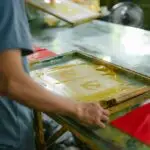
Screen printing is a stencil-based method where ink is forced through a fine mesh screen onto the printing surface. Areas of the screen are blocked off to prevent ink from passing through, creating the desired image. It is versatile and used for printing on various materials like fabric, paper, and plastic.
The basic process involves:
- Preparing a screen with a stencil.
- Placing the material to be printed beneath the screen.
- Pouring ink onto the screen.
- Using a squeegee to force the ink through the open areas of the stencil onto the material.
Intaglio Printing
Intaglio printing is a method where the image is incised or etched into the surface of the matrix. The recessed lines or areas hold the ink. The surface is wiped clean, leaving ink only in the grooves. Paper is then pressed against the plate under high pressure, causing it to pick up the ink from the recessed areas.
Examples of intaglio printing techniques include:
- Engraving
- Etching
- Drypoint
- Mezzotint
- Aquatint
Planography (Lithography)
Planography, specifically lithography, is a printing method based on the principle that oil and water do not mix. The image is drawn with an oil-based medium onto a flat surface (traditionally a limestone slab). The surface is then treated so that the drawn areas repel water but attract oil-based ink, while the blank areas attract water and repel ink. When inked, only the drawn areas hold ink, which is then transferred to paper.
Key characteristics of planography are:
- The printing surface remains flat, not raised or incised.
- It relies on chemical repulsion between oil and water.
Common Materials and Tools for Print Making
The following are common materials and tools used in various print making processes:
- Matrices: Wood blocks, linoleum blocks, metal plates (copper, zinc), silk screens, lithographic stones or plates.
- Cutting/Carving Tools: Gouges, chisels, etching needles, burins.
- Inks: Oil-based inks, water-based inks, screen printing inks.
- Rollers (Brayers): Used to apply ink evenly to relief surfaces.
- Squeegee: Used in screen printing to force ink through the mesh.
- Paper: Various types of printing paper.
- Presses: Printing presses (relief, intaglio, lithographic) to apply pressure.
- Chemicals: Acids for etching, solvents for cleaning, gum arabic for lithography.
Teaching Methods/Instructional Techniques
Discussion, Lecture, Demonstration, Question and Answer, Visual Aids
Instructional Procedures
Step 1: Introduction
Time: 5 minutes
Teaching Skill: Set Induction/Prior Knowledge Activation
Teacher’s Activity: The teacher greets the pupils, reviews the previous lesson briefly, and asks pupils if they have ever seen multiple copies of the same image, like on T-shirts or posters, and how they think these are made. The teacher then introduces the topic: Print Making.
Pupils’ Activity: Pupils respond to questions and listen attentively.
Learning Point: Pupils are engaged and connect previous knowledge to the new topic.
Step 2: Definition of Print Making
Time: 7 minutes
Teaching Skill: Explanation/Definition
Teacher’s Activity: The teacher defines print making, explaining it as a process of transferring images from a matrix to another surface. The teacher emphasizes the concept of creating multiple identical copies.
Pupils’ Activity: Pupils listen, take notes, and ask questions for clarity.
Learning Point: Pupils understand the basic definition and purpose of print making.
Step 3: Types of Print Making
Time: 5 minutes
Teaching Skill: Listing/Classification
Teacher’s Activity: The teacher lists the four main types of print making: Relief Printing, Intaglio Printing, Planography, and Screen Printing, writing them on the board.
Pupils’ Activity: Pupils note down the types of print making.
Learning Point: Pupils can identify the major categories of print making.
Step 4: Explaining Relief and Screen Printing
Time: 10 minutes
Teaching Skill: Demonstration/Explanation
Teacher’s Activity: The teacher explains Relief Printing, using a relief block and roller to demonstrate how ink is applied to the raised surface. The teacher then explains Screen Printing, using the screen frame and squeegee to illustrate the stencil method. The teacher highlights the key differences in how ink is transferred for each type.
Pupils’ Activity: Pupils observe the demonstrations, ask questions, and take notes.
Learning Point: Pupils understand the processes of relief and screen printing and can differentiate them.
Step 5: Explaining Intaglio and Planography
Time: 8 minutes
Teaching Skill: Explanation/Visual Aid
Teacher’s Activity: The teacher explains Intaglio Printing, describing how the image is incised and holds ink, using the etching plate sample as a visual aid. The teacher then explains Planography (Lithography), describing the oil and water principle, using the litho stone image or print example.
Pupils’ Activity: Pupils pay attention to the explanations and visuals, comparing these methods to the previous ones.
Learning Point: Pupils grasp the concepts of intaglio and planography, understanding their unique ink transfer mechanisms.
Step 6: Common Materials and Tools
Time: 5 minutes
Teaching Skill: Identification/Display
Teacher’s Activity: The teacher displays and names various common materials and tools used in print making, such as different types of blocks/plates, inks, rollers, and carving tools, linking them to the specific print making types where they are used.
Pupils’ Activity: Pupils identify the materials and tools and relate them to the explained processes.
Learning Point: Pupils can recognize and name essential print making materials and tools.
Step 7: Evaluation/Review
Time: 5 minutes
Teaching Skill: Questioning/Assessment
Teacher’s Activity: The teacher evaluates the learning by asking the following questions:
- Define print making in your own words.
- Mention any three types of print making.
- Explain the main difference between relief printing and intaglio printing.
- List three common materials or tools used in print making.
Pupils’ Activity: Pupils answer orally and in writing.
Learning Point: Pupils demonstrate understanding of the lesson.
Step 8: Conclusion
Time: 2 minutes
Teaching Skill: Summarization/Homework Assignment
Teacher’s Activity: The teacher summarizes the main points of the lesson, reiterating the definition, types, and basic processes of print making. The teacher assigns homework: “Research and bring examples of prints made using each of the four types discussed today.”
Pupils’ Activity: Pupils listen to the summary and copy down the homework.
Learning Point: Pupils consolidate their learning and are prepared for further exploration.
Lesson Keywords
- Print Making – The process of creating images by transferring ink from a matrix to another surface.
- Matrix – The surface (e.g., block, plate, screen) from which a print is made.
- Relief Printing – A print making method where the image to be printed is raised from the surface.
- Screen Printing – A stencil-based print making method where ink is forced through a mesh screen.
- Intaglio Printing – A print making method where the image is incised or etched into the surface.
- Planography (Lithography) – A printing method based on the principle that oil and water do not mix, using a flat surface.
- Brayer – A hand roller used to apply ink to a printing surface.
- Squeegee – A tool used in screen printing to force ink through the mesh.
Differentiation
For pupils who grasp concepts quickly, the teacher can encourage them to research specific artists known for each print making technique. For pupils needing more support, the teacher can provide simplified diagrams of each process and offer one-on-one guidance during activity time, focusing on identifying tools and basic definitions.
Note for teachers using this lesson plan
It is beneficial to bring actual examples or high-quality images of prints made using each technique to enhance pupil understanding. Encourage hands-on interaction with the tools and materials where possible and safe. Emphasize safety precautions when handling any sharp tools or chemicals.

Community Join the conversation Open discussion +