

Class: Senior Secondary School 1 (SS1 / SSS1)
Term: 2nd Term
Week: 8
Age: 15 years
Duration: 45 minutes
Subject: Printing Craft
Curriculum Theme: Trade
Previous Lesson: Relief Printing Without A Press: Leaf, Yam, Potato And Lino-Cut Printing.
Topic: EXCURSION TO PRINTING PRESS
Subject Matter: Visit to a nearby printing press, Observation of press operations, Prepress and press sections, Finishing and binding section overview, Report writing on observations.
Specific Objectives
By the end of the lesson, pupils should be able to:
Cognitive Domain:
- Identify the different sections of a printing press.
- Describe the basic operations performed in each section.
- Explain the importance of an excursion to a printing press.
Affective Domain:
- Appreciate the practical aspects of printing technology.
- Develop an interest in the printing industry.
- Recognize the importance of safety measures in a printing environment.
Psychomotor Domain:
- Observe and note down key operations during the visit.
- Ask relevant questions about the printing process.
- Write a simple report detailing their observations from the excursion.
Social Domain:
- Collaborate with peers during observation and discussion.
- Communicate their observations clearly and effectively.
Reference Materials
The following resources were used in planning this lesson:
- 9 Years Basic Education Curriculum
- State Unified Scheme of Work
- Printing Craft for Senior Secondary Schools Textbook
Instructional Materials
The teacher will teach this lesson with the aid of:
- A printing press facility (for the actual excursion)
- Sample printed products
- Observation checklist
- Notebook and pen
Rationale for the Lesson
This lesson helps pupils to connect theoretical knowledge of printing with practical experience. Visiting a printing press enables them to see real-world applications of the concepts learned in class, which deepens their understanding and appreciation for the craft.
Prerequisite/Previous Knowledge
Pupils have a basic understanding of what printing is and some common terms associated with it, having covered introductory topics in Printing Craft.
Lesson Content/Board Summary
EXCURSION TO PRINTING PRESS
Purpose of a Printing Press Excursion
An excursion to a printing press is important for pupils because it:
- Provides practical exposure to the printing industry.
- Helps in understanding the various stages of printing production.
- Enables pupils to observe machines and equipment in operation.
- Connects classroom theories with real-world applications.
- Inspires interest in potential career paths within the printing sector.
Key Sections of a Printing Press
A typical printing press facility is divided into several sections, including:
- Pre-press Section: This is where designs are prepared, images are processed, and plates are made. Activities include graphic design, typesetting, scanning, and plate-making.
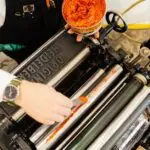
- Press Section: This is where the actual printing takes place. Machines like offset presses, digital presses, or flexographic presses transfer ink onto paper or other substrates.
- Post-press / Finishing and Binding Section: After printing, materials undergo finishing processes. These include cutting, folding, collating, stitching, perfect binding, laminating, and packaging.
Activities Involved in Printing Operations
The operations observed in a printing press typically include:
- Design and Layout: Creating the visual elements and arrangement of text and images.
- Platemaking: Transferring the digital design onto physical plates used in the press.
- Ink Application: Applying ink to the plates and then to the printing material.
- Paper Feeding: Loading paper or other materials into the printing machine.
- Quality Control: Checking printed items for accuracy, color consistency, and defects.
- Cutting: Trimming printed sheets to their final size.
- Folding: Bending sheets into desired forms, especially for books and brochures.
- Binding: Assembling and fastening pages together to form books, magazines, or reports.
Importance of Report Writing After an Excursion
Report writing after an excursion helps pupils to:
- Consolidate their observations and learning.
- Develop their descriptive and analytical writing skills.
- Recall specific details and processes from the visit.
- Organize information logically.
- Demonstrate their understanding of the lesson.
Teaching Methods/Instructional Techniques
Discussion, Lecture, Demonstration, Question and Answer, Visual Aids
Instructional Procedures
Step 1: Introduction
Time: 5 minutes
Teaching Skill: Set Induction
Teacher’s Activity: The teacher greets the pupils, reviews the previous lesson briefly, and introduces the day’s topic: an excursion to a printing press. The teacher explains the purpose of the excursion and what pupils are expected to learn and observe.
Pupils’ Activity: Pupils respond to greetings, recall the previous lesson, and listen attentively to the introduction.
Learning Point: Pupils are prepared for the day’s practical learning experience.
Step 2: Pre-Excursion Briefing
Time: 5 minutes
Teaching Skill: Explanation/Preparation
Teacher’s Activity: The teacher discusses safety rules to be observed at the printing press, outlines the sections to be visited, and gives pupils an observation checklist or key points to note down. The teacher also encourages pupils to ask relevant questions during the visit.
Pupils’ Activity: Pupils listen to the instructions, ask clarifying questions, and prepare their notebooks and pens.
Learning Point: Pupils understand the expectations and safety protocols for the excursion.
Step 3: Travel to Printing Press
Time: (Varies, outside 45 min lesson slot)
Teaching Skill: Logistics Management
Teacher’s Activity: The teacher leads the pupils to the designated printing press, ensuring their safety and orderliness.
Pupils’ Activity: Pupils follow the teacher and maintain order during transit.
Learning Point: Pupils arrive safely at the learning environment.
Step 4: Observation and Guided Tour
Time: (Varies, outside 45 min lesson slot)
Teaching Skill: Demonstration/Guidance
Teacher’s Activity: At the printing press, the teacher, possibly with a guide from the press, explains each section (pre-press, press, finishing/binding) and the operations taking place. The teacher points out key machines and processes, answering pupils’ questions.
Pupils’ Activity: Pupils observe the operations, take notes, ask questions, and interact with the guide/teacher.
Learning Point: Pupils gain first-hand experience and understanding of printing processes.
Step 5: Post-Excursion Discussion
Time: 15 minutes
Teaching Skill: Discussion/Recap
Teacher’s Activity: Back in the classroom or a suitable discussion area, the teacher facilitates a discussion about the observations. The teacher asks pupils what they saw, what surprised them, and what they learned. The teacher clarifies any misconceptions.
Pupils’ Activity: Pupils share their observations, discuss what they learned, and ask further questions.
Learning Point: Pupils consolidate their understanding and clarify doubts from the excursion.
Step 6: Report Writing Instruction
Time: 10 minutes
Teaching Skill: Instruction/Guidance
Teacher’s Activity: The teacher explains the structure and content expected in the excursion report. This includes an introduction, description of sections visited, observations, challenges (if any), and a conclusion. The teacher sets a deadline for submission.
Pupils’ Activity: Pupils listen to the instructions for report writing and take notes.
Learning Point: Pupils understand how to structure and write a comprehensive report on their excursion.
Step 7: Evaluation/Review
Time: 5 minutes
Teaching Skill: Questioning/Assessment
Teacher’s Activity: The teacher evaluates the learning by asking the following questions:
- Mention two main sections you observed in a printing press.
- Describe one operation that takes place in the pre-press section.
- State two reasons why visiting a printing press is important for a Printing Craft student.
- List three finishing processes you might see in a printing press.
Pupils’ Activity: Pupils answer orally and in writing.
Learning Point: Pupils demonstrate understanding of the lesson.
Step 8: Conclusion
Time: 5 minutes
Teaching Skill: Summarization/Assignment
Teacher’s Activity: The teacher summarizes the key learning points from the excursion and reminds pupils of the importance of the practical experience. The teacher reiterates the assignment to write a detailed report on the excursion, due next class.
Pupils’ Activity: Pupils listen to the summary and take note of the assignment.
Learning Point: Pupils grasp the overall importance of the excursion and are aware of their follow-up task.
Lesson Keywords
- Excursion – A short journey or trip, especially one engaged in as a leisure activity or for educational purposes.
- Printing Press – A machine for printing text or pictures from type or plates.
- Pre-press – The processes that occur before actual printing, such as design, typesetting, and plate-making.
- Press Section – The part of a printing facility where ink is transferred onto paper or other materials.
- Finishing – The processes applied to printed material after printing, such as cutting, folding, and binding.
- Binding – The process of joining together sheets of paper or other materials to form a book, magazine, or document.
Differentiation
For pupils who may struggle, the teacher will provide a more detailed observation checklist and simplified report guidelines. Advanced learners will be encouraged to research specific machines or processes observed and include more detailed technical descriptions in their reports. Group discussions will allow all pupils to contribute and learn from each other’s observations.
Note for teachers using this lesson plan
Ensure all necessary permissions and arrangements for the printing press visit are secured well in advance. Emphasize safety throughout the excursion. The actual duration of the excursion itself will extend beyond the typical 45-minute lesson slot, so coordinate with school administration for an extended period. The time allocations in the instructional procedures refer to classroom-based briefing and debriefing sessions. Encourage pupils to be inquisitive and respectful during the visit.


Community Join the conversation Open discussion +