

Class: Senior Secondary School 1 (SS1, SS 1, SSS1, SSS 1)
Term: Third Term
Week: 3
Age: 15 years
Duration: 45 minutes
Subject: History
Curriculum Theme: History
Previous Lesson: Early External Influence: Trans-Saharan Trade Locations.
Topic: EARLY EXTERNAL INFLUENCES CONTINUED
Subject Matter: commodities traded across Trans-Saharan routes, salt, gold and other trade goods, sources of the commodities, how commodities moved between regions, importance of the goods in trade.
Specific Objectives
By the end of the lesson, pupils should be able to:
Cognitive Domain:
- Define the term ‘commodity’ in the context of trade.
- List at least five major commodities traded across the Trans-Saharan routes.
- Identify the sources of key commodities like salt and gold.
- Explain how commodities were moved between different regions.
- State the importance of these goods in Trans-Saharan trade.
Affective Domain:
- Appreciate the historical significance of Trans-Saharan trade to West African economies.
- Value the ingenuity of ancient traders in facilitating long-distance exchange.
Psychomotor Domain:
- Identify pictures or samples of common Trans-Saharan trade goods.
- Point out on a map the general regions associated with the sources of major commodities.
Social Domain:
- Collaborate with peers to identify and discuss various trade commodities.
Reference Materials
The following resources were used in planning this lesson:
- 9 Years Basic Education Curriculum for History.
- State Unified Scheme of Work for Senior Secondary School History.
- History for Senior Secondary Schools 1 by J.B. Adeyemi.
Instructional Materials
The teacher will teach this lesson with the aid of:
- Samples of trade goods (e.g., salt, kola nuts, pieces of cloth).
- Pictures illustrating Trans-Saharan trade caravans and goods.
- Maps showing Trans-Saharan trade routes and regions of commodity sources.
- Charts displaying lists of commodities and their sources.
Rationale for the Lesson
This lesson helps pupils understand the types of goods that fueled early trade between West Africa and North Africa. It enables them to see how these exchanges shaped the economies and cultures of the regions involved, providing a foundation for understanding historical economic development.
Prerequisite/Previous Knowledge
Pupils should have prior knowledge of the concept of trade, early external influences, and the general geographical location of the Sahara Desert and West Africa.
Lesson Content/Board Summary
EARLY EXTERNAL INFLUENCES: COMMODITIES TRADED ACROSS TRANS-SAHARAN ROUTES
Definition of Commodities
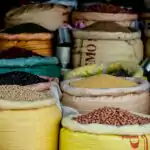
In trade, commodities refer to raw materials or primary agricultural products that can be bought and sold, such as salt, gold, or grains.
Major Commodities Traded Across Trans-Saharan Routes
The following were major commodities exchanged across the Trans-Saharan routes:
- From West Africa to North Africa/Europe: Gold, kola nuts, slaves, ivory, ostrich feathers, animal hides, gum.
- From North Africa/Europe to West Africa: Salt, textiles (cloth), copper, glass beads, dates, horses, firearms (later periods), books.
Sources of the Commodities
The sources of these commodities were diverse:
- Gold: Sourced mainly from the goldfields of Wangara (Ghana Empire), Bambuk, Bure, and later Akan lands in West Africa.
- Salt: Primarily mined from the Sahara Desert, particularly from places like Taghaza and Bilma. It was also obtained from coastal areas.
- Kola Nuts: Grown in the forest regions of West Africa.
- Slaves: Captured during inter-tribal wars or raids in West Africa.
- Textiles: Produced in North Africa and Europe.
- Copper: Mined in North Africa.
How Commodities Moved Between Regions
Commodities moved across the vast Sahara Desert primarily through:
- Caravans: Large groups of traders and their goods, often numbering thousands of camels, travelled together for safety and efficiency.
- Camels: These animals were essential for desert travel due as they could endure long journeys without water and carry heavy loads.
- Trade Routes: Established paths connected major trading cities like Timbuktu, Gao, Jenne in West Africa with cities like Sijilmasa, Ghadames, Tripoli, and Cairo in North Africa.
Importance of the Goods in Trade
The goods traded were important for several reasons:
- Economic Development: The trade stimulated economic growth, leading to the rise of powerful empires and kingdoms in West Africa (e.g., Ghana, Mali, Songhai) that controlled the flow of goods.
- Resource Exchange: It allowed regions to acquire essential resources they lacked, such as salt for West Africans and gold for North Africans and Europeans.
- Cultural Diffusion: The movement of goods facilitated the exchange of ideas, technologies, and religions (like Islam) between different cultures.
- Wealth Accumulation: Rulers and merchants accumulated great wealth from taxing and participating in the trade.
Teaching Methods/Instructional Techniques
Discussion, Lecture, Demonstration, Question and Answer, Visual Aids
Instructional Procedures
Step 1: Introduction
Time: 5 minutes
Teaching Skill: Set Induction
Teacher’s Activity: The teacher greets the pupils and reviews the previous lesson on early external influences. The teacher then asks pupils to name some things they exchange with friends or family, leading into the concept of trade and commodities. The topic for the day is then introduced.
Pupils’ Activity: Pupils respond to greetings, recall points from the previous lesson, and share examples of exchanges. They listen attentively to the introduction of the new topic.
Learning Point: Pupils recall previous knowledge and are prepared for the new lesson.
Step 2: Defining Commodities and Identifying Major Goods
Time: 10 minutes
Teaching Skill: Explanation/Demonstration
Teacher’s Activity: The teacher defines “commodity” and then uses pictures, samples, and charts to introduce the major goods traded across the Trans-Saharan routes, distinguishing between goods from West Africa and North Africa. The teacher asks pupils to mention some of these goods.
Pupils’ Activity: Pupils listen to the definition, observe the instructional materials, and mention some of the commodities they see or hear about.
Learning Point: Pupils understand the term ‘commodity’ and can identify major goods traded.
Step 3: Locating Sources of Commodities
Time: 8 minutes
Teaching Skill: Visualisation/Mapping
Teacher’s Activity: Using a map, the teacher points out the general sources of key commodities like gold (West African goldfields) and salt (Sahara Desert). The teacher asks pupils to identify these locations.
Pupils’ Activity: Pupils observe the map and identify the geographical sources of the commodities as pointed out by the teacher.
Learning Point: Pupils can identify the geographical origins of important trade goods.
Step 4: Describing the Movement of Goods
Time: 7 minutes
Teaching Skill: Explanation/Discussion
Teacher’s Activity: The teacher explains how commodities were transported across the Sahara, focusing on the role of caravans and camels. Pictures of caravans can be shown to aid understanding. The teacher asks how such long journeys were possible.
Pupils’ Activity: Pupils listen to the explanation, observe pictures, and contribute ideas on the methods of transportation.
Learning Point: Pupils understand the logistics of commodity movement in Trans-Saharan trade.
Step 5: Discussing the Importance of Trade Goods
Time: 7 minutes
Teaching Skill: Questioning/Facilitation
Teacher’s Activity: The teacher leads a discussion on why these commodities were important, highlighting their economic, social, and cultural significance. The teacher asks pupils to state some benefits of this trade.
Pupils’ Activity: Pupils participate in the discussion, offering their thoughts on the importance of the trade goods.
Learning Point: Pupils grasp the broader impact and significance of the Trans-Saharan trade commodities.
Step 6: Evaluation/Review
Time: 5 minutes
Teaching Skill: Questioning/Assessment
Teacher’s Activity: The teacher evaluates the learning by asking the following questions:
- Define the term ‘commodity’.
- List three commodities traded from West Africa to North Africa.
- Mention two commodities traded from North Africa to West Africa.
- State the primary source of gold for the Trans-Saharan trade.
- Explain how goods were transported across the Sahara Desert.
Pupils’ Activity: Pupils answer orally and in writing.
Learning Point: Pupils demonstrate understanding of the lesson.
Step 7: Conclusion
Time: 3 minutes
Teaching Skill: Summarization
Teacher’s Activity: The teacher summarizes the key points of the lesson, reiterating the major commodities, their sources, movement, and importance in Trans-Saharan trade. An assignment is given to pupils.
Pupils’ Activity: Pupils listen to the summary and copy down the assignment.
Learning Point: Pupils reinforce their understanding of the lesson and have a task for further learning.
Lesson Keywords
- Commodity – A raw material or primary agricultural product that can be bought and sold.
- Trans-Saharan Trade – Trade across the Sahara Desert, connecting West Africa with North Africa and beyond.
- Caravan – A group of travellers, especially merchants or pilgrims, journeying together across deserts.
- Gold – A precious metal, a key export from West Africa.
- Salt – An essential mineral, a key export from the Sahara Desert.
Differentiation
For pupils who grasp concepts quickly, they can be asked to research the specific routes or the role of particular trading cities. For those needing extra support, the teacher will provide simplified charts and more direct guidance, focusing on identifying the main commodities and their general sources.
Note for teachers using this lesson plan
Teachers should use clear visual aids and engage pupils actively in discussions. Encouraging pupils to relate the historical trade to modern trade concepts can enhance their understanding. Emphasize the long-term impact of the trade on the development of West African societies.


Community Join the conversation Open discussion +