

Class: Senior Secondary School 1 (SS1, SS 1, SSS1, SSS 1)
Term: 2nd Term
Week: 5
Age: 15 years
Duration: 45 minutes
Subject: Basic Electronics
Curriculum Theme: Basic Electronics
Previous Lesson: Circuit Components: Resistors, Symbols and Units.
Topic: CIRCUIT COMPONENTS: Resistance colour coding and rating. Calculation of resistance.
Subject Matter: Resistor colour codes, resistor rating, reading colour bands, calculating resistance from colour coding, checking resistance values.
Specific Objectives
By the end of the lesson, pupils should be able to:
Cognitive Domain:
- Define resistor colour coding.
- State the meaning of each colour band on a resistor.
- Explain how to calculate resistance from colour codes.
- Identify the importance of resistor rating.
Affective Domain:
- Appreciate the standard method of identifying resistor values.
- Develop interest in practical electronics work.
Psychomotor Domain:
- Read the colour bands on various resistors.
- Calculate the resistance value of given resistors using the colour code chart.
- Demonstrate the ability to check resistance values using a multimeter (if available).
Social Domain:
- Collaborate with peers to solve resistance calculation problems.
- Participate actively in class discussions and practical activities.
Reference Materials
The following resources were used in planning this lesson:
- 9 Years Basic Education Curriculum for Basic Technology (JSS) and Basic Science and Technology (SSS).
- State Unified Scheme of Work for Basic Electronics, SSS 1.
- Anyanwu, J. U. (2018). Basic Electronics for Senior Secondary Schools. Learnwell Publishers.
Instructional Materials
The teacher will teach this lesson with the aid of:
- Assorted resistors of different values.
- Resistor colour code charts.
- Whiteboard and markers.
- Multimeter (optional, for demonstration).
Rationale for the Lesson
This lesson helps pupils understand how to identify the value of resistors, which are fundamental components in electronic circuits. Knowing how to read colour codes enables pupils to select the correct resistor for various applications and troubleshoot electronic devices effectively.
Prerequisite/Previous Knowledge
Pupils should have basic knowledge of electrical components and the concept of resistance from their previous lessons.
Lesson Content/Board Summary
CIRCUIT COMPONENTS: Resistance Colour Coding and Rating
1. Resistor Colour Code
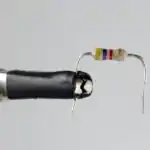
Resistor colour coding is a universal system used to indicate the resistance value and tolerance of a resistor by using a series of coloured bands.
2. Resistor Colour Bands
Most common resistors have four or five colour bands. Each band represents a specific part of the resistance value:
- The **first band** represents the first digit of the resistance value.
- The **second band** represents the second digit of the resistance value.
- The **third band** (for 4-band resistors) or **third digit** (for 5-band resistors) represents the third digit of the resistance value.
- The **fourth band** represents the multiplier (power of 10).
- The **fifth band** (for 4-band resistors) or **sixth band** (for 5-band resistors) represents the tolerance (percentage of deviation from the stated value).
3. Colour Code Chart
The following is a standard colour code chart:
- Black – 0
- Brown – 1
- Red – 2
- Orange – 3
- Yellow – 4
- Green – 5
- Blue – 6
- Violet – 7
- Grey – 8
- White – 9
- Gold – Multiplier x 0.1, Tolerance ±5%
- Silver – Multiplier x 0.01, Tolerance ±10%
- No Colour – Tolerance ±20%
4. Reading and Calculating Resistance
To calculate resistance from colour coding:
- Identify the first digit from the first band colour.
- Identify the second digit from the second band colour.
- Combine these two digits.
- Identify the multiplier from the third band colour (for 4-band) or fourth band (for 5-band) and multiply the combined digits by it.
- Identify the tolerance from the last band.
Example: A resistor has bands: Red, Violet, Orange, Gold.
- Red = 2 (first digit)
- Violet = 7 (second digit)
- Orange = x 1,000 (multiplier)
- Gold = ±5% (tolerance)
Therefore, the resistance value is 27 x 1,000 Ohms = 27,000 Ohms or 27 kOhms with ±5% tolerance.
5. Resistor Rating
Resistor rating refers to the maximum power (in Watts) a resistor can safely dissipate without being damaged. Common power ratings include 1/8W, 1/4W, 1/2W, 1W, and higher. Exceeding the power rating can cause the resistor to overheat and burn out.
6. Checking Resistance Values
The actual resistance value of a resistor can be checked using a multimeter set to the Ohms (Ω) range. This is useful for verifying the colour code calculation and for identifying unmarked resistors.
Teaching Methods/Instructional Techniques
Discussion, Lecture, Demonstration, Question and Answer, Visual Aids
Instructional Procedures
Step 1: Introduction
Time: 5 minutes
Teaching Skill: Set Induction
Teacher’s Activity: The teacher greets the pupils, checks their previous knowledge on basic electrical components, and introduces the topic of resistors as fundamental components in electronics. The teacher then asks if pupils know how to determine the value of a resistor without writing on it.
Pupils’ Activity: Pupils respond to questions and share their prior knowledge.
Learning Point: Pupils recall basic knowledge of electrical components and are introduced to the lesson’s topic.
Step 2: Presentation of Resistor Colour Codes
Time: 10 minutes
Teaching Skill: Explanation/Demonstration
Teacher’s Activity: The teacher explains what resistor colour coding is and its importance. Using a large resistor colour code chart and actual resistors, the teacher points out the different bands and explains that each colour represents a number, multiplier, or tolerance. The teacher displays the colour code chart on the board.
Pupils’ Activity: Pupils observe the resistors and the colour code chart, listen attentively, and ask questions for clarification.
Learning Point: Pupils understand the concept of resistor colour coding and its purpose.
Step 3: Explaining Colour Band Meanings
Time: 10 minutes
Teaching Skill: Explanation/Illustration
Teacher’s Activity: The teacher elaborates on the meaning of each band (first digit, second digit, multiplier, tolerance) using the colour code chart. The teacher provides a mnemonic or a simple method to remember the colour sequence (e.g., BB ROY GreaT BriTain Very Good Wife).
Pupils’ Activity: Pupils listen, take notes, and try to recall the colour sequence and their corresponding values.
Learning Point: Pupils learn the specific value and function of each colour in the resistor colour code system.
Step 4: Demonstration of Reading Colour Codes and Calculation
Time: 8 minutes
Teaching Skill: Demonstration/Application
Teacher’s Activity: The teacher takes several assorted resistors and, with the help of the chart, demonstrates how to read the colour bands and calculate their resistance values step-by-step on the board. The teacher includes examples for 4-band and 5-band resistors if available.
Pupils’ Activity: Pupils observe the teacher’s demonstration, follow the calculation steps, and try to read values from other resistors.
Learning Point: Pupils learn the practical application of the colour code chart to determine resistance values.
Step 5: Resistor Rating
Time: 2 minutes
Teaching Skill: Explanation
Teacher’s Activity: The teacher briefly explains what resistor rating (power rating) means and why it is important in circuit design. The teacher shows examples of different sized resistors and mentions their typical power ratings.
Pupils’ Activity: Pupils listen and understand the concept of resistor power rating.
Learning Point: Pupils understand that resistors have a maximum power they can dissipate safely.
Step 6: Class Practice/Checking Resistance Values
Time: 5 minutes
Teaching Skill: Practical Application/Guided Practice
Teacher’s Activity: The teacher gives pupils different resistors and asks them to calculate their values in pairs or small groups. If a multimeter is available, the teacher demonstrates how to measure resistance to verify the calculated values.
Pupils’ Activity: Pupils work in groups to calculate resistance values and observe the multimeter demonstration.
Learning Point: Pupils apply their knowledge to calculate resistance and understand how to verify it practically.
Step 7: Evaluation/Review
Time: 5 minutes
Teaching Skill: Questioning/Assessment
Teacher’s Activity: The teacher evaluates the learning by asking the following questions:
- What is resistor colour coding?
- List the first five colours of the resistor colour code chart and their corresponding numerical values.
- Explain how the multiplier band is used in calculating resistance.
- A resistor has the following colour bands: Brown, Black, Red, Gold. Calculate its resistance value and tolerance.
Pupils’ Activity: Pupils answer orally and in writing.
Learning Point: Pupils demonstrate understanding of the lesson.
Step 8: Conclusion
Time: 2 minutes
Teaching Skill: Summarization
Teacher’s Activity: The teacher summarizes the key points of the lesson, emphasizing the importance of accurately reading resistor colour codes for practical electronics. The teacher gives homework: research common applications of resistors in electronic devices.
Pupils’ Activity: Pupils listen to the summary and note down the homework.
Learning Point: Pupils consolidate their understanding of resistor colour coding and rating.
Lesson Keywords
- Resistor – An electronic component that limits the flow of electric current in a circuit.
- Colour Code – A system of coloured bands used to indicate the value and tolerance of a resistor.
- Multiplier – The band on a resistor that indicates the power of ten by which the combined first two (or three) digits are multiplied.
- Tolerance – The permissible variation of a resistor’s actual resistance from its stated nominal value, expressed as a percentage.
- Ohm (Ω) – The unit of electrical resistance.
- Power Rating – The maximum amount of power a resistor can safely dissipate without being damaged.
Differentiation
For pupils who grasp concepts quickly, the teacher can provide more complex resistors (e.g., 5-band resistors) or introduce series and parallel resistance calculations. For those needing extra support, the teacher can provide simplified colour code charts, offer one-on-one guidance, or pair them with stronger pupils for collaborative learning.
Note for teachers using this lesson plan
Ensure that a variety of resistors are available for hands-on practice. A large, clear colour code chart is essential for effective demonstration. Encourage pupils to develop a systematic approach to reading the bands to avoid errors.

Community Join the conversation Open discussion +