

Class: Senior Secondary School 1 (SS1, SS 1, SSS1, SSS 1)
Term: 2nd Term
Week: 7
Age: 15 years
Duration: 45 minutes
Subject: Basic Electronics
Curriculum Theme: Basic Electronics
Previous Lesson: Circuit Components: Capacitors and Inductors.
Topic: CAPACITOR COLOUR CODING AND CALCULATION. INDUCTOR CALCULATION
Subject Matter: Capacitor colour coding and rating, inductor rating, capacitance calculations in series, capacitance calculations in parallel, inductance calculations in series, inductance calculations in parallel, series parallel calculations
Specific Objectives
By the end of the lesson, pupils should be able to:
Cognitive Domain:
- Explain capacitor colour coding and rating.
- Describe inductor rating.
- State the formulas for calculating total capacitance in series and parallel.
- State the formulas for calculating total inductance in series and parallel.
Affective Domain:
- Appreciate the importance of correct component identification and calculation in circuit design.
- Demonstrate carefulness when applying calculation formulas.
Psychomotor Domain:
- Interpret the colour code on given capacitors to determine their values.
- Calculate the total capacitance of capacitors connected in series and parallel.
- Calculate the total inductance of inductors connected in series and parallel.
- Solve problems involving series-parallel combinations of capacitors and inductors.
Social Domain:
- Collaborate with peers to solve calculation problems effectively.
Reference Materials
The following resources were used in planning this lesson:
- 9 Years Basic Education Curriculum for Basic Electronics.
- State Unified Scheme of Work for Senior Secondary Schools.
- Basic Electronics for Senior Secondary Schools by C.K. Okoro.
Instructional Materials
The teacher will teach this lesson with the aid of:
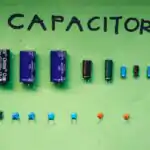
- Assorted capacitors (with colour codes visible).
- Assorted inductors.
- Circuit diagrams showing series and parallel connections.
- Whiteboard and markers.
Rationale for the Lesson
This lesson helps pupils understand how to identify the values of capacitors and inductors, which is important for practical electronics work. Learning how to calculate total capacitance and inductance in different circuit arrangements enables pupils to design and troubleshoot electronic circuits correctly.
Prerequisite/Previous Knowledge
Pupils should have a basic understanding of what capacitors and inductors are, their functions, and their basic units of measurement.
Lesson Content/Board Summary
CAPACITOR COLOUR CODING AND CALCULATION. INDUCTOR CALCULATION
1. Capacitor Colour Coding and Rating
Capacitors sometimes use a colour code system to indicate their value, tolerance, and voltage rating. This is common for smaller, non-polarised capacitors.
The colour code often follows a system similar to resistors, using bands or dots. The colour bands represent digits, multiplier, tolerance, and sometimes voltage.
The rating of a capacitor includes its capacitance value (in Farads, microfarads, nanofarads, picofarads), its working voltage, and its tolerance (percentage deviation from the stated value).
2. Inductor Rating
Inductors are rated by their inductance value (in Henrys, millihenrys, microhenrys), their maximum current rating (the maximum current they can carry without saturating or overheating), and their DC resistance (the resistance of the coil wire).
Some inductors may also use a colour code, but numerical markings are more common.
3. Capacitance Calculations
The total capacitance in a circuit depends on how capacitors are connected.
a. Capacitors in Series
When capacitors are connected in series, the total capacitance is less than the smallest individual capacitance. The reciprocal of the total capacitance is the sum of the reciprocals of the individual capacitances.
The formula for total capacitance (CT) in series is:
1/CT = 1/C1 + 1/C2 + 1/C3 + …
For two capacitors in series: CT = (C1 * C2) / (C1 + C2)
b. Capacitors in Parallel
When capacitors are connected in parallel, the total capacitance is the sum of the individual capacitances.
The formula for total capacitance (CT) in parallel is:
CT = C1 + C2 + C3 + …
4. Inductance Calculations
The total inductance in a circuit depends on how inductors are connected.
a. Inductors in Series
When inductors are connected in series (and there is no mutual inductance or coupling between them), the total inductance is the sum of the individual inductances.
The formula for total inductance (LT) in series is:
LT = L1 + L2 + L3 + …
b. Inductors in Parallel
When inductors are connected in parallel (and there is no mutual inductance or coupling between them), the reciprocal of the total inductance is the sum of the reciprocals of the individual inductances.
The formula for total inductance (LT) in parallel is:
1/LT = 1/L1 + 1/L2 + 1/L3 + …
For two inductors in parallel: LT = (L1 * L2) / (L1 + L2)
5. Series-Parallel Calculations
Many circuits contain both series and parallel combinations of components. To calculate the total capacitance or inductance in such circuits, one must identify the series and parallel sections and apply the appropriate formulas sequentially until a single equivalent value is obtained.
Teaching Methods/Instructional Techniques
Discussion, Lecture, Demonstration, Question and Answer, Visual Aids
Instructional Procedures
Step 1: Introduction
Time: 5 minutes
Teaching Skill: Set Induction
Teacher’s Activity: The teacher greets the pupils and reviews the previous lesson on basic properties of capacitors and inductors. The teacher then introduces the topic of capacitor colour coding, inductor rating, and calculations by asking pupils how they would determine the value of a capacitor without a multimeter, or combine several components to achieve a specific total value.
Pupils’ Activity: Pupils respond to the teacher’s questions and listen attentively to the introduction of the new topic.
Learning Point: Pupils recall previous knowledge and are prepared for the new lesson.
Step 2: Capacitor Colour Coding and Rating
Time: 10 minutes
Teaching Skill: Explanation/Demonstration
Teacher’s Activity: The teacher explains the concept of capacitor colour coding, demonstrating with actual capacitors. The teacher discusses how to interpret the bands or dots for capacitance value, tolerance, and voltage. The teacher also explains the various ratings of capacitors.
Pupils’ Activity: Pupils observe the capacitors, ask questions, and take notes on how to decode capacitor values.
Learning Point: Pupils learn to interpret capacitor colour codes and understand their ratings.
Step 3: Inductor Rating
Time: 5 minutes
Teaching Skill: Explanation
Teacher’s Activity: The teacher explains the different ratings of inductors, including inductance value, current rating, and DC resistance. The teacher mentions that while some inductors may have colour codes, numerical markings are more common.
Pupils’ Activity: Pupils listen and note the key ratings for inductors.
Learning Point: Pupils understand how inductors are rated.
Step 4: Capacitance Calculations (Series and Parallel)
Time: 8 minutes
Teaching Skill: Explanation/Problem Solving
Teacher’s Activity: The teacher presents the formulas for calculating total capacitance for capacitors connected in series and parallel. The teacher works out a few examples on the board, demonstrating the application of each formula.
Pupils’ Activity: Pupils copy the formulas and examples, participating in solving the problems.
Learning Point: Pupils learn to calculate total capacitance for series and parallel arrangements.
Step 5: Inductance Calculations (Series and Parallel)
Time: 8 minutes
Teaching Skill: Explanation/Problem Solving
Teacher’s Activity: The teacher presents the formulas for calculating total inductance for inductors connected in series and parallel (assuming no mutual inductance). The teacher works out examples on the board, similar to the capacitance calculations.
Pupils’ Activity: Pupils copy the formulas and examples, engaging in the problem-solving process.
Learning Point: Pupils learn to calculate total inductance for series and parallel arrangements.
Step 6: Series-Parallel Calculations
Time: 4 minutes
Teaching Skill: Problem Solving
Teacher’s Activity: The teacher explains the approach to solving problems involving both series and parallel combinations of capacitors or inductors. The teacher demonstrates by outlining the steps for a complex circuit diagram.
Pupils’ Activity: Pupils follow the explanation and ask clarifying questions.
Learning Point: Pupils understand the method for solving series-parallel combination problems.
Step 7: Evaluation/Review
Time: 5 minutes
Teaching Skill: Questioning/Assessment
Teacher’s Activity: The teacher evaluates the learning by asking the following questions:
- Explain how the colour code on a capacitor helps determine its value.
- Mention two key ratings of an inductor.
- State the formula for calculating total capacitance when capacitors are connected in series.
- If three 10µF capacitors are connected in parallel, what is their total capacitance?
- What is the total inductance of two 50mH inductors connected in series?
Pupils’ Activity: Pupils answer orally and in writing.
Learning Point: Pupils demonstrate understanding of the lesson.
Step 8: Conclusion
Time: 2 minutes
Teaching Skill: Summarization
Teacher’s Activity: The teacher summarizes the main points of the lesson, reiterating the importance of correctly identifying and calculating component values. The teacher assigns homework, which includes solving additional problems on capacitance and inductance calculations.
Pupils’ Activity: Pupils listen to the summary and copy down the homework.
Learning Point: Pupils consolidate their learning and prepare for further practice.
Lesson Keywords
- Capacitor – An electronic component that stores electrical energy in an electric field.
- Inductor – An electronic component that stores energy in a magnetic field when current flows through it.
- Colour Coding – A system using coloured bands or dots to indicate the value and characteristics of a component.
- Rating – The specified operating limits and values of an electronic component.
- Series Connection – Components connected end-to-end, forming a single path for current.
- Parallel Connection – Components connected across the same two points, providing multiple paths for current.
- Capacitance – The ability of a capacitor to store an electric charge, measured in Farads (F).
- Inductance – The property of an inductor to oppose changes in current, measured in Henrys (H).
- Tolerance – The permissible deviation from the stated value of a component, usually expressed as a percentage.
Differentiation
For pupils who grasp concepts quickly, additional complex series-parallel problems will be provided. For those needing more support, the teacher will offer one-on-one guidance and simpler problems, focusing on basic series and parallel calculations with visual aids.
Note for teachers using this lesson plan
Ensure that actual capacitors and inductors are available for demonstration. Emphasize the practical application of these calculations in real-world circuits. Encourage pupils to draw circuit diagrams for each calculation problem to visualize the connections better.
Community Join the conversation Open discussion +