

Class: Junior Secondary School 3 (JSS 3 / JS3)
Term: Third Term
Week: 5
Age: 14 years
Duration: 45 minutes
Subject: Mathematics
Curriculum Theme: Mathematics
Previous Lesson: Approximation: Revision of Approximation of Numbers to.
Topic: FRACTIONS (REVISION)
Subject Matter: Addition and subtraction of fractions, Multiplication and division of fractions, Use of order of operations in simplifying expressions with fractions: Simplifying algebraic fractions with monomial denominators
Specific Objectives
By the end of the lesson, pupils should be able to:
Cognitive Domain:
- Define what a fraction is.
- Add and subtract fractions correctly.
- Multiply and divide fractions accurately.
- Apply the order of operations (BODMAS) to simplify expressions involving fractions.
- Simplify algebraic fractions with monomial denominators.
Affective Domain:
- Appreciate the importance of fractions in everyday calculations.
- Show precision and accuracy in solving problems involving fractions.
Psychomotor Domain:
- Solve various problems involving the four basic operations on fractions.
- Demonstrate the step-by-step process of simplifying fractional expressions.
Social Domain:
- Collaborate with peers to solve fractional problems during group activities.
- Share different approaches to simplifying complex fractional expressions.
Reference Materials
The following resources were used in planning this lesson:
- 9 Years Basic Education Curriculum for Junior Secondary Schools.
- State Unified Scheme of Work for Mathematics JSS 3.
- New General Mathematics for Junior Secondary Schools Book 3.
Instructional Materials
The teacher will teach this lesson with the aid of:
- Whiteboard and markers/chalk.
- Textbooks.
- Charts showing examples of different types of fractions.
Rationale for the Lesson
Understanding fractions is important for pupils to perform various mathematical calculations and solve problems in real-life situations. This revision helps to consolidate their foundational knowledge and prepares them for more advanced topics in mathematics.
Prerequisite/Previous Knowledge
Pupils are expected to have a basic understanding of whole numbers, basic arithmetic operations, and preliminary concepts of fractions from previous classes.
Lesson Content/Board Summary
FRACTIONS (REVISION)
Definition of a Fraction
A fraction represents a part of a whole or a collection. It consists of a numerator (the number of parts being considered) and a denominator (the total number of equal parts the whole is divided into).
Addition and Subtraction of Fractions
To add or subtract fractions:
- If the denominators are the same, add or subtract the numerators and keep the common denominator.
- If the denominators are different, find the Least Common Multiple (LCM) of the denominators, convert the fractions to equivalent fractions with the common denominator, then add or subtract the numerators.
Example 1 (Addition): Simplify 1/4 + 3/8
Step 1: Find the LCM of the denominators (4 and 8), which is 8.
Step 2: Convert the fractions to equivalent fractions with denominator 8:
1/4 = (1 × 2)/(4 × 2) = 2/8
Step 3: Add the numerators:
2/8 + 3/8 = (2 + 3)/8 = 5/8
Example 2 (Subtraction): Simplify 5/6 – 1/3
Step 1: Find the LCM of the denominators (6 and 3), which is 6.
Step 2: Convert the fractions to equivalent fractions with denominator 6:
1/3 = (1 × 2)/(3 × 2) = 2/6
Step 3: Subtract the numerators:
5/6 – 2/6 = (5 – 2)/6 = 3/6
Step 4: Simplify the result:
3/6 = 1/2
Multiplication and Division of Fractions
Multiplication: To multiply fractions, multiply the numerators together and multiply the denominators together. Simplify the result if possible.
Example 1 (Multiplication): Simplify 2/3 × 5/4
Step 1: Multiply the numerators and denominators:
2/3 × 5/4 = (2 × 5)/(3 × 4) = 10/12
Step 2: Simplify the result by dividing both numerator and denominator by their greatest common divisor (2):
10/12 = 5/6
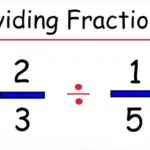
Division: To divide fractions, invert the second fraction (find its reciprocal) and then multiply the first fraction by the reciprocal of the second fraction.
Example 2 (Division): Simplify 3/5 ÷ 9/10
Step 1: Invert the second fraction (9/10 becomes 10/9).
Step 2: Change the division sign to multiplication and multiply:
3/5 × 10/9
Step 3: Multiply numerators and denominators (or cross-cancel):
(3 × 10)/(5 × 9) = 30/45
Step 4: Simplify the result by dividing both numerator and denominator by their greatest common divisor (15):
30/45 = 2/3
Use of Order of Operations (BODMAS) in Simplifying Expressions with Fractions
BODMAS (Brackets, Orders/Of, Division, Multiplication, Addition, Subtraction) is the rule used to determine the correct sequence of operations in a mathematical expression.
- Brackets (Parentheses)
- Orders (Powers and Square Roots, etc.) / Of
- Division
- Multiplication
- Addition
- Subtraction
Example 1: Simplify 1/2 + 1/3 × 3/4
Step 1: Perform multiplication first (according to BODMAS):
1/3 × 3/4 = (1 × 3)/(3 × 4) = 3/12 = 1/4
Step 2: Now perform addition:
1/2 + 1/4
Step 3: Find LCM of 2 and 4, which is 4. Convert fractions:
2/4 + 1/4 = 3/4
Example 2: Simplify (2/5 + 1/10) ÷ 3/4
Step 1: Solve the expression inside the bracket first:
2/5 + 1/10 (LCM is 10)
4/10 + 1/10 = 5/10 = 1/2
Step 2: Now perform the division:
1/2 ÷ 3/4
Step 3: Invert the second fraction and multiply:
1/2 × 4/3 = (1 × 4)/(2 × 3) = 4/6
Step 4: Simplify the result:
4/6 = 2/3
Simplifying Algebraic Fractions with Monomial Denominators
Algebraic fractions involve variables. To simplify them, find a common denominator (LCM) if adding or subtracting, and then combine the numerators. Factorize and cancel common terms where possible.
Example 1: Simplify x/3 + y/2
Step 1: Find the LCM of the denominators (3 and 2), which is 6.
Step 2: Convert each fraction to an equivalent fraction with denominator 6:
x/3 = (x × 2)/(3 × 2) = 2x/6
y/2 = (y × 3)/(2 × 3) = 3y/6
Step 3: Add the numerators:
2x/6 + 3y/6 = (2x + 3y)/6
Example 2: Simplify 5a/4 – a/2
Step 1: Find the LCM of the denominators (4 and 2), which is 4.
Step 2: Convert each fraction to an equivalent fraction with denominator 4:
a/2 = (a × 2)/(2 × 2) = 2a/4
Step 3: Subtract the numerators:
5a/4 – 2a/4 = (5a – 2a)/4 = 3a/4
Teaching Methods/Instructional Techniques
Discussion, Lecture, Demonstration, Question and Answer, Visual Aids
Instructional Procedures
Step 1: Introduction
Time: 5 minutes
Teaching Skill: Set Induction
Teacher’s Activity: The teacher greets the pupils, reviews the previous lesson briefly, and then introduces the topic “Fractions (Revision)” by asking pupils to recall what a fraction is.
Pupils’ Activity: Pupils respond to greetings, recall previous knowledge, and attempt to define a fraction.
Learning Point: Pupils are reminded of the basic concept of fractions and prepared for the lesson.
Step 2: Definition and Types of Fractions
Time: 5 minutes
Teaching Skill: Explanation/Recall
Teacher’s Activity: The teacher provides a clear definition of a fraction and briefly recalls different types of fractions (proper, improper, mixed numbers) using examples.
Pupils’ Activity: Pupils listen attentively, take notes, and identify examples of different fraction types.
Learning Point: Pupils recall and understand the definition and types of fractions.
Step 3: Addition and Subtraction of Fractions
Time: 10 minutes
Teaching Skill: Demonstration/Practice
Teacher’s Activity: The teacher explains and demonstrates how to add and subtract fractions, using examples with both common and different denominators. The teacher emphasizes finding the LCM.
Pupils’ Activity: Pupils observe the examples, ask questions, and solve practice problems from their textbooks or the board.
Learning Point: Pupils learn how to correctly add and subtract fractions.
Step 4: Multiplication and Division of Fractions
Time: 8 minutes
Teaching Skill: Explanation/Demonstration
Teacher’s Activity: The teacher explains the rules for multiplying and dividing fractions, including inverting the divisor for division. The teacher demonstrates with worked examples.
Pupils’ Activity: Pupils pay attention, take notes, and attempt to solve similar problems.
Learning Point: Pupils understand the procedures for multiplying and dividing fractions.
Step 5: Order of Operations (BODMAS) with Fractions
Time: 7 minutes
Teaching Skill: Problem Solving/Application
Teacher’s Activity: The teacher introduces the BODMAS rule and explains its application in simplifying expressions with fractions, demonstrating with a complex example.
Pupils’ Activity: Pupils follow the steps, identify the order of operations, and work through example problems.
Learning Point: Pupils learn to apply the BODMAS rule to simplify fractional expressions.
Step 6: Simplifying Algebraic Fractions with Monomial Denominators
Time: 5 minutes
Teaching Skill: Explanation/Guidance
Teacher’s Activity: The teacher explains how to simplify algebraic fractions with monomial denominators, focusing on finding the LCM for the numerical parts and combining terms. The teacher provides examples.
Pupils’ Activity: Pupils observe, ask clarifying questions, and try to solve simple algebraic fraction problems.
Learning Point: Pupils learn to simplify basic algebraic fractions.
Step 7: Evaluation/Review
Time: 5 minutes
Teaching Skill: Questioning/Assessment
Teacher’s Activity: The teacher evaluates the learning by asking the following questions:
- What is a fraction?
- Simplify 3/4 + 1/2.
- Calculate 2/5 × 15/4.
- Evaluate 7/8 ÷ 1/4.
- Simplify x/5 + 2x/10.
Pupils’ Activity: Pupils answer orally and in writing.
Learning Point: Pupils demonstrate understanding of the lesson.
Step 8: Conclusion
Time: 2 minutes
Teaching Skill: Summarization
Teacher’s Activity: The teacher summarizes the key points of the lesson, reiterating the importance of fractions and their operations. The teacher assigns homework for further practice.
Pupils’ Activity: Pupils listen to the summary and copy the homework assignment.
Learning Point: The lesson is concluded, and pupils are given tasks to reinforce their learning.
Lesson Keywords
- Fraction – A part of a whole.
- Numerator – The top number in a fraction, indicating the number of parts taken.
- Denominator – The bottom number in a fraction, indicating the total number of equal parts.
- LCM – Least Common Multiple, used to find a common denominator.
- BODMAS – An acronym for the order of operations (Brackets, Orders, Division, Multiplication, Addition, Subtraction).
- Algebraic fraction – A fraction containing variables in the numerator, denominator, or both.
- Monomial – An algebraic expression consisting of a single term.
Differentiation
For struggling learners, the teacher will provide simpler examples and more direct guidance, possibly using fraction manipulatives. Advanced learners will be given more complex problems involving multiple operations and more challenging algebraic fractions to simplify independently or in small groups.
Note for teachers using this lesson plan
Teachers should ensure that pupils have a solid grasp of basic arithmetic before diving into complex fraction operations. Emphasize the LCM for addition and subtraction, and the reciprocal for division. Encourage pupils to show all their working steps, especially when applying BODMAS, to avoid errors. Regular practice and quick quizzes will help reinforce learning.

Community Join the conversation Open discussion +