

Class: Senior Secondary School 1 (SS1 / SSS 1)
Term: 1st Term
Week: 3
Age: 15 years
Duration: 45 minutes
Subject: Painting And Decoration
Curriculum Theme: Trade
Previous Lesson: Painting: Types of painting, Tools And Equipment for painting.
Topic: COLOR MIXING AND MATCHING
Subject Matter: Classes of color, primary colors, secondary colors, tertiary colors, properties of color, hues, tones, color intensity
Specific Objectives
By the end of the lesson, pupils should be able to:
Cognitive Domain:
- Define color mixing.
- Identify the three primary colors.
- Differentiate between primary, secondary, and tertiary colors.
- Explain the properties of color such as hue, tone, and intensity.
Affective Domain:
- Appreciate the importance of correct color mixing in painting and decoration.
- Show interest in experimenting with different color combinations.
Psychomotor Domain:
- Mix primary colors to create secondary and tertiary colors.
- Demonstrate the creation of different tones by adding white or black to a color.
Social Domain:
- Collaborate with peers during practical color mixing activities.
- Discuss observations on how colors change when mixed.
Reference Materials
The following resources were used in planning this lesson:
- 9 Years Basic Education Curriculum for Cultural and Creative Arts (CCA).
- State Unified Scheme of Work for Painting and Decoration, SS1.
- Painting and Decoration for Senior Secondary Schools, Book 1.
Instructional Materials
The teacher will teach this lesson with the aid of:
- Color charts
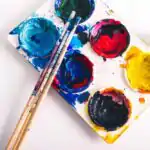
- Palettes
- Brushes
- Primary color paints (red, yellow, blue)
- White and black paints
- Water
- Mixing surfaces (e.g., cardboard, paper)
- Flowers (for color observation)
Rationale for the Lesson
This lesson helps pupils understand the basic principles of color, which are fundamental to painting and decoration. Knowing how to mix and match colors enables them to create a wide range of hues and achieve desired visual effects in their practical work and daily life.
Prerequisite/Previous Knowledge
Pupils are expected to have basic knowledge of different colors and have seen colors being mixed in everyday situations.
Lesson Content/Board Summary
COLOR MIXING AND MATCHING
Classes of Color
Colors are broadly grouped based on their origin and how they are produced. Understanding these classes is the first step in effective color mixing.
The main classes of color include:
- Primary Colors
- Secondary Colors
- Tertiary Colors
Primary Colors
Primary colors are the fundamental colors that cannot be created by mixing other colors. They serve as the building blocks for all other colors.
The three primary colors are:
- Red
- Yellow
- Blue
Secondary Colors
Secondary colors are created by mixing two primary colors in equal proportions.
The secondary colors and their primary color combinations are:
- Orange (Red + Yellow)
- Green (Yellow + Blue)
- Violet or Purple (Blue + Red)
Tertiary Colors
Tertiary colors are formed by mixing a primary color with an adjacent secondary color. These colors typically have hyphenated names.
Examples of tertiary colors include:
- Red-Orange
- Yellow-Orange
- Yellow-Green
- Blue-Green
- Blue-Violet
- Red-Violet
Properties of Color
The properties of color describe the characteristics that define and differentiate one color from another. These properties help in understanding and manipulating colors effectively.
The key properties of color are:
- Hue
- Tone (or Value)
- Intensity (or Saturation)
Hues, Tones, and Color Intensity
Hue: This refers to the pure, unadulterated color itself, such as red, blue, or yellow. It is essentially the name of the color.
Tone (or Value): This describes the lightness or darkness of a color. It is adjusted by adding white or black to a pure hue.
- Tints: Created by adding white to a color, making it lighter.
- Shades: Created by adding black to a color, making it darker.
Color Intensity (or Saturation): This indicates the brightness or dullness of a color. A highly intense color is vivid and pure, while a low intense color appears dull or muted.
Teaching Methods/Instructional Techniques
Discussion, Lecture, Demonstration, Question and Answer, Visual Aids
Instructional Procedures
Step 1: Introduction
Time: 5 minutes
Teaching Skill: Set Induction
Teacher’s Activity: The teacher greets the pupils and reviews the previous lesson briefly. The teacher then asks pupils to mention different colors they know and where they see them in their environment. The teacher introduces the topic “Color Mixing and Matching” by explaining its relevance in painting and decoration.
Pupils’ Activity: Pupils respond to the teacher’s questions, mention various colors, and listen attentively to the introduction.
Learning Point: Pupils recall prior knowledge and are introduced to the lesson topic.
Step 2: Explanation of Classes of Color and Primary Colors
Time: 8 minutes
Teaching Skill: Explanation/Identification
Teacher’s Activity: The teacher explains the concept of color classes and defines primary colors. The teacher shows examples of primary colors using color charts and paints, asking pupils to identify them.
Pupils’ Activity: Pupils listen to the explanation, identify primary colors, and ask questions for clarification.
Learning Point: Pupils understand what primary colors are and can identify them.
Step 3: Explanation of Secondary and Tertiary Colors
Time: 10 minutes
Teaching Skill: Demonstration/Explanation
Teacher’s Activity: The teacher defines secondary and tertiary colors. The teacher demonstrates how to mix two primary colors to get a secondary color (e.g., red + yellow = orange) and explains how tertiary colors are formed. The teacher uses the color chart to show the relationship between primary, secondary, and tertiary colors.
Pupils’ Activity: Pupils observe the color mixing demonstration, listen to the explanations, and ask questions.
Learning Point: Pupils learn how secondary and tertiary colors are created.
Step 4: Explanation of Properties of Color
Time: 7 minutes
Teaching Skill: Explanation/Illustration
Teacher’s Activity: The teacher explains the properties of color: hue, tone (value), and intensity (saturation). The teacher illustrates these properties by showing how adding white or black changes the tone of a color and discusses how vividness changes.
Pupils’ Activity: Pupils listen to the explanation and observe the illustrations of color properties.
Learning Point: Pupils understand the different properties used to describe colors.
Step 5: Practical Demonstration of Color Mixing
Time: 5 minutes
Teaching Skill: Demonstration
Teacher’s Activity: The teacher performs a practical demonstration of mixing primary colors to achieve secondary colors, and then demonstrates creating tints and shades by adding white and black paint to a base color. The teacher encourages pupils to pay close attention to the process.
Pupils’ Activity: Pupils carefully observe the teacher’s demonstration of color mixing and tone creation.
Learning Point: Pupils see practical application of color mixing principles.
Step 6: Pupils Practice Color Mixing
Time: 5 minutes
Teaching Skill: Practical Application
Teacher’s Activity: The teacher guides pupils to practice mixing primary colors to form secondary colors on their palettes. The teacher moves around to provide assistance and feedback.
Pupils’ Activity: Pupils engage in practical color mixing, trying to create secondary colors and observing the changes.
Learning Point: Pupils gain hands-on experience in color mixing.
Step 7: Evaluation/Review
Time: 5 minutes
Teaching Skill: Questioning/Assessment
Teacher’s Activity: The teacher evaluates the learning by asking the following questions:
- Define primary colors and mention the three primary colors.
- How are secondary colors formed? Give two examples.
- What is a tertiary color?
- State any two properties of color and explain them briefly.
Pupils’ Activity: Pupils answer orally and in writing.
Learning Point: Pupils demonstrate understanding of the lesson.
Step 8: Conclusion
Time: 2 minutes
Teaching Skill: Summarization
Teacher’s Activity: The teacher summarizes the key points of the lesson, reinforcing the importance of color mixing in painting and decoration. The teacher assigns homework, asking pupils to draw a color wheel showing primary, secondary, and tertiary colors.
Pupils’ Activity: Pupils listen to the summary and copy down the homework.
Learning Point: Pupils consolidate their learning and prepare for further practice.
Lesson Keywords
- Primary Colors – Basic colors (red, yellow, blue) that cannot be made by mixing other colors.
- Secondary Colors – Colors made by mixing two primary colors (e.g., orange, green, violet).
- Tertiary Colors – Colors made by mixing a primary and an adjacent secondary color (e.g., red-orange).
- Hue – The pure name of a color (e.g., red, blue).
- Tone – The lightness or darkness of a color, also known as value.
- Intensity – The brightness or dullness of a color, also known as saturation.
Differentiation
For pupils who grasp concepts quickly, the teacher can challenge them to mix more complex tertiary colors or identify complementary colors. For pupils needing more support, the teacher can provide pre-drawn outlines of color wheels for them to fill, or offer closer supervision during practical mixing activities.
Note for teachers using this lesson plan
Ensure all necessary instructional materials, especially paints and mixing tools, are readily available before the lesson. Safety precautions regarding paint handling and cleanliness should be emphasized. Encourage hands-on participation as much as possible to solidify understanding of color mixing principles. The practical session can be extended if time permits.
Community Join the conversation Open discussion +