

Class: Senior Secondary School 1 (SS1 / SSS1)
Term: 1st Term
Week: 12
Age: 15 years
Duration: 45 minutes
Subject: Painting And Decoration
Curriculum Theme: Trade
Previous Lesson: Wall Decoration: Production of wall decoration designs, surface design practice & motif application.
Topic: PAPER DECORATION FOR FESTIVE OCCASION
Subject Matter: Paper flower, paper chain, Christmas decoration, Salah decoration, festive paper crafts
Specific Objectives
By the end of the lesson, pupils should be able to:
Cognitive Domain:
- Define paper decoration.
- List different types of paper decorations.
- State the materials and tools used for paper decoration.
- Explain the importance of paper decorations.
Affective Domain:
- Appreciate the aesthetic value of paper decorations.
- Show interest in creating paper crafts for various occasions.
- Demonstrate patience and attention to detail while working with paper.
Psychomotor Domain:
- Safely use scissors and glue to cut and join paper.
- Construct a simple paper flower or paper chain.
- Create basic paper decorations suitable for festive occasions.
Social Domain:
- Collaborate effectively with peers during group craft activities.
- Share ideas and techniques for making paper decorations.
Reference Materials
The following resources were used in planning this lesson:
- 9 Years Basic Education Curriculum for Cultural and Creative Arts (CCA)
- State Unified Scheme of Work for Senior Secondary School Painting and Decoration
- Painting and Decoration for Senior Secondary Schools by A.O. Okoro
- Relevant online craft tutorials and visual examples.
Instructional Materials
The teacher will teach this lesson with the aid of:
- Colored paper (e.g., construction paper, crepe paper)
- Scissors
- Glue
- Cutting knife (to be used by the teacher or under strict supervision)
- Examples of finished paper flowers, paper chains, and other festive paper crafts
- Pictures or charts showing various paper decorations.
Rationale for the Lesson
This lesson helps pupils understand how simple materials like paper can be transformed into beautiful decorations for celebrations. It develops their creativity and practical skills, enabling them to contribute to festive atmospheres at home or in school. Learning these skills also introduces pupils to potential avenues for craft-making as a hobby or small business.
Prerequisite/Previous Knowledge
Pupils are assumed to have basic knowledge of handling craft materials like paper, scissors, and glue. They should also be familiar with common festive occasions and the concept of decoration.
Lesson Content/Board Summary
Paper Decoration for Festive Occasions
What is Paper Decoration?
Paper decoration involves using various types of paper to create ornamental items for beautifying spaces, especially during celebrations or special events. These decorations add visual appeal and a festive atmosphere.
Types of Paper Decorations
The following are common types of paper decorations:
- Paper Flowers: Artificial flowers made from paper, often used as centerpieces or wall decor.
- Paper Chains: Interlinked loops of paper strips, typically hung across rooms or doorways.
- Christmas Decorations: Ornaments like paper stars, angels, or baubles for Christmas trees and homes.
- Salah Decorations: Paper crafts and banners used to decorate homes and mosques during Islamic festivals like Eid al-Fitr and Eid al-Adha.
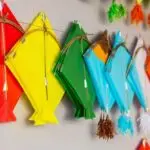
- Festive Paper Crafts: A general term for various paper items like lanterns, garlands, cut-outs, and confetti used for parties and celebrations.
Materials and Tools for Paper Decoration
Making paper decorations requires simple and accessible materials and tools. These include:
- Colored paper (construction paper, cardstock, crepe paper, tissue paper)
- Scissors (for cutting)
- Glue (PVA glue, craft glue, glue stick)
- Cutting knife (utility knife or craft knife, used carefully by teacher or under supervision)
- Ruler (for measuring and straight lines)
- Pencil (for marking)
- Stapler (for joining paper)
- String or thread (for hanging)
Basic Steps in Making a Simple Paper Decoration (e.g., Paper Chain)
Making a paper chain involves a series of simple steps:
- Step 1: Cut Paper Strips: Cut several strips of colored paper of equal width and length (e.g., 1 inch wide and 8 inches long).
- Step 2: Form the First Loop: Take one strip, apply glue to one end, and join it with the other end to form a loop.
- Step 3: Link Subsequent Loops: Take a second strip, thread it through the first loop, apply glue to its ends, and join to form another loop.
- Step 4: Continue Linking: Repeat step 3, linking each new strip through the previous loop until the desired length of chain is achieved.
Importance of Paper Decorations
Paper decorations serve several important purposes:
- They enhance the aesthetic appeal of a venue during celebrations.
- They are cost-effective and easy to make, making them accessible.
- They encourage creativity and develop fine motor skills.
- They can be customized to suit specific themes or colors of an event.
- They foster a sense of community and participation when made collectively.
Teaching Methods/Instructional Techniques
Discussion, Lecture, Demonstration, Question and Answer, Visual Aids
Instructional Procedures
Step 1: Introduction
Time: 5 minutes
Teaching Skill: Set Induction
Teacher’s Activity: The teacher greets the pupils, checks attendance, and asks them to recall different ways people decorate their homes or venues for festivals like Christmas, Salah, or birthdays. The teacher then introduces the topic: “Paper Decoration for Festive Occasions.”
Pupils’ Activity: Pupils respond to greetings, answer questions about decorations they have seen, and listen attentively to the introduction of the new topic.
Learning Point: Pupils are prepared for the lesson and connect the topic to their experiences.
Step 2: Explanation of Paper Decoration and Types
Time: 7 minutes
Teaching Skill: Explanation/Elucidation
Teacher’s Activity: The teacher defines paper decoration and explains that it involves using paper to create beautiful items for celebrations. The teacher then lists and briefly explains different types of paper decorations such as paper flowers, paper chains, Christmas decorations, and Salah decorations, showing examples where available.
Pupils’ Activity: Pupils listen, take notes, and ask questions for clarification. They observe the examples shown by the teacher.
Learning Point: Pupils understand what paper decoration is and can identify various types.
Step 3: Identification of Materials and Tools
Time: 5 minutes
Teaching Skill: Identification/Demonstration
Teacher’s Activity: The teacher displays the instructional materials (colored paper, scissors, glue, etc.) and names each item, explaining its use in paper decoration. The teacher emphasizes safety precautions when using scissors or a cutting knife.
Pupils’ Activity: Pupils observe the materials and tools, identify them, and note their uses. They listen to the safety instructions.
Learning Point: Pupils can identify materials and tools needed for paper decoration and understand their functions.
Step 4: Demonstration of Paper Craft Making
Time: 10 minutes
Teaching Skill: Demonstration/Modeling
Teacher’s Activity: The teacher demonstrates step-by-step how to make a simple paper decoration, such as a paper chain or a basic paper flower, using the displayed materials. The teacher clearly explains each step, showing cutting, folding, and gluing techniques.
Pupils’ Activity: Pupils observe the demonstration carefully, paying attention to the techniques and asking questions about specific steps.
Learning Point: Pupils learn the practical steps involved in making a paper decoration.
Step 5: Guided Practice
Time: 10 minutes
Teaching Skill: Guided Practice/Supervision
Teacher’s Activity: The teacher distributes materials to pupils (or groups of pupils) and guides them as they attempt to create their own simple paper decorations, following the demonstrated steps. The teacher moves around the classroom, providing assistance and correcting errors.
Pupils’ Activity: Pupils actively engage in making paper decorations, applying the techniques learned, and seeking help when needed.
Learning Point: Pupils apply practical skills to create paper decorations.
Step 6: Discussion on Importance of Paper Decorations
Time: 3 minutes
Teaching Skill: Discussion/Reinforcement
Teacher’s Activity: The teacher leads a brief discussion on the importance of paper decorations, asking pupils why people use them and what benefits they offer (e.g., beautification, cost-effectiveness, creativity).
Pupils’ Activity: Pupils contribute their ideas and listen to the teacher’s summary of the importance of paper decorations.
Learning Point: Pupils understand the various reasons and benefits of using paper decorations.
Step 7: Evaluation/Review
Time: 5 minutes
Teaching Skill: Questioning/Assessment
Teacher’s Activity: The teacher evaluates the learning by asking the following questions:
- What is paper decoration?
- Mention three types of paper decorations.
- List three materials used for paper decoration.
- Briefly explain two reasons why paper decorations are important.
Pupils’ Activity: Pupils answer orally and in writing.
Learning Point: Pupils demonstrate understanding of the lesson.
Step 8: Conclusion
Time: 5 minutes
Teaching Skill: Summarization/Assignment
Teacher’s Activity: The teacher summarizes the main points of the lesson, reiterating the definition, types, materials, and importance of paper decorations. The teacher assigns homework, asking pupils to create another paper decoration at home using available materials and bring it to the next class.
Pupils’ Activity: Pupils listen to the summary and copy down the homework assignment.
Learning Point: Pupils consolidate their learning and are given an opportunity for further practice.
Lesson Keywords
- Paper Decoration – The art of using paper to create ornamental items for aesthetic appeal, especially during celebrations.
- Paper Flower – An artificial flower made from paper, used for decoration.
- Paper Chain – A decorative item made by linking together strips of paper to form a chain.
- Festive Occasion – A special event or celebration such as Christmas, Salah, or birthdays.
- Crafts – Items made skillfully by hand.
Differentiation
For pupils who grasp concepts quickly, the teacher can challenge them to create more complex paper decoration designs or encourage them to lead small groups. For pupils who require more support, the teacher will provide closer supervision, simpler templates, and additional one-on-one guidance during the practical session.
Note for teachers using this lesson plan
Ensure all materials are prepared and organized before the lesson begins. Emphasize safety when using sharp objects like scissors and cutting knives. Encourage creativity and allow pupils to explore different paper types and colors. Displaying examples of diverse paper decorations can inspire pupils. Consider playing light, festive music during the practical activity to enhance the learning atmosphere.

Community Join the conversation Open discussion +