

Class: Senior Secondary School 1 (SS1, SS 1, SSS1, SSS 1)
Term: 3rd Term
Week: 5
Age: 15 years
Duration: 45 minutes
Subject: General Mathematics
Curriculum Theme: General Mathematics
Previous Lesson: Trigonometry (I): Ratios and Special Angles.
Topic: TRIGONOMETRY (II)
Subject Matter: Solving problems using sine, cosine and tangent in right-angled triangles; Application of trigonometric ratios of 45°, 30° and 60° to solving problems without calculating aids.
Specific Objectives
By the end of the lesson, pupils should be able to:
Cognitive Domain:
- Solve problems involving lengths and angles in right-angled triangles using sine, cosine, and tangent.
- Apply trigonometric ratios to problems involving angles of elevation and depression.
- Derive trigonometric ratios for special angles (45°, 30°, and 60°).
- Apply trigonometric ratios of 45°, 30°, and 60° to solve problems without calculating aids.
Affective Domain:
- Appreciate the practical applications of trigonometric ratios in real-life situations.
- Develop a systematic approach to solving problems involving trigonometry.
Psychomotor Domain:
- Draw and label right-angled triangles accurately for problem-solving.
- Construct triangles to derive special angle ratios.
Social Domain:
- Participate actively in class discussions and problem-solving sessions.
Reference Materials
The following resources were used in planning this lesson:
- 9 Years Basic Education Curriculum (Senior Secondary Mathematics)
- State Unified Scheme of Work (Senior Secondary Mathematics)
- New General Mathematics for Senior Secondary Schools Book 1 by J.B. Channon et al.
- https://www.mathsisfun.com/algebra/trigonometry-angles-30-45-60.html
- https://www.khanacademy.org/math/geometry/right-triangles-trig/angles-of-elevation-and-depression/v/angles-of-elevation-and-depression
Instructional Materials
The teacher will teach this lesson with the aid of:
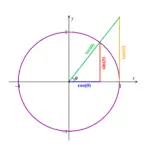
- Chart showing the unit circle and trigonometric ratios
- Protractor, ruler, and a pair of compasses
- Chalk/marker and whiteboard/blackboard
- Right-angled triangle cut-outs
Rationale for the Lesson
This lesson helps pupils to understand how trigonometry is used to find unknown lengths and angles in everyday situations. It also enables them to solve problems without using calculators, which is an important skill for examinations and mental computation.
Prerequisite/Previous Knowledge
Pupils are expected to have prior knowledge of basic trigonometric ratios (SOH CAH TOA) in right-angled triangles and the concept of angles.
Lesson Content/Board Summary
Solving Problems Using Sine, Cosine, and Tangent
Trigonometric Ratios in Right-Angled Triangles
Trigonometric ratios relate the angles of a right-angled triangle to the ratio of the lengths of its sides.
The three basic ratios are:
- Sine (sin): Opposite side / Hypotenuse
- Cosine (cos): Adjacent side / Hypotenuse
- Tangent (tan): Opposite side / Adjacent side
These are often remembered by the acronym SOH CAH TOA.
Angles of Elevation and Depression
These are angles formed between a horizontal line and the line of sight to an object.
- Angle of Elevation: The angle measured upwards from the horizontal line to the line of sight of an object above the observer.
- Angle of Depression: The angle measured downwards from the horizontal line to the line of sight of an object below the observer.
Application of Special Angles (45°, 30°, 60°)
Trigonometric ratios for certain angles can be derived and remembered without the use of calculators.
The ratios for 45° can be derived from an isosceles right-angled triangle with equal sides of length 1 unit.
The ratios for 30° and 60° can be derived from an equilateral triangle with sides of length 2 units, bisected into two right-angled triangles.
The values for these special angles are:
- sin 30° = 1/2, cos 30° = √3/2, tan 30° = 1/√3
- sin 45° = 1/√2, cos 45° = 1/√2, tan 45° = 1
- sin 60° = √3/2, cos 60° = 1/2, tan 60° = √3
Teaching Methods/Instructional Techniques
Discussion, Lecture, Demonstration, Question and Answer, Visual Aids
Instructional Procedures
Step 1: Introduction
Time: 5 minutes
Teaching Skill: Set Induction
Teacher’s Activity: The teacher greets the pupils and reviews the previous lesson on basic trigonometric ratios. The teacher then introduces the topic by asking pupils how they would measure the height of a tall building without climbing it or using a tape measure. This leads to the idea of using trigonometry.
Pupils’ Activity: Pupils respond to questions and listen attentively to the introduction.
Learning Point: Pupils recall previous knowledge and understand the relevance of the new topic.
Step 2: Review of Basic Ratios and Problem Solving
Time: 10 minutes
Teaching Skill: Explanation/Demonstration
Teacher’s Activity: The teacher quickly revisits the SOH CAH TOA mnemonic. The teacher then demonstrates how to use sine, cosine, and tangent to find unknown sides and angles in right-angled triangles using practical examples on the board. This includes examples involving angles of elevation and depression.
Pupils’ Activity: Pupils observe the examples, ask questions, and solve similar problems in their notebooks under the teacher’s guidance.
Learning Point: Pupils refresh their understanding of basic ratios and learn to apply them to solve problems involving lengths and angles.
Step 3: Derivation of Special Angle Ratios (45°, 30°, 60°)
Time: 15 minutes
Teaching Skill: Guidance/Demonstration
Teacher’s Activity: The teacher guides pupils to draw an isosceles right-angled triangle with sides of 1 unit to derive the ratios for 45°. Next, the teacher guides pupils to draw an equilateral triangle of side 2 units, bisect it, and use the resulting right-angled triangle to derive the ratios for 30° and 60°. The teacher then summarizes these values on the board.
Pupils’ Activity: Pupils actively participate by drawing the triangles, calculating the hypotenuse/other side lengths, and deriving the sine, cosine, and tangent values for 45°, 30°, and 60°.
Learning Point: Pupils understand how the special angle ratios are derived and can recall their values.
Step 4: Application of Special Angle Ratios
Time: 10 minutes
Teaching Skill: Problem Solving/Practice
Teacher’s Activity: The teacher presents various problems that require the application of the special angle ratios (30°, 45°, 60°) without the use of calculators. The teacher demonstrates solving a few problems and then gives pupils similar problems to solve independently or in pairs.
Pupils’ Activity: Pupils solve the given problems, applying the derived special angle ratios, and discuss their solutions with classmates.
Learning Point: Pupils learn to apply special angle ratios to solve problems efficiently without calculating aids.
Step 5: Evaluation/Review
Time: 5 minutes
Teaching Skill: Questioning/Assessment
Teacher’s Activity: The teacher evaluates the learning by asking the following questions:
- Define an angle of elevation and an angle of depression.
- State the sine, cosine, and tangent of 30°.
- A ladder leans against a wall, making an angle of 60° with the ground. If the base of the ladder is 5m from the wall, calculate the length of the ladder.
- Explain how you would derive the trigonometric ratios for 45°.
Pupils’ Activity: Pupils answer orally and in writing.
Learning Point: Pupils demonstrate understanding of the lesson.
Step 6: Conclusion
Time: 5 minutes
Teaching Skill: Summarization
Teacher’s Activity: The teacher summarizes the key points of the lesson, emphasizing the importance of understanding and applying trigonometric ratios in real-life scenarios and for solving problems without calculators. The teacher assigns homework.
Pupils’ Activity: Pupils listen to the summary and copy down the homework.
Learning Point: Pupils consolidate their learning and prepare for independent practice.
Lesson Keywords
- Sine – The ratio of the length of the opposite side to the length of the hypotenuse in a right-angled triangle.
- Cosine – The ratio of the length of the adjacent side to the length of the hypotenuse in a right-angled triangle.
- Tangent – The ratio of the length of the opposite side to the length of the adjacent side in a right-angled triangle.
- Right-angled triangle – A triangle with one angle measuring 90 degrees.
- Hypotenuse – The longest side of a right-angled triangle, opposite the right angle.
- Opposite side – The side across from a given angle in a right-angled triangle.
- Adjacent side – The side next to a given angle in a right-angled triangle, not the hypotenuse.
- Angle of Elevation – The angle measured upwards from the horizontal to an object above.
- Angle of Depression – The angle measured downwards from the horizontal to an object below.
- Special Angles – Specific angles (e.g., 30°, 45°, 60°) whose trigonometric ratios can be derived geometrically.
Differentiation
For pupils who grasp concepts quickly, challenge them with more complex word problems or ask them to explore inverse trigonometric functions. For those needing more support, provide additional guided practice with simpler direct application problems and visual aids for deriving special angles.
Note for teachers using this lesson plan
Emphasize drawing clear diagrams for word problems involving angles of elevation and depression. Encourage pupils to memorize the special angle ratios by understanding their derivations rather than rote learning alone.


Community Join the conversation Open discussion +