

Class: Senior Secondary School 1 (SS1, SS 1, SSS1, SSS 1)
Term: Second Term
Week: 8
Age: 15 years
Duration: 45 minutes
Subject: General Mathematics
Curriculum Theme: General Mathematics
Previous Lesson: Mensuration of Solid Shapes (II): Surface Areas and Cone Sector Relation.
Topic: MENSURATION OF SOLID SHAPES (III)
Subject Matter: Volume of solids – cube, cuboids, cylinder, cone, prism, pyramids, frustum of cone and pyramids., Surface area and volume of compound shapes.
Specific Objectives
By the end of the lesson, pupils should be able to:
Cognitive Domain:
- Recall the formulas for calculating the area of various plane shapes.
- Calculate the volume of basic solid shapes such as cubes, cuboids, cylinders, cones, prisms, and pyramids.
- Determine the volume of frustums of cones and pyramids.
- Calculate the surface area and volume of compound solid shapes.
Affective Domain:
- Show interest in solving problems involving mensuration of solid shapes.
- Appreciate the practical application of volume and surface area in real-life situations.
- Participate actively in class discussions and problem-solving sessions.
Psychomotor Domain:
- Accurately apply relevant formulas to solve mensuration problems.
- Sketch and label simple solid shapes and their frustums.
- Construct models of compound shapes if given appropriate materials.
Social Domain:
- Collaborate with peers to solve complex mensuration problems.
- Present solutions clearly and logically to the class.
Reference Materials
The following resources were used in planning this lesson:
- Nigerian Secondary School Mathematics Curriculum
- State Unified Scheme of Work
- New General Mathematics for Senior Secondary Schools 1
Instructional Materials
The teacher will teach this lesson with the aid of:
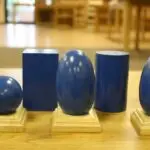
- Models of cubes, cuboids, cylinders, cones, prisms, and pyramids.
- Real-life examples of frustums like a lampshade or a bucket.
- Charts showing formulas for volume and surface area of various solids.
Rationale for the Lesson
Understanding the volume and surface area of solid shapes helps pupils solve practical problems related to space, capacity, and material usage in everyday situations. This knowledge is important for fields like engineering, architecture, and packaging design, and it also helps pupils make informed decisions in daily life.
Prerequisite/Previous Knowledge
Pupils should have prior knowledge of basic mensuration, including the area of plane shapes and the basic volumes of simple solids like cubes and cuboids.
Lesson Content/Board Summary
MENSURATION OF SOLID SHAPES (III)
Volume of Basic Solid Shapes
Volume is the amount of space occupied by a three-dimensional object. It is measured in cubic units (e.g., cm³, m³).
The following are formulas for the volume of basic solid shapes:
- Cube: V = L³ (where L is the length of a side)
- Cuboid: V = L × W × H (where L is length, W is width, H is height)
- Cylinder: V = πr²h (where r is radius, h is height)
- Cone: V = (1/3)πr²h (where r is radius, h is height)
- Prism: V = Area of base × height (e.g., triangular prism: V = (1/2)bh × H)
- Pyramid: V = (1/3) × Area of base × height
Frustum of Cone and Pyramids
A frustum is the part of a solid (like a cone or pyramid) that remains when its top part is cut off by a plane parallel to its base.
The volume of a frustum can be found by subtracting the volume of the smaller cut-off cone/pyramid from the volume of the original larger cone/pyramid.
For a frustum of a cone with large radius R, small radius r, and height H:
- V = (1/3)πH(R² + Rr + r²)
For a frustum of a pyramid with large base area A₁, small base area A₂, and height H:
- V = (1/3)H(A₁ + √(A₁A₂) + A₂)
Surface Area and Volume of Compound Shapes
Compound shapes are shapes made up of two or more simple geometric shapes. To find their surface area or volume, we often break them down into their component simple shapes.
To find the volume of a compound shape:
- Identify the simple solid shapes that make up the compound shape.
- Calculate the volume of each simple shape.
- Add or subtract the volumes as appropriate to find the total volume.
To find the surface area of a compound shape:
- Identify all the exposed surfaces of the compound shape.
- Calculate the area of each exposed surface.
- Sum the areas of all exposed surfaces. Remember not to include areas of surfaces that are joined together.
Teaching Methods/Instructional Techniques
Discussion, Lecture, Demonstration, Question and Answer, Visual Aids
Instructional Procedures
Step 1: Introduction
Time: 5 minutes
Teaching Skill: Set Induction
Teacher’s Activity: The teacher greets the pupils, reviews the previous lesson on mensuration of plane shapes, and asks questions like, “What is the difference between area and volume?” and “Can anyone give examples of objects that have volume?” The teacher then introduces the topic of the lesson: Mensuration of Solid Shapes (III), focusing on volume of various solids and compound shapes.
Pupils’ Activity: Pupils respond to the teacher’s questions, share examples, and listen attentively to the introduction of the new topic.
Learning Point: Pupils recall previous knowledge and are prepared for the new lesson.
Step 2: Volume of Basic Solids
Time: 10 minutes
Teaching Skill: Explanation/Demonstration
Teacher’s Activity: The teacher revises the concept of volume and displays models of cubes, cuboids, cylinders, cones, prisms, and pyramids. The teacher writes the formulas for calculating the volume of each on the board and explains how to apply them with simple examples.
Pupils’ Activity: Pupils observe the models, copy the formulas, and ask questions for clarification. They solve simple examples as guided by the teacher.
Learning Point: Pupils understand and recall the formulas for calculating the volume of basic solid shapes.
Step 3: Frustum of Cone and Pyramids
Time: 10 minutes
Teaching Skill: Explanation/Problem-solving
Teacher’s Activity: The teacher shows models of a frustum (e.g., a lampshade or bucket) and explains how it is formed. The teacher then presents the formulas for the volume of a frustum of a cone and a pyramid, solving a worked example for each on the board.
Pupils’ Activity: Pupils observe the models, copy the formulas, and follow the teacher’s examples, asking questions where necessary.
Learning Point: Pupils learn to identify and calculate the volume of frustums of cones and pyramids.
Step 4: Surface Area of Compound Shapes
Time: 7 minutes
Teaching Skill: Explanation/Illustration
Teacher’s Activity: The teacher introduces compound shapes and explains that their surface area is the sum of the areas of all their exposed surfaces. The teacher uses a diagram or a simple model (e.g., a cylinder with a hemisphere on top) to illustrate how to identify and calculate the exposed areas, emphasizing that internal surfaces are not included.
Pupils’ Activity: Pupils listen, observe the diagrams/models, and take notes. They participate by suggesting which surfaces are exposed.
Learning Point: Pupils understand how to identify exposed surfaces and calculate the surface area of compound shapes.
Step 5: Volume of Compound Shapes
Time: 7 minutes
Teaching Skill: Problem-solving/Application
Teacher’s Activity: The teacher explains that the volume of a compound shape is found by adding or subtracting the volumes of the simple shapes that form it. The teacher works through an example on the board, breaking down a compound shape into its basic components and calculating its total volume.
Pupils’ Activity: Pupils follow the teacher’s steps, noting down the calculations and asking questions to clarify their understanding.
Learning Point: Pupils can calculate the volume of compound solid shapes by decomposing them into simpler solids.
Step 6: Class Activity/Practice
Time: 5 minutes
Teaching Skill: Group Work/Monitoring
Teacher’s Activity: The teacher gives pupils a short problem involving calculating the volume or surface area of a compound shape to solve in pairs or small groups. The teacher monitors their progress and provides assistance as needed.
Pupils’ Activity: Pupils work collaboratively to solve the given problem, applying the formulas and methods learned.
Learning Point: Pupils practice applying the learned concepts and reinforce their understanding through peer collaboration.
Step 7: Evaluation/Review
Time: 5 minutes
Teaching Skill: Questioning/Assessment
Teacher’s Activity: The teacher evaluates the learning by asking the following questions:
- State the formula for the volume of a cylinder.
- Define a frustum of a cone.
- How would you find the volume of a compound shape made of a cuboid and a pyramid?
- Give two examples of frustums you can find in daily life.
Pupils’ Activity: Pupils answer orally and in writing.
Learning Point: Pupils demonstrate understanding of the lesson.
Step 8: Conclusion
Time: 1 minute
Teaching Skill: Summarization
Teacher’s Activity: The teacher summarizes the key points of the lesson, reiterating the importance of knowing how to calculate the volume and surface area of various solid shapes and compound shapes. The teacher then assigns relevant homework from the textbook.
Pupils’ Activity: Pupils listen to the summary and copy down the homework assignment.
Learning Point: Pupils review the main concepts and receive follow-up tasks.
Lesson Keywords
- Volume – The amount of space occupied by a three-dimensional object.
- Surface Area – The total area of the exposed surfaces of a three-dimensional object.
- Solid Shapes – Three-dimensional objects that have length, width, and height.
- Frustum – The part of a cone or pyramid that remains after its top portion has been cut off by a plane parallel to the base.
- Compound Shapes – Shapes formed by combining two or more simple geometric shapes.
Differentiation
For pupils who are struggling, the teacher will provide simplified problems and more direct guidance, possibly using physical manipulatives to demonstrate concepts. For advanced learners, more complex problems involving multi-step calculations or real-world application scenarios will be provided, encouraging them to explore alternative solution methods.
Note for teachers using this lesson plan
Ensure that pupils have a strong grasp of basic area formulas before proceeding to volume. Emphasize the units of measurement for both area and volume. Encourage pupils to draw diagrams for each problem to help visualize the shapes and their components.
Community Join the conversation Open discussion +