

Class: Senior Secondary School 1 (SS1, SS 1, SSS1, SSS 1)
Term: 3rd Term
Week: 4
Age: 15 years
Duration: 45 minutes
Subject: General Mathematics
Curriculum Theme: General Mathematics
Previous Lesson: Deductive Proofs (III): Parallelogram, Intercept theorem and Polygon & Types.
Topic: TRIGONOMETRY (I)
Subject Matter: Basic trigonometric ratios sine, cosine and tangent in right-angled triangles; Trigonometric ratios of special angles 30°, 45°, 60°; Deriving trigonometric ratios of 30°, 45°, 60°.
Specific Objectives
By the end of the lesson, pupils should be able to:
Cognitive Domain:
- Define sine, cosine, and tangent in relation to a right-angled triangle.
- Identify the hypotenuse, opposite, and adjacent sides of a right-angled triangle relative to a given angle.
- State the trigonometric ratios for special angles 30°, 45°, and 60°.
Affective Domain:
- Participate actively in identifying and deriving trigonometric ratios.
- Appreciate the application of trigonometry in real-life problems.
Psychomotor Domain:
- Construct right-angled triangles to derive trigonometric ratios for special angles.
- Solve problems involving basic trigonometric ratios in right-angled triangles.
Social Domain:
- Collaborate with peers to construct triangles and derive ratios.
Reference Materials
The following resources were used in planning this lesson:
- 9 Years Basic Education Curriculum for Mathematics.
- State Unified Scheme of Work for Senior Secondary Schools.
- New General Mathematics for Senior Secondary Schools 1.
Instructional Materials
The teacher will teach this lesson with the aid of:
- Charts showing trigonometric ratios of a right-angled triangle.
- Pencil and ruler.
- Protractor.
- Cutout shapes of right-angled triangles showing 45°, 30°, and 60° respectively.
Rationale for the Lesson
This lesson helps pupils understand the fundamental relationships between angles and sides in right-angled triangles. This knowledge is important for solving various problems in geometry, physics, and engineering, enabling pupils to apply mathematical concepts to practical situations.
Prerequisite/Previous Knowledge
Pupils should have prior knowledge of right-angled triangles, Pythagoras theorem, and basic angle properties.
Lesson Content/Board Summary
TRIGONOMETRY (I)
Basic Trigonometric Ratios (Sine, Cosine, Tangent)
Trigonometry is the branch of mathematics that deals with the relationships between the sides and angles of triangles.
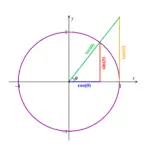
In a right-angled triangle, the sides are named relative to a reference angle (θ):
- Hypotenuse: The side opposite the right angle, always the longest side.
- Opposite: The side directly opposite the reference angle.
- Adjacent: The side next to the reference angle, not the hypotenuse.
The three basic trigonometric ratios are:
- Sine (sin θ): Opposite / Hypotenuse
- Cosine (cos θ): Adjacent / Hypotenuse
- Tangent (tan θ): Opposite / Adjacent
A common mnemonic to remember these ratios is SOH CAH TOA.
Trigonometric Ratios of Special Angles (30°, 45°, 60°)
These are specific angles whose trigonometric ratios can be derived geometrically.
Derivation of Trigonometric Ratios for 45°
Consider an isosceles right-angled triangle with two equal sides of length 1 unit. The angles are 45°, 45°, and 90°.
By Pythagoras theorem, the hypotenuse is √(1² + 1²) = √2.
From this triangle:
- sin 45° = Opposite / Hypotenuse = 1 / √2 = √2 / 2
- cos 45° = Adjacent / Hypotenuse = 1 / √2 = √2 / 2
- tan 45° = Opposite / Adjacent = 1 / 1 = 1
Derivation of Trigonometric Ratios for 30° and 60°
Consider an equilateral triangle with sides of length 2 units. All angles are 60°.
Draw an altitude from one vertex to the opposite side. This bisects the angle and the base, forming two right-angled triangles with angles 30°, 60°, and 90°.
The sides of this right-angled triangle are: Hypotenuse = 2, Adjacent (to 60°) = 1, Opposite (to 60°) = √ (2² – 1²) = √3.
From this triangle:
For 60°:
- sin 60° = Opposite / Hypotenuse = √3 / 2
- cos 60° = Adjacent / Hypotenuse = 1 / 2
- tan 60° = Opposite / Adjacent = √3 / 1 = √3
For 30° (using the same triangle, but changing the reference angle):
- sin 30° = Opposite / Hypotenuse = 1 / 2
- cos 30° = Adjacent / Hypotenuse = √3 / 2
- tan 30° = Opposite / Adjacent = 1 / √3 = √3 / 3
Summary Table of Special Angle Ratios
The following table summarizes the trigonometric ratios for special angles:
- sin 30° = 1/2
- cos 30° = √3/2
- tan 30° = 1/√3
- sin 45° = 1/√2
- cos 45° = 1/√2
- tan 45° = 1
- sin 60° = √3/2
- cos 60° = 1/2
- tan 60° = √3
Teaching Methods/Instructional Techniques
Discussion, Lecture, Demonstration, Question and Answer, Visual Aids
Instructional Procedures
Step 1: Introduction
Time: 5 minutes
Teaching Skill: Set Induction/Recall
Teacher’s Activity: The teacher greets the pupils and asks them to recall what a right-angled triangle is and state the Pythagoras theorem. The teacher then introduces the topic “Trigonometry (I)” and states the objectives of the lesson.
Pupils’ Activity: Pupils respond to questions and listen attentively to the teacher.
Learning Point: Pupils recall prior knowledge of right-angled triangles.
Step 2: Presentation of Basic Trigonometric Ratios
Time: 10 minutes
Teaching Skill: Explanation/Demonstration
Teacher’s Activity: The teacher displays a chart of a right-angled triangle with a marked angle (θ). The teacher then explains how to identify the hypotenuse, opposite, and adjacent sides relative to the marked angle. The teacher defines sine, cosine, and tangent using the SOH CAH TOA mnemonic.
Pupils’ Activity: Pupils study the chart and identify the sides. They listen to the definitions and take notes.
Learning Point: Pupils understand the definitions of basic trigonometric ratios and can identify the sides of a right-angled triangle.
Step 3: Practice with Basic Ratios
Time: 5 minutes
Teaching Skill: Application/Problem Solving
Teacher’s Activity: The teacher presents a simple right-angled triangle with known side lengths and asks pupils to calculate sin θ, cos θ, and tan θ for a given angle. The teacher guides them through the calculations.
Pupils’ Activity: Pupils work out the ratios and share their answers.
Learning Point: Pupils can apply the definitions to calculate basic trigonometric ratios.
Step 4: Introduction to Special Angles
Time: 3 minutes
Teaching Skill: Introduction/Motivation
Teacher’s Activity: The teacher introduces the concept of special angles (30°, 45°, 60°) and explains that their trigonometric ratios can be derived geometrically without a calculator.
Pupils’ Activity: Pupils listen and prepare for the derivations.
Learning Point: Pupils understand that some angles have specific, derivable trigonometric values.
Step 5: Derivation of Ratios for 45°
Time: 7 minutes
Teaching Skill: Guided Discovery/Demonstration
Teacher’s Activity: The teacher guides pupils to draw an isosceles right-angled triangle (e.g., sides 1, 1, √2). Using the protractor, pupils confirm the 45° angles. The teacher then leads pupils to derive sin 45°, cos 45°, and tan 45° from the drawn triangle.
Pupils’ Activity: Pupils draw the triangle, measure angles, and derive the ratios under the teacher’s supervision.
Learning Point: Pupils can derive the trigonometric ratios for 45°.
Step 6: Derivation of Ratios for 30° and 60°
Time: 7 minutes
Teaching Skill: Guided Discovery/Demonstration
Teacher’s Activity: The teacher guides pupils to draw an equilateral triangle and then draw an altitude to form a 30-60-90 degree right-angled triangle. The teacher leads pupils to derive sin 30°, cos 30°, tan 30°, sin 60°, cos 60°, and tan 60° from this triangle.
Pupils’ Activity: Pupils draw the triangle, identify the sides, and derive the ratios for 30° and 60°.
Learning Point: Pupils can derive the trigonometric ratios for 30° and 60°.
Step 7: Evaluation/Review
Time: 5 minutes
Teaching Skill: Questioning/Assessment
Teacher’s Activity: The teacher evaluates the learning by asking the following questions:
- Define sine, cosine, and tangent in the context of a right-angled triangle.
- In a right-angled triangle, if the side opposite angle A is 3 units and the hypotenuse is 5 units, what is sin A?
- State the value of cos 60°.
- Explain how to derive the trigonometric ratios for 45° using a suitable triangle.
Pupils’ Activity: Pupils answer orally and in writing.
Learning Point: Pupils demonstrate understanding of the lesson.
Step 8: Conclusion
Time: 3 minutes
Teaching Skill: Summarization/Consolidation
Teacher’s Activity: The teacher summarizes the key points of the lesson, emphasizing the definitions of basic ratios and the derived values for special angles. The teacher assigns homework: memorize the special angle ratios and solve problems from the textbook involving these ratios.
Pupils’ Activity: Pupils listen to the summary and copy the homework.
Learning Point: Pupils consolidate their understanding and are prepared for further practice.
Lesson Keywords
- Trigonometry – The study of relationships between sides and angles of triangles.
- Right-angled triangle – A triangle with one angle measuring 90 degrees.
- Hypotenuse – The longest side of a right-angled triangle, opposite the right angle.
- Opposite side – The side across from a given angle in a right-angled triangle.
- Adjacent side – The side next to a given angle in a right-angled triangle, not the hypotenuse.
- Sine (sin) – The ratio of the length of the opposite side to the length of the hypotenuse.
- Cosine (cos) – The ratio of the length of the adjacent side to the length of the hypotenuse.
- Tangent (tan) – The ratio of the length of the opposite side to the length of the adjacent side.
- Special angles – Angles (e.g., 30°, 45°, 60°) whose trigonometric ratios can be found exactly using geometric methods.
Differentiation
For pupils who grasp the concepts quickly, the teacher can provide more complex problems involving finding missing sides or angles. For pupils who require more support, the teacher will provide additional guided practice with identifying sides and applying the basic ratios.
Note for teachers using this lesson plan
Ensure that pupils actively participate in drawing and deriving the ratios for special angles. Emphasize the importance of accurately labeling the sides of the triangle relative to the reference angle. Encourage memorization of the special angle values.


Community Join the conversation Open discussion +