

Class: Senior Secondary School 1 (SS1, SS 1, SSS1, SSS 1)
Term: Second Term
Week: 10
Age: 15 years
Duration: 45 minutes
Subject: Chemistry
Curriculum Theme: Chemistry
Previous Lesson: Chemical Equilibrium and Le Chatelier’s Principle.
Topic: ACIDS, BASES AND SALTS
Subject Matter: relative acidity and alkalinity using the pH scale, deliquescent, efflorescent and hygroscopic substances, natural indicators extracted from flowers
Specific Objectives
By the end of the lesson, pupils should be able to:
Cognitive Domain:
- Explain the concept of pH scale for relative acidity and alkalinity.
- Differentiate between deliquescent, efflorescent, and hygroscopic substances.
- Identify examples of deliquescent, efflorescent, and hygroscopic substances.
Affective Domain:
- Appreciate the use of natural indicators in determining acidity and alkalinity.
- Observe with interest the phenomena of efflorescence, deliquescence, and hygroscopy.
Psychomotor Domain:
- Prepare simple flower extract indicators.
- Use the pH scale (e.g., pH paper) to compare the acidity and alkalinity of various samples.
- Identify deliquescent, efflorescent, and hygroscopic samples by observation.
Social Domain:
- Work collaboratively during the preparation and testing of natural indicators.
Reference Materials
The following resources were used in planning this lesson:
- 9 Years Basic Education Curriculum (Chemistry)
- State Unified Scheme of Work (Chemistry, SSS 1)
- New School Chemistry for Senior Secondary Schools by Osei Yaw Ababio
Instructional Materials
The teacher will teach this lesson with the aid of:
- Brightly coloured flowers or leaves (e.g., hibiscus, red cabbage)
- Test tubes, beakers, stirring rods, droppers
- Chemicals such as sodium hydroxide (NaOH), potassium hydroxide (KOH), hydrochloric acid (HCl), and sulphuric acid (H2SO4)
- pH paper or universal indicator solution
- Samples of deliquescent substances (e.g., anhydrous calcium chloride), efflorescent substances (e.g., washing soda crystals), and hygroscopic substances (e.g., sugar, common salt)
Rationale for the Lesson
This lesson helps pupils understand how to measure the strength of acids and bases using the pH scale, which is important in everyday life for things like soil testing and maintaining swimming pools. It also introduces them to different ways substances interact with moisture in the air, explaining common observations like salt becoming damp or crystals turning powdery.
Prerequisite/Previous Knowledge
Pupils should have a basic understanding of acids, bases, and salts, including their general properties, from previous lessons.
Lesson Content/Board Summary
ACIDS, BASES AND SALTS
Relative Acidity and Alkalinity using the pH Scale
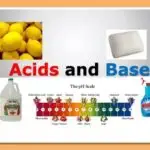
The pH scale is a numerical scale used to specify the acidity or alkalinity (basicity) of an aqueous solution. It ranges from 0 to 14.
The following points describe the pH scale:
- pH 7: Indicates a neutral solution (e.g., pure water).
- pH less than 7: Indicates an acidic solution. The lower the pH, the stronger the acid.
- pH greater than 7: Indicates an alkaline (basic) solution. The higher the pH, the stronger the base.
Deliquescent, Efflorescent and Hygroscopic Substances
These terms describe how certain substances interact with moisture in the atmosphere.
Deliquescent Substances:
These are substances that absorb moisture from the atmosphere and dissolve in it to form a solution. They become wet and eventually turn into a liquid if left exposed to air.
The following are examples of deliquescent substances:
- Anhydrous calcium chloride (CaCl2)
- Sodium hydroxide pellets (NaOH)
- Potassium hydroxide pellets (KOH)
- Iron(III) chloride (FeCl3)
Efflorescent Substances:
These are hydrated crystalline substances that lose their water of crystallisation when exposed to the atmosphere, becoming powdery. This process occurs when the vapour pressure of the hydrate is greater than the partial pressure of water vapour in the air.
The following are examples of efflorescent substances:
- Washing soda crystals (Na2CO3.10H2O)
- Glauber’s salt (Na2SO4.10H2O)
- Epsom salt (MgSO4.7H2O)
Hygroscopic Substances:
These are substances that absorb moisture from the atmosphere but do not dissolve in it to form a solution. They simply become damp or wet, without changing their physical state to a liquid.
The following are examples of hygroscopic substances:
- Concentrated sulphuric acid (H2SO4)
- Anhydrous copper(II) sulphate (CuSO4)
- Silica gel
- Sugar
- Common salt (NaCl)
Natural Indicators Extracted from Flowers
Indicators are substances that change colour in the presence of an acid or a base. Natural indicators can be extracted from various plants, especially brightly coloured flowers and leaves.
The following are steps to extract natural indicators from flowers:
- Crush brightly coloured petals (e.g., hibiscus, rose, red cabbage leaves) in a mortar.
- Add a small amount of hot water or ethanol to the crushed petals.
- Stir well and filter the mixture to obtain the coloured extract.
The extract can then be used to test for acidity or alkalinity, showing different colours in acidic versus basic solutions.
Teaching Methods/Instructional Techniques
Discussion, Lecture, Demonstration, Question and Answer, Visual Aids
Instructional Procedures
Step 1: Introduction
Time: 5 minutes
Teaching Skill: Set Induction
Teacher’s Activity: The teacher greets the pupils and asks questions to activate prior knowledge, such as: “What are acids and bases?” “Can you give examples of acidic or basic substances you use at home?”
Pupils’ Activity: Pupils respond by mentioning common acids like lemon juice, vinegar, and bases like soap, detergents.
Learning Point: Pupils recall previous knowledge about acids and bases, connecting it to the new lesson.
Step 2: Introduction to pH Scale
Time: 10 minutes
Teaching Skill: Explanation/Demonstration
Teacher’s Activity: The teacher explains the concept of the pH scale (0-14) and how it is used to measure the relative acidity or alkalinity of a solution. The teacher demonstrates the use of pH paper or a universal indicator solution with samples of known acids (e.g., HCl) and bases (e.g., NaOH) to show colour changes and corresponding pH values.
Pupils’ Activity: Pupils listen attentively, observe the demonstration, and ask questions for clarification.
Learning Point: Pupils understand how the pH scale indicates acidity, neutrality, or alkalinity.
Step 3: Experiment – Preparing and Using Natural Indicators
Time: 10 minutes
Teaching Skill: Practical/Guidance
Teacher’s Activity: The teacher guides pupils on how to extract indicators from brightly coloured flowers or leaves. The teacher then instructs pupils to use their prepared natural indicator extracts to test various acidic and basic solutions (e.g., lemon juice, soap solution, water) and record the colour changes.
Pupils’ Activity: Pupils work in groups to prepare flower extract indicators and test different samples, observing and recording colour changes.
Learning Point: Pupils learn a practical method of making and using natural indicators to identify acids and bases.
Step 4: Explanation of Deliquescent, Efflorescent, and Hygroscopic Substances
Time: 5 minutes
Teaching Skill: Lecture/Explanation
Teacher’s Activity: The teacher defines and explains the terms deliquescent, efflorescent, and hygroscopic substances, providing examples for each category. The teacher emphasizes the difference in how each type of substance interacts with atmospheric moisture.
Pupils’ Activity: Pupils listen, take notes, and ask questions to ensure understanding of the definitions and differences.
Learning Point: Pupils understand the characteristics that distinguish deliquescent, efflorescent, and hygroscopic substances.
Step 5: Demonstration of Deliquescent, Efflorescent, and Hygroscopic Behavior
Time: 5 minutes
Teaching Skill: Demonstration/Observation
Teacher’s Activity: The teacher demonstrates the behavior of deliquescent (e.g., anhydrous CaCl2), efflorescent (e.g., washing soda crystals), and hygroscopic (e.g., sugar, conc. H2SO4) substances by exposing them to the air and pointing out the changes over a short period (or showing pre-prepared samples that have been exposed).
Pupils’ Activity: Pupils observe the samples and the changes occurring, relating them to the definitions learned.
Learning Point: Pupils visually confirm the properties of these substances and their interaction with moisture.
Step 6: Class Discussion and Question & Answer
Time: 5 minutes
Teaching Skill: Discussion/Questioning
Teacher’s Activity: The teacher facilitates a brief discussion to clarify any misconceptions and answers questions from the pupils regarding the pH scale, natural indicators, and the different types of moisture-absorbing substances.
Pupils’ Activity: Pupils actively participate in the discussion, ask questions, and contribute their observations.
Learning Point: Pupils consolidate their understanding and clarify any doubts about the lesson content.
Step 7: Evaluation/Review
Time: 5 minutes
Teaching Skill: Questioning/Assessment
Teacher’s Activity: The teacher evaluates the learning by asking the following questions:
- What is the pH scale used for?
- State the pH range for acidic, neutral, and alkaline solutions.
- Mention two examples of natural indicators you can extract from flowers.
- Differentiate between a deliquescent substance and a hygroscopic substance.
- List two examples of efflorescent substances.
Pupils’ Activity: Pupils answer orally and in writing.
Learning Point: Pupils demonstrate understanding of the lesson.
Step 8: Conclusion
Time: 5 minutes
Teaching Skill: Summarization/Assignment
Teacher’s Activity: The teacher summarizes the key points of the lesson, reinforcing the understanding of pH, natural indicators, and the three types of moisture-interacting substances. The teacher then assigns homework, such as researching other natural indicators or common applications of pH in daily life.
Pupils’ Activity: Pupils listen to the summary, copy down the homework, and prepare for the next lesson.
Learning Point: Pupils get a concise recap of the lesson and an opportunity to extend their learning.
Lesson Keywords
- pH scale – A scale from 0 to 14 used to measure the acidity or alkalinity of a solution.
- Indicator – A substance that changes colour in the presence of an acid or a base.
- Deliquescent – Substances that absorb moisture from the atmosphere and dissolve in it to form a solution.
- Efflorescent – Hydrated crystalline substances that lose their water of crystallisation to the atmosphere.
- Hygroscopic – Substances that absorb moisture from the atmosphere without dissolving to form a solution.
Differentiation
For pupils who grasp concepts quickly, the teacher can challenge them to investigate the chemical reactions involved in deliquescence or efflorescence. For pupils needing more support, the teacher can provide simplified diagrams of the pH scale or pre-made flashcards with definitions and examples of the different substance types.
Note for teachers using this lesson plan
Ensure all chemicals are handled with appropriate safety precautions, including wearing safety goggles. When demonstrating the substances, use small quantities and ensure good ventilation. Encourage pupils to record their observations carefully during the indicator experiment. It is advisable to have pre-exposed samples of deliquescent, efflorescent, and hygroscopic substances ready for demonstration if time is limited for real-time observation.
Community Join the conversation Open discussion +