

Class: Senior Secondary School 1 (SS1, SS 1, SSS1, SSS 1)
Term: 2nd Term
Week: 9
Age: 15 years
Duration: 45 minutes
Subject: Chemistry
Curriculum Theme: Chemistry
Previous Lesson: Chemical Bonds, Types, Properties and IUPAC Naming.
Topic: Acids, Bases and Salts
Subject Matter: Characteristics of acids, bases and salts, preparation methods and common reactions, uses of acids, bases and salts and indicators
Specific Objectives
By the end of the lesson, pupils should be able to:
Cognitive Domain:
- Define acids, bases and salts.
- List characteristics of acids, bases and salts.
- Identify common indicators and state their colour changes in acids and bases.
- State preparation methods of salts and mention common reactions involving acids and bases.
- List common uses of acids, bases and salts.
Affective Domain:
- Show interest in careful testing and recording of indicator colour changes.
- Demonstrate safety awareness when handling laboratory substances and indicators.
Psychomotor Domain:
- Test given samples with indicators and record observations correctly.
- Classify substances as acidic or basic based on indicator results.
Social Domain:
- Work in groups to test samples and compare results.
- Participate in class discussion on uses of acids, bases and salts.
Reference Materials
The following resources were used in planning this lesson:
- 9 Years Basic Education Curriculum
- State Unified Scheme of Work
- New School Chemistry for Senior Secondary Schools (or any approved SS Chemistry textbook)
- Encyclopaedia Britannica: Acid
- Encyclopaedia Britannica: Base (Chemistry)
- Khan Academy: Acids and Bases
Instructional Materials
The teacher will teach this lesson with the aid of:
- Ripe and unripe fruits (e.g., orange, banana, pineapple, lemon)
- Sour milk
- Common laboratory indicators (litmus paper, methyl orange, phenolphthalein, universal indicator)
- Droppers, white tiles/spot plates, test tubes and rack
- Water, beakers, and sample labels
- Observation table sheet for recording colours
Rationale for the Lesson
Acids, bases and salts are found in foods, medicines, cleaning agents and many household materials. Understanding their properties and indicator colour changes helps pupils to identify substances correctly and handle them safely.
Prerequisite/Previous Knowledge
Pupils have basic knowledge of solutions, simple laboratory safety rules, and can observe and record colour changes during experiments.
Lesson Content/Board Summary
Acids, Bases and Salts
Meaning of Acids, Bases and Salts
An acid is a substance that produces hydrogen ions (H+) in water. A base is a substance that produces hydroxide ions (OH–) in water or accepts H+. A salt is an ionic compound formed when the hydrogen ion of an acid is replaced by a metal ion or ammonium ion.
Characteristics of Acids
The following are characteristics of acids:
- They have a sour taste (do not taste in the laboratory).
- They turn blue litmus paper red.
- They have pH less than 7.
- They react with metals such as zinc and magnesium to produce hydrogen gas.
- They react with carbonates and hydrogencarbonates to produce carbon dioxide.
- They neutralize bases to form salt and water.
Characteristics of Bases (Alkalis)
The following are characteristics of bases:
- They have a bitter taste and a soapy feel (do not taste in the laboratory).
- They turn red litmus paper blue.
- They have pH greater than 7.
- They neutralize acids to form salt and water.
- Soluble bases are called alkalis.
Characteristics of Salts
The following are characteristics of salts:
- They are ionic compounds made up of positive and negative ions.
- Many salts are crystalline solids.
- Some salts dissolve in water while others do not.
- Some salt solutions can be acidic, basic, or neutral depending on the salt.
Indicators and Colour Changes
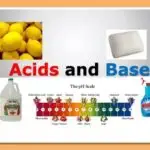
An indicator is a substance that changes colour in acidic or basic solutions to show whether a solution is an acid or a base.
The following are common indicators and their colour changes:
- Litmus: acid turns blue litmus red; base turns red litmus blue.
- Methyl orange: red in acid; yellow in base.
- Phenolphthalein: colourless in acid; pink in base.
- Universal indicator: red/orange/yellow in acid; green in neutral; blue/purple in base.
Preparation Methods of Salts
The following are methods of preparing salts:
- Acid + base (alkali) → salt + water (neutralization).
- Acid + metal → salt + hydrogen gas.
- Acid + metal carbonate/hydrogencarbonate → salt + water + carbon dioxide.
- Precipitation: mixing two soluble salt solutions to form an insoluble salt.
Common Reactions of Acids and Bases
The following are common reactions involving acids and bases:
- Neutralization: acid + base → salt + water.
- Acid with metal: produces hydrogen gas.
- Acid with carbonate: produces carbon dioxide gas.
Uses of Acids, Bases and Salts
The following are common uses of acids:
- Sulfuric acid is used in car batteries.
- Hydrochloric acid is used for cleaning metals and removing rust.
- Nitric acid is used in making fertilizers.
- Acetic acid is found in vinegar used for food preservation and flavouring.
The following are common uses of bases:
- Sodium hydroxide is used in soap making.
- Calcium hydroxide is used in treating acidic soil and water treatment.
- Magnesium hydroxide is used as an antacid.
- Ammonia solution is used as a cleaning agent.
The following are common uses of salts:
- Sodium chloride is used as table salt and for food preservation.
- Sodium carbonate is used in glass making and washing powders.
- Ammonium salts are used in fertilizers.
- Calcium carbonate is used in cement and as a raw material for lime.
Teaching Methods/Instructional Techniques
Discussion, Lecture, Demonstration, Practical Activity, Question and Answer, Visual Aids
Instructional Procedures
Step 1: Introduction
Time: 5 minutes
Teaching Skill: Set Induction
Teacher’s Activity: The teacher displays ripe and unripe fruits and sour milk and asks pupils to describe their taste experiences at home, then links the idea to acids and bases found in daily life.
Pupils’ Activity: Pupils mention examples of sour substances and common cleaning agents and respond to questions.
Learning Point: Acids and bases are common in foods and household materials.
Step 2: Meaning and Characteristics of Acids
Time: 8 minutes
Teaching Skill: Explanation
Teacher’s Activity: The teacher defines acids and lists their characteristics, then writes key points and examples on the board.
Pupils’ Activity: Pupils copy notes and mention common acids they know from home and laboratory examples.
Learning Point: Acids have specific properties and react in known ways.
Step 3: Meaning and Characteristics of Bases and Salts
Time: 7 minutes
Teaching Skill: Explanation
Teacher’s Activity: The teacher defines bases and salts and lists their characteristics, stressing the difference between bases and alkalis.
Pupils’ Activity: Pupils copy notes and classify examples given by the teacher as base/alkali/salt.
Learning Point: Bases and salts also have identifiable properties.
Step 4: Indicators and Colour Changes
Time: 7 minutes
Teaching Skill: Demonstration
Teacher’s Activity: The teacher shows different indicators and explains their colour changes in acids and bases, then prepares a simple observation table for pupils to use.
Pupils’ Activity: Pupils observe, copy the colour change table, and ask questions for clarity.
Learning Point: Indicators show whether a substance is acidic or basic through colour change.
Step 5: Practical Testing and Classification
Time: 8 minutes
Teaching Skill: Practical Activity/Guided Practice
Teacher’s Activity: The teacher guides pupils to test samples (fruit juice, sour milk, and provided solutions) using indicators and helps them record results and classify each sample as acidic or basic.
Pupils’ Activity: Pupils test samples with indicators, record colours, and classify substances based on results.
Learning Point: Substances can be classified as acids or bases using indicator results.
Step 6: Preparation Methods, Common Reactions, and Uses
Time: 5 minutes
Teaching Skill: Discussion/Explanation
Teacher’s Activity: The teacher explains simple salt preparation methods, common reactions of acids and bases, and leads a discussion on uses of acids, bases and salts in daily life.
Pupils’ Activity: Pupils list uses from home and school and take part in discussion, giving examples of salts and their uses.
Learning Point: Acids, bases and salts react in predictable ways and have many uses.
Step 7: Evaluation/Review
Time: 5 minutes
Teaching Skill: Questioning/Assessment
Teacher’s Activity: The teacher evaluates the learning by asking the following questions:
- Define an acid, a base and a salt.
- List four characteristics of acids and three characteristics of bases.
- State the colour changes of litmus and phenolphthalein in acids and bases.
- Explain two methods of preparing salts and state two uses each of acids, bases and salts.
Pupils’ Activity: Pupils answer orally and in writing.
Learning Point: Pupils demonstrate understanding of the lesson.
Step 8: Conclusion
Time: 5 minutes
Teaching Skill: Reinforcement/Summary
Teacher’s Activity: The teacher summarizes the meanings, characteristics, indicator colour changes, preparation methods of salts, and uses of acids, bases and salts, then gives a short assignment to practice classification and reactions.
Pupils’ Activity: Pupils state key points, submit their observation tables, and copy the assignment.
Learning Point: Acids, bases and salts can be identified by properties and indicators and are useful in many areas.
Lesson Keywords
- Acid – substance that produces H+ ions in water.
- Base – substance that produces OH– ions in water or accepts H+.
- Salt – ionic compound formed from acid-base reaction or replacement of acid hydrogen.
- Indicator – substance that changes colour in acids or bases.
- Neutralization – reaction between an acid and a base to form salt and water.
- Alkali – a base that is soluble in water.
Differentiation
Pupils who need support will use a simplified indicator colour chart and guided classification steps, while faster learners will write balanced word equations for simple acid-base reactions and suggest more household examples of acids, bases and salts.
Note for teachers using this lesson plan
Ensure pupils do not taste any laboratory samples and handle indicators carefully to avoid stains. Emphasize accurate recording of colour changes and insist on proper labeling of samples to prevent incorrect classification.
Community Join the conversation Open discussion +