

Class: Senior Secondary School 1 (SS1, SS 1, SSS1, SSS 1)
Term: 3rd Term
Week: 10
Age: 15 years
Duration: 45 minutes
Subject: Chemistry
Curriculum Theme: Chemistry
Previous Lesson: Entrepreneurship and Chemistry-Based Business Opportunities.
Topic: PETROLEUM OR CRUDE OIL
Subject Matter: origin and composition of petroleum, Nigerian and world crude oil reserves, exploration and drilling, fractional distillation and major products, Nigerian refineries, cracking and reforming
Specific Objectives
By the end of the lesson, pupils should be able to:
Cognitive Domain:
- Describe the origin and composition of petroleum.
- List the major fractions obtained from fractional distillation of petroleum and state their uses.
- Identify major Nigerian refineries.
- Explain the processes of cracking and reforming petroleum fractions.
Affective Domain:
- Appreciate the economic importance of petroleum to Nigeria.
- Show interest in learning about the different products derived from crude oil.
Psychomotor Domain:
- Locate major crude oil producing regions or refineries on a map of Nigeria.
- Describe the basic steps involved in petroleum exploration and drilling.
Social Domain:
- Discuss the environmental impact of petroleum exploration and refining.
Reference Materials
The following resources were used in planning this lesson:
- 9 Years Basic Education Curriculum (Senior Secondary Chemistry)
- State Unified Scheme of Work (Chemistry SSS 1)
- New School Chemistry for Senior Secondary Schools by Osei Yaw Ababio
- https://www.nnpcgroup.com/our-business/downstream/refineries
- https://nigerianembassy-usa.org/index.php?page=oil-and-gas
Instructional Materials
The teacher will teach this lesson with the aid of:
- Pictures on oil exploration
- Pictures of a refinery in Nigeria
- Fractional distillation apparatus (diagram or model)
- Petroleum product samples such as kerosene, diesel, and grease
- Map of Nigeria showing oil-producing areas and refineries
Rationale for the Lesson
This lesson helps pupils understand petroleum, a key natural resource in Nigeria. It enables them to learn how crude oil is formed, processed into useful products, and its importance to daily life and the nation’s economy. Understanding these concepts is important for appreciating energy sources and industrial processes.
Prerequisite/Previous Knowledge
Pupils have prior knowledge of mixtures, separation techniques like distillation, and basic concepts of natural resources from their earlier studies in Integrated Science.
Lesson Content/Board Summary
PETROLEUM OR CRUDE OIL
Origin and Composition of Petroleum
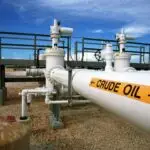
Petroleum, also known as crude oil, is a naturally occurring flammable liquid found in rock formations beneath the Earth’s surface. It is a complex mixture of hydrocarbons.
The origin of petroleum is explained by the biogenic theory:
- It was formed over millions of years from the decomposition of dead marine organisms (plants and animals) under intense heat and pressure, in the absence of air (anaerobic conditions).
- These conditions converted the organic matter into crude oil and natural gas.
The main components of crude oil are:
- Hydrocarbons (alkanes, cycloalkanes, aromatic hydrocarbons)
- Small amounts of compounds containing sulphur, nitrogen, and oxygen
Nigerian and World Crude Oil Reserves
Crude oil reserves refer to the amount of crude oil that can be technically and economically extracted from the ground. Nigeria possesses significant crude oil reserves, making it one of the largest oil producers in Africa and a major player in global oil markets.
Exploration and Drilling
Petroleum exploration involves locating potential oil and gas deposits. Drilling is the process of creating a wellbore to extract the crude oil.
The basic steps in exploration and drilling include:
- Geological Surveys: Studying rock formations to identify potential source rocks and reservoirs.
- Seismic Surveys: Using sound waves to create images of subsurface rock structures to pinpoint oil traps.
- Exploratory Drilling: Drilling a well to confirm the presence of oil or gas.
- Production Drilling: Drilling more wells if the exploratory well is successful to extract the oil.
Fractional Distillation of Petroleum
Fractional distillation is the process used to separate crude oil into various fractions (products) based on their different boiling points. Crude oil is heated and vaporized, and the vapours rise through a fractionating column, cooling and condensing at different levels.
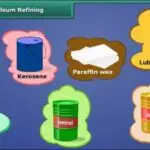
The major fractions obtained from fractional distillation of petroleum and their uses are:
- Refinery Gases (Petroleum Gas): Boiling point below 40°C. Used as liquefied petroleum gas (LPG) for cooking and as feedstock for petrochemicals.
- Gasoline (Petrol): Boiling point 40-180°C. Used as fuel for cars.
- Naphtha: Boiling point 70-180°C. Used as feedstock for petrochemicals and as a solvent.
- Kerosene (Paraffin): Boiling point 180-250°C. Used as jet fuel, lamp oil, and domestic heating fuel.
- Diesel Oil (Gas Oil): Boiling point 250-350°C. Used as fuel for diesel engines, lorries, and buses.
- Lubricating Oils: Boiling point 350-400°C. Used as lubricants for engines and machinery.
- Fuel Oils: Boiling point above 400°C. Used as fuel for ships, power stations, and industrial furnaces.
- Bitumen/Asphalt: Residue with boiling point above 400°C. Used for road surfacing and roofing.
Nigerian Refineries
Nigeria has several refineries designed to process crude oil into refined petroleum products. These include:
- Port Harcourt Refining Company (PHRC) – Old and New refineries
- Warri Refining and Petrochemical Company (WRPC)
- Kaduna Refining and Petrochemical Company (KRPC)
- Dangote Refinery (a private refinery)
Cracking and Reforming
- Cracking: This is the process of breaking down large hydrocarbon molecules (from heavier fractions like gas oil or fuel oil) into smaller, more valuable hydrocarbon molecules (like gasoline) using heat, pressure, and/or catalysts. This increases the yield of high-demand products.
- Reforming: This is a process used to convert straight-chain alkanes (which burn poorly) into branched-chain alkanes and aromatic hydrocarbons (which burn more efficiently and have higher octane ratings) using catalysts and heat. This improves the quality of gasoline.
Teaching Methods/Instructional Techniques
Discussion, Lecture, Demonstration, Question and Answer, Visual Aids
Instructional Procedures
Step 1: Introduction
Time: 5 minutes
Teaching Skill: Set Induction
Teacher’s Activity: The teacher greets the pupils and asks them to mention common sources of energy they know. The teacher then guides them to identify petroleum as a major energy source and introduces the topic: PETROLEUM OR CRUDE OIL.
Pupils’ Activity: Pupils respond by mentioning various energy sources like firewood, electricity, and petrol. They listen attentively as the topic is introduced.
Learning Point: Pupils are introduced to the topic and relate it to their prior knowledge of energy sources.
Step 2: Origin and Composition of Petroleum
Time: 10 minutes
Teaching Skill: Explanation/Discussion
Teacher’s Activity: The teacher explains the biogenic theory of petroleum formation, emphasizing the role of dead marine organisms, heat, and pressure over millions of years. The teacher then discusses the main chemical composition of crude oil, highlighting hydrocarbons.
Pupils’ Activity: Pupils listen, take notes, and ask questions for clarification regarding the formation process and composition.
Learning Point: Pupils understand how crude oil is formed and its primary chemical components.
Step 3: Nigerian and World Crude Oil Reserves, Exploration and Drilling
Time: 5 minutes
Teaching Skill: Explanation/Visualisation
Teacher’s Activity: The teacher explains what crude oil reserves are and states Nigeria’s position as a major oil producer. Using pictures, the teacher illustrates and briefly explains the basic steps of petroleum exploration and drilling.
Pupils’ Activity: Pupils observe the pictures, listen, and note key points about Nigeria’s oil reserves and the exploration process.
Learning Point: Pupils gain knowledge about crude oil reserves and the methods of obtaining crude oil.
Step 4: Fractional Distillation of Petroleum
Time: 10 minutes
Teaching Skill: Demonstration/Explanation
Teacher’s Activity: The teacher explains the process of fractional distillation using a diagram or model of a fractionating column. The teacher then lists and explains the major fractions obtained, their boiling points, and their respective uses, showing samples of available products like kerosene and diesel.
Pupils’ Activity: Pupils observe the diagram/samples, listen to the explanation, and copy notes on the fractions and their uses.
Learning Point: Pupils learn about the separation of crude oil into useful products and the applications of these products.
Step 5: Nigerian Refineries
Time: 5 minutes
Teaching Skill: Identification/Mapping
Teacher’s Activity: The teacher lists the major Nigerian refineries and, using a map of Nigeria, points out their locations. The teacher also shows pictures of some Nigerian refineries.
Pupils’ Activity: Pupils identify the refineries on the map and note their names and locations.
Learning Point: Pupils can identify and locate major petroleum refineries in Nigeria.
Step 6: Cracking and Reforming
Time: 4 minutes
Teaching Skill: Explanation
Teacher’s Activity: The teacher defines and explains the processes of cracking and reforming, highlighting their importance in increasing the yield of valuable products like gasoline and improving fuel quality.
Pupils’ Activity: Pupils listen, ask questions, and take notes on the definitions and purposes of cracking and reforming.
Learning Point: Pupils understand the concepts of cracking and reforming and their relevance in petroleum refining.
Step 7: Evaluation/Review
Time: 5 minutes
Teaching Skill: Questioning/Assessment
Teacher’s Activity: The teacher evaluates the learning by asking the following questions:
- Define petroleum and state its primary chemical components.
- List three major fractions obtained from the fractional distillation of crude oil and state one use for each.
- Mention two major petroleum refineries in Nigeria.
- Differentiate between cracking and reforming in petroleum refining.
Pupils’ Activity: Pupils answer orally and in writing.
Learning Point: Pupils demonstrate understanding of the lesson.
Step 8: Conclusion
Time: 1 minute
Teaching Skill: Summarization
Teacher’s Activity: The teacher summarizes the key points of the lesson, reiterating the importance of petroleum as a vital resource and the various processes involved in its utilization.
Pupils’ Activity: Pupils listen and participate in the summary.
Learning Point: Pupils consolidate their understanding of the topic.
Lesson Keywords
- Petroleum – A naturally occurring flammable liquid found in rock formations beneath the Earth’s surface, consisting mainly of hydrocarbons.
- Crude Oil – Another term for petroleum, in its unrefined state.
- Hydrocarbons – Organic compounds composed entirely of hydrogen and carbon atoms.
- Fractional Distillation – A process used to separate crude oil into different fractions based on their boiling points.
- Cracking – The process of breaking down large hydrocarbon molecules into smaller, more useful ones.
- Reforming – A process that converts straight-chain alkanes into branched-chain alkanes and aromatic hydrocarbons to improve fuel quality.
- Refinery – An industrial plant where crude oil is processed and refined into petroleum products.
Differentiation
For pupils who grasp concepts quickly, the teacher can challenge them to research the environmental impacts of oil spills or the future of renewable energy. For pupils needing more support, the teacher can provide simplified diagrams of fractional distillation or assign group work to discuss the uses of petroleum products, ensuring peer support.
Note for teachers using this lesson plan
Ensure to use clear and simple language, especially when explaining complex chemical processes. Visual aids are very important for this topic. Encourage pupils to ask questions and relate the lesson to their everyday experiences. Emphasize the economic significance of petroleum to Nigeria while also touching on environmental responsibilities.
Community Join the conversation Open discussion +