

Class: Junior Secondary School 3 (JSS3, JSS 3)
Term: 1st Term
Week: 4
Age: 14 years
Duration: 45 minutes
Subject: Business Studies
Curriculum Theme: Business Studies
Previous Lesson: Procedure for Store Procurement, Stock Taking, Delivery Note and Gate Pass
Topic: Office Equipment (Part 1)
Subject Matter: Meaning of Office, Meaning of Office Equipment, List of Office Equipment, Importance of Office Equipment
Specific Objectives
By the end of the lesson, pupils should be able to:
- Cognitive Domain:
(a) Explain what an office is.
(b) Identify and list different types of office equipment.
(c) State the importance of office equipment to office work. - Affective Domain:
(a) Appreciate the value of using proper office equipment in achieving efficiency at work. - Psychomotor Domain:
(a) Identify common office equipment through pictures, charts, or physical demonstration. - Social Domain:
(a) Work collaboratively in groups to classify office equipment and discuss their uses.
Reference Materials
The following resources was used in planning this lesson:
- 9 Years Basic Education Curriculum
- Lagos State Unified Scheme of work for Junior Secondary Schools
- Wikipedia – Office
- Relevant Textbooks
Instructional Materials
The teacher will teach this lesson with the aid of:
- Charts or posters showing different office equipment
- Real office tools like stapler, calculator, pen, file, etc.
- Computer or printed images of modern office machines
- Whiteboard and marker
- Projector or laptop (if available)
Rationale for the Lesson
This lesson introduces students to the basic equipment used in offices and their importance in promoting accuracy, speed, and efficiency in office operations.
Prerequisite/Previous Knowledge
Pupils have seen or used simple tools like pens, staplers, or filing materials at home or school and can relate to their uses in keeping work organized.
Lesson Content/Board Summary
Office Equipment
Meaning of Office
An office is a place where administrative, clerical, and managerial work is carried out. It serves as the center for recording, processing, and communicating business information.
Meaning of Office Equipment
Office equipment refers to the various tools, machines, and materials used to make office work easier, faster, and more accurate. They help staff to perform their duties effectively and efficiently.
List of Office Equipment
The following are examples of common office equipment:
- Typewriter
- Computer system
- Telephone
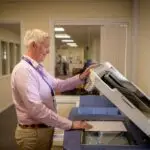
- Photocopier
- Filing cabinet
- Stapler and punch
- Printer
- Calculator
- Shredder
- Desk and chair
Importance of Office Equipment
Office equipment plays an important role in ensuring smooth running of office activities.
The following are the importance of office equipment:
- They help to increase the speed of work.
- They make work easier and reduce fatigue.
- They improve accuracy in handling information.
- They help in keeping records safe and well-organized.
- They aid communication between departments and staff.
- They help reduce human error in office operations.
- They create a conducive and professional working environment.
Teaching Methods/Instructional Techniques:
Discussion, Lecture, Explanation, Demonstration, Group Work, Question and Answer, Visual Aids
Instructional Procedures
To deliver this lesson, the teacher will adopt the following steps:
Step 1: Introduction
Time: 5 minutes
Teaching Skill: Set Induction
Teacher’s Activity: Teacher asks pupils questions about tools they have seen in offices or at home and links their responses to office equipment.
Pupils’ Activity: Pupils mention examples of tools and equipment they know.
Learning Point: Pupils become interested and ready to learn about office equipment.
Step 2: Meaning of Office and Office Equipment
Time: 10 minutes
Teaching Skill: Explanation
Teacher’s Activity: Teacher explains the meaning of an office and office equipment, emphasizing their importance in business.
Pupils’ Activity: Pupils listen attentively and take notes.
Learning Point: Pupils understand what an office and office equipment are.
Step 3: Examples of Office Equipment
Time: 10 minutes
Teaching Skill: Demonstration
Teacher’s Activity: Teacher displays pictures or real items like stapler, telephone, or computer and names each as office equipment.
Pupils’ Activity: Pupils identify and describe the equipment shown.
Learning Point: Pupils recognize common office equipment.
Step 4: Importance of Office Equipment
Time: 10 minutes
Teaching Skill: Discussion
Teacher’s Activity: Teacher leads pupils in discussing why office equipment is necessary for effective office work.
Pupils’ Activity: Pupils share ideas and participate in discussion.
Learning Point: Pupils understand the importance of office equipment in business operations.
Step 5: Note-Taking
Time: 5 minutes
Teaching Skill: Explanation
Teacher’s Activity: Teacher dictates or writes the board summary for pupils to copy.
Pupils’ Activity: Pupils copy the notes neatly into their notebooks.
Learning Point: Pupils have a written record of the lesson.
Step 6: Evaluation/Review
Time: 3 minutes
Teaching Skill: Questioning
Teacher’s Activity: The teacher evaluates the learning by asking the following questions:
- What is an office?
- What is office equipment?
- Mention five examples of office equipment.
- State three importance of office equipment.
Pupils’ Activity: Pupils answer the questions orally.
Learning Point: Pupils recall and apply what they have learned.
Step 7: Conclusion
Time: 2 minutes
Teaching Skill: Reinforcement
Teacher’s Activity: Teacher summarizes the lesson and emphasizes that office equipment improves efficiency in business operations.
Pupils’ Activity: Pupils listen attentively.
Learning Point: Pupils appreciate the value of using office equipment.
Lesson Keywords
- Office – a place where business or administrative work is done
- Equipment – tools or machines used for a specific purpose
- Efficiency – doing work quickly and correctly with minimal waste
- Communication – exchange of information between people or departments
- Accuracy – being correct and precise in work or record keeping
Differentiation
Teacher provides simpler explanations and visual aids for slower learners, while advanced learners can classify equipment as manual or electronic.
Note for teachers using this lesson plan
Use real or picture samples of office equipment to make the lesson engaging. Encourage pupils to handle or identify familiar tools where possible. Emphasize safety in handling equipment.



Community Join the conversation Open discussion +