

Class: Senior Secondary School 2 (SS2 / SSS 2)
Term: 1st Term
Week: 4
Age: 16 years
Duration: 45 minutes
Subject: Visual Art
Curriculum Theme: Drawing
Previous Lesson: Still-Life Painting: Drawing Basic Forms.
Topic: LIFE DRAWING
Subject Matter: Meaning of life drawing (drawing of the human figure from observation), anatomical studies of the model (various postures, quick poses, action postures, muscles)
Specific Objectives
By the end of the lesson, pupils should be able to:
Cognitive Domain:
- Define life drawing.
- Identify various postures and anatomical features relevant to human figure drawing.
- Explain the importance of anatomical studies in life drawing.
Affective Domain:
- Appreciate the complexity and beauty of the human form.
- Develop patience and keen observation skills during drawing.
- Show interest in exploring different drawing techniques for the human figure.
Psychomotor Domain:
- Draw a basic human figure from observation, showing correct proportions.
- Create a self-portrait that demonstrates an understanding of posture and basic anatomy.
- Apply gesture drawing techniques to capture quick poses.
Social Domain:
- Respect the human model or fellow pupils during observation exercises.
- Collaborate in setting up appropriate poses for drawing.
- Share and discuss their drawings constructively with peers.
Reference Materials
The following resources were used in planning this lesson:
- Senior Secondary Schools Education Curriculum
- State Unified Scheme of Work
- Visual Art for Senior Secondary Schools by A.O. Okoro
Instructional Materials
The teacher will teach this lesson with the aid of:
- Cardboard
- Brushes
- Watercolor
- Drawing board
- Human model (or a large mirror for self-portrait)
- Pencils and erasers
Rationale for the Lesson
This lesson helps pupils understand how to draw the human figure accurately from observation. It enables them to develop essential skills in capturing proportions, postures, and anatomical details, which is important for advanced artistic expression and understanding the human form.
Prerequisite/Previous Knowledge
Pupils should have basic knowledge of observational drawing, sketching, and understanding of simple geometric shapes.
Lesson Content/Board Summary
LIFE DRAWING
Meaning of Life Drawing
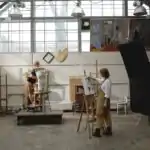
Life drawing is the practice of drawing the human figure from direct observation of a live model. It involves capturing the form, proportion, posture, and movement of the human body. This type of drawing helps artists develop their observational skills and understanding of human anatomy.
Anatomical Studies in Life Drawing
Anatomical studies are important in life drawing to help artists understand the underlying structure of the human body. Knowledge of bones and muscles allows artists to draw the figure more accurately, conveying volume, tension, and movement, even when the model’s skin covers these structures.
Key Elements of Anatomical Studies for Life Drawing
When studying anatomy for life drawing, artists focus on:
- Various Postures: Understanding how the body balances and shifts weight in different standing, sitting, or reclining positions.
- Quick Poses (Gesture Drawing): Capturing the overall movement, energy, and flow of a pose in a short time. This often involves using continuous lines to suggest the figure’s action rather than detailed forms.
- Action Postures: Drawing figures in dynamic movement, emphasizing the lines of force and energy.
- Muscles and Skeletal Structure: Learning the major muscle groups and bones, how they attach, and how they affect the surface form of the body. Key aspects include:
- Gesture Drawing: A quick, expressive drawing that captures the essence of a pose.
- Stick-figure Structure: A basic foundational sketch used to establish proportion and pose before adding mass.
- Muscle Placement: Understanding where major muscle groups are located and how they flex or relax to create form.
Creating a Self-Portrait (Life Drawing)
A self-portrait is a drawing of oneself. Creating one from observation involves:
- Setting up a mirror to observe your own reflection.
- Focusing on your posture, facial features, and the basic anatomy of your head and shoulders.
- Paying attention to light and shadow to create form.
Teaching Methods/Instructional Techniques
Discussion, Lecture, Demonstration, Question and Answer, Visual Aids
Instructional Procedures
Step 1: Introduction
Time: 5 minutes
Teaching Skill: Set Induction
Teacher’s Activity: The teacher greets the pupils, checks their previous knowledge on observational drawing, and introduces the topic of life drawing, explaining its importance in art.
Pupils’ Activity: Pupils respond to greetings, share their knowledge, and listen attentively to the introduction.
Learning Point: Pupils are prepared for the lesson and understand the relevance of the topic.
Step 2: Explanation of Life Drawing
Time: 5 minutes
Teaching Skill: Explanation
Teacher’s Activity: The teacher defines life drawing as drawing the human figure from direct observation and discusses why it is an important skill for artists.
Pupils’ Activity: Pupils listen, take notes, and ask questions for clarification.
Learning Point: Pupils understand the meaning and purpose of life drawing.
Step 3: Introduction to Anatomical Studies
Time: 10 minutes
Teaching Skill: Discussion/Illustration
Teacher’s Activity: The teacher introduces anatomical studies, explaining how understanding bones and muscles helps in drawing accurate human figures. The teacher shows examples of anatomical drawings or diagrams.
Pupils’ Activity: Pupils observe the examples, participate in discussions, and ask questions about human anatomy in relation to art.
Learning Point: Pupils grasp the importance of anatomy for realistic human figure drawing.
Step 4: Exploring Postures and Muscles
Time: 8 minutes
Teaching Skill: Demonstration/Guidance
Teacher’s Activity: The teacher guides learners through examples of various postures (e.g., standing, sitting), quick poses (gesture drawing), and action postures. The teacher also highlights basic muscle placement and how it affects form.
Pupils’ Activity: Pupils observe the teacher’s demonstrations and practice quick sketches of simple poses.
Learning Point: Pupils learn to identify and represent different postures and understand basic muscle structure.
Step 5: Self-Portrait Demonstration/Guidance
Time: 7 minutes
Teaching Skill: Practical Demonstration
Teacher’s Activity: The teacher assists learners in understanding how to make a self-portrait by posing before a mirror, guiding them on how to observe their own posture and basic anatomical features of the head and shoulders.
Pupils’ Activity: Pupils prepare their materials and observe the teacher’s guidance on self-portrait drawing.
Learning Point: Pupils prepare for practical application of life drawing through self-portraiture.
Step 6: Evaluation/Review
Time: 5 minutes
Teaching Skill: Questioning/Assessment
Teacher’s Activity: The teacher evaluates the learning by asking the following questions:
- What is life drawing?
- Mention two reasons why anatomical studies are important in life drawing.
- List three key elements artists focus on during anatomical studies for life drawing.
- What is a self-portrait?
Pupils’ Activity: Pupils answer orally and in writing.
Learning Point: Pupils demonstrate understanding of the lesson.
Step 7: Conclusion
Time: 5 minutes
Teaching Skill: Summarization
Teacher’s Activity: The teacher summarizes the key points of the lesson, emphasizing the importance of continuous practice in life drawing and anatomical studies. The teacher assigns homework for pupils to complete a detailed self-portrait.
Pupils’ Activity: Pupils listen to the summary, ask any remaining questions, and note down the homework assignment.
Learning Point: Pupils consolidate their learning and are given tasks to reinforce understanding.
Lesson Keywords
- Life Drawing – The practice of drawing the human figure from direct observation of a live model.
- Anatomy – The study of the structure of the human body.
- Posture – The position in which someone holds their body when standing or sitting.
- Gesture Drawing – A quick, expressive drawing that captures the essence of a pose, emphasizing movement and energy.
- Self-Portrait – A drawing or painting of the artist by the artist themselves.
Differentiation
For pupils who grasp concepts quickly, the teacher will encourage them to experiment with different drawing media or more complex poses. For pupils who need more support, the teacher will provide simplified anatomical diagrams, offer more one-on-one guidance during drawing, and focus on basic proportions before moving to details.
Note for teachers using this lesson plan
Encourage pupils to practice drawing from various sources beyond the classroom, such as photographs of figures in action, to reinforce their observational skills. Emphasize that perfection is not the goal, but rather the development of keen observation and understanding of the human form.

Community Join the conversation Open discussion +