

Class: Senior Secondary School 2 (SS2 / SSS 2)
Term: 2nd Term
Week: 2
Age: 16 years
Duration: 45 minutes
Subject: Visual Art
Curriculum Theme: Traditional Crafts and Indigenous Art Forms
Previous Lesson: Indigenous Decorative Motif: Calabash Decoration and Patterns.
Topic: INDIGENOUS DECORATIVE MOTIF
Subject Matter: Using patterns to produce a decorative calabash (painted pattern, carved pattern, scorched pattern, scrapped pattern)
Specific Objectives
By the end of the lesson, pupils should be able to:
Cognitive Domain:
- Identify and define indigenous decorative motifs.
- Describe different methods of calabash decoration.
Affective Domain:
- Appreciate the cultural significance of calabash decoration in Nigeria.
- Show interest in learning about traditional art forms.
Psychomotor Domain:
- Sketch a simple decorative pattern suitable for a calabash.
- Observe and recognize various calabash decoration techniques.
Social Domain:
- Discuss the work of local calabash artisans.
- Share ideas on how to preserve indigenous crafts.
Reference Materials
The following resources were used in planning this lesson:
- Senior Secondary Schools Education Curriculum
- State Unified Scheme of Work
- Visual Arts for Senior Secondary Schools, Book 2
- https://www.nigerianarts.gov.ng
- https://www.culture.gov.ng
Instructional Materials
The teacher will teach this lesson with the aid of:
- Samples of decorated calabashes
- Photographs illustrating different decoration methods (painted, carved, scorched, scrapped)
- Calabash blanks
- Carving tools (e.g., small knives, chisels)
- Pattern samples or design sketches
- Drawing materials (pencils, drawing books)
Rationale for the Lesson
This lesson helps pupils understand and appreciate indigenous decorative motifs, specifically through the art of calabash decoration. It enables them to recognize various traditional techniques, thereby fostering an appreciation for Nigeria’s rich cultural heritage and local craftsmanship.
Prerequisite/Previous Knowledge
Pupils should have basic knowledge of art elements and principles, and some familiarity with traditional Nigerian crafts.
Lesson Content/Board Summary
Indigenous Decorative Motifs
Definition of Indigenous Decorative Motifs
Indigenous decorative motifs are traditional designs, patterns, and symbols that originate from a particular culture or ethnic group. These motifs often carry cultural meanings, stories, or beliefs, and are used to beautify objects, textiles, and architecture.
Calabash and its Cultural Significance
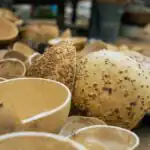
A calabash is a hard-shelled fruit from the calabash plant, often dried and used as a container, utensil, or decorative object in many cultures, especially in Nigeria. It holds significant cultural value, used in ceremonies, as musical instruments, and as household items.
Methods of Calabash Decoration
The following are common methods used to decorate calabashes:
- Painted Pattern: This involves applying natural or synthetic pigments (paints) onto the surface of the calabash to create designs, often using brushes or other applicators.
- Carved Pattern: This method uses sharp tools to incise or cut designs directly into the hard shell of the calabash, creating raised or sunken patterns.
- Scorched Pattern (Pyro-engraving): This technique involves burning the surface of the calabash with a heated tool (like a hot wire or poker) to create dark lines and shaded areas, forming patterns.
- Scrapped Pattern (Etching): This method involves scratching or scraping away the outer layer of the calabash surface with a sharp tool to reveal a lighter layer underneath, creating intricate designs.
Teaching Methods/Instructional Techniques
Discussion, Lecture, Demonstration, Question and Answer, Visual Aids
Instructional Procedures
Step 1: Introduction
Time: 5 minutes
Teaching Skill: Set Induction
Teacher’s Activity: The teacher greets the pupils and asks them to name some traditional Nigerian crafts they are familiar with.
Pupils’ Activity: Pupils respond by mentioning crafts like pottery, weaving, or carving.
Learning Point: Connects to prior knowledge and introduces the lesson topic.
Step 2: Explanation of Indigenous Decorative Motifs
Time: 7 minutes
Teaching Skill: Explanation
Teacher’s Activity: The teacher explains what indigenous decorative motifs are, providing examples from various Nigerian cultures.
Pupils’ Activity: Pupils listen attentively, take notes, and ask questions for clarification.
Learning Point: Pupils understand the concept and cultural relevance of indigenous decorative motifs.
Step 3: Introduction to Calabash Decoration
Time: 7 minutes
Teaching Skill: Discussion/Demonstration
Teacher’s Activity: The teacher introduces the calabash, discusses its uses and cultural importance, and shows samples or pictures of decorated calabashes.
Pupils’ Activity: Pupils observe the samples/pictures and contribute to the discussion on the uses and significance of calabashes.
Learning Point: Pupils understand what a calabash is and its role in Nigerian culture.
Step 4: Explanation of Painted Patterns
Time: 6 minutes
Teaching Skill: Explanation/Visual Aid
Teacher’s Activity: The teacher explains how painted patterns are created on calabashes, showing examples of calabashes decorated with paint.
Pupils’ Activity: Pupils observe the examples and take notes on the technique of painted patterns.
Learning Point: Pupils learn about the painted pattern method of calabash decoration.
Step 5: Explanation of Carved Patterns
Time: 6 minutes
Teaching Skill: Explanation/Demonstration
Teacher’s Activity: The teacher explains the carving method for calabash decoration, showing carving tools and examples of carved calabashes.
Pupils’ Activity: Pupils observe the tools and products, noting the process involved in creating carved patterns.
Learning Point: Pupils understand how carved patterns are created on calabashes.
Step 6: Explanation of Scorched and Scrapped Patterns
Time: 8 minutes
Teaching Skill: Explanation/Visual Aid
Teacher’s Activity: The teacher describes both scorching and scrapping techniques for calabash decoration, using visual aids or demonstrating with appropriate materials.
Pupils’ Activity: Pupils pay close attention to the details of these techniques and ask relevant questions.
Learning Point: Pupils comprehend the methods of scorched and scrapped patterns in calabash decoration.
Step 7: Evaluation/Review
Time: 5 minutes
Teaching Skill: Questioning/Assessment
Teacher’s Activity: The teacher evaluates the learning by asking the following questions:
- What are indigenous decorative motifs?
- Mention two uses of a calabash in Nigerian culture.
- List three methods of decorating a calabash.
- Briefly explain one method of calabash decoration.
Pupils’ Activity: Pupils answer orally and in writing.
Learning Point: Pupils demonstrate understanding of the lesson.
Step 8: Conclusion
Time: 1 minute
Teaching Skill: Summarization
Teacher’s Activity: The teacher summarizes the lesson by reiterating the main points on indigenous decorative motifs and calabash decoration methods. Homework: Sketch a simple indigenous decorative pattern suitable for a calabash.
Pupils’ Activity: Pupils listen, copy the homework, and prepare for the next lesson.
Learning Point: Reinforces the day’s learning and provides an opportunity for practical application.
Lesson Keywords
- Motif – A decorative design or pattern.
- Indigenous – Originating or occurring naturally in a particular place; native.
- Calabash – A dried, hollow shell of a gourd, used as a container or utensil.
- Carving – The act of cutting or incising designs into a material.
- Scorching – Burning the surface lightly to create patterns.
- Scrapping – Scraping away material to create patterns.
Differentiation
For pupils who grasp concepts quickly, the teacher can encourage them to research specific indigenous motifs from their local culture. For those needing more support, the teacher can provide simpler patterns to sketch and offer more direct guidance during observation and note-taking.
Note for teachers using this lesson plan
Encourage pupils to bring in pictures or actual examples of decorated calabashes from their homes or communities. If possible, arrange a virtual or physical visit to a local artisan to observe the decoration process firsthand. Emphasize the cultural significance and artistic value of each decoration method.


Community Join the conversation Open discussion +