

Class: Senior Secondary School 1 (SSS 1)
Term: First Term
Week: 2
Age: 15 years
Duration: 45 minutes
Subject: Data Processing
Curriculum Theme: Technology
Previous Lesson: History of Computing: Concrete Devices.
Topic: Number Systems and Conversion
Subject Matter: Meaning of number systems, binary, octal, decimal, hexadecimal number systems, conversion from one number system to another.
Specific Objectives
By the end of the lesson, pupils should be able to:
Cognitive Domain:
- Define a number system.
- Identify different types of number systems and their bases.
- Explain the process of converting numbers between different systems.
Affective Domain:
- Appreciate the importance of different number systems in computing.
- Show interest in performing number system conversions.
Psychomotor Domain:
- Convert numbers from decimal to binary, octal, and hexadecimal.
- Convert numbers from binary, octal, and hexadecimal to decimal.
Social Domain:
- Collaborate with peers to solve number system conversion problems.
Reference Materials
The following resources were used in planning this lesson:
- Senior Secondary Education Curriculum for Data Processing SSS 1.
- State Unified Scheme of Work for Data Processing SSS 1.
- Data Processing for Senior Secondary Schools by Hi-Tech.
Instructional Materials
The teacher will teach this lesson with the aid of:
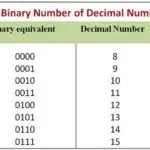
- Number system conversion chart.
- Whiteboard and markers.
- Calculators.
- Printed practice questions.
Rationale for the Lesson
Understanding number systems is important for pupils to grasp how computers store and process information. This knowledge also helps them to appreciate the different ways quantities can be represented beyond the familiar decimal system.
Prerequisite/Previous Knowledge
Pupils are expected to have basic knowledge of counting and arithmetic operations.
Lesson Content/Board Summary
Number Systems and Conversion
Meaning of Number Systems
A number system is a set of symbols used to represent numbers. It defines how numbers are counted and manipulated. The base or radix of a number system indicates the number of unique digits, including zero, used in that system.
Types of Number Systems
The following are common types of number systems:
- Decimal Number System (Base 10): Uses 10 digits (0-9). It is the most commonly used number system in everyday life. Each position represents a power of 10.
- Binary Number System (Base 2): Uses 2 digits (0 and 1). It is the fundamental number system used by computers. Each position represents a power of 2.
- Octal Number System (Base 8): Uses 8 digits (0-7). It is sometimes used in computing as a compact way to represent binary numbers. Each position represents a power of 8.
- Hexadecimal Number System (Base 16): Uses 16 digits (0-9 and A-F, where A=10, B=11, C=12, D=13, E=14, F=15). It is widely used in computing to represent large binary numbers concisely. Each position represents a power of 16.
Conversion from One Number System to Another
Numbers can be converted between different number systems using specific methods.
Converting Decimal to Other Bases (Binary, Octal, Hexadecimal)
To convert a decimal number to another base, repeatedly divide the decimal number by the target base and record the remainders. Read the remainders from bottom to top to get the equivalent number in the new base.
Example: Convert 2510 to Binary.
- 25 ÷ 2 = 12 R 1
- 12 ÷ 2 = 6 R 0
- 6 ÷ 2 = 3 R 0
- 3 ÷ 2 = 1 R 1
- 1 ÷ 2 = 0 R 1
Reading remainders from bottom to top: 110012. So, 2510 = 110012.
Converting Other Bases (Binary, Octal, Hexadecimal) to Decimal
To convert a number from any base to decimal, multiply each digit by its positional weight (base raised to the power of its position) and sum the results. Positions are numbered from 0 starting from the rightmost digit.
Example: Convert 110012 to Decimal.
- 1 × 24 = 1 × 16 = 16
- 1 × 23 = 1 × 8 = 8
- 0 × 22 = 0 × 4 = 0
- 0 × 21 = 0 × 2 = 0
- 1 × 20 = 1 × 1 = 1
Summing the results: 16 + 8 + 0 + 0 + 1 = 2510. So, 110012 = 2510.
Teaching Methods/Instructional Techniques
Discussion, Lecture, Demonstration, Question and Answer, Visual Aids
Instructional Procedures
Step 1: Introduction
Time: 5 minutes
Teaching Skill: Set Induction
Teacher’s Activity: The teacher greets the pupils and asks them how they count numbers in everyday life (e.g., 1, 2, 3…). The teacher then introduces the idea that computers use a different way of counting.
Pupils’ Activity: Pupils respond to the teacher’s questions and listen attentively.
Learning Point: Pupils are introduced to the concept of different ways of representing numbers.
Step 2: Meaning of Number Systems
Time: 5 minutes
Teaching Skill: Explanation/Definition
Teacher’s Activity: The teacher explains what a number system is, emphasizing the role of the base or radix. The teacher writes the definition on the board.
Pupils’ Activity: Pupils listen, take notes, and ask questions for clarification.
Learning Point: Pupils understand the definition of a number system.
Step 3: Types of Number Systems
Time: 10 minutes
Teaching Skill: Explanation/Classification
Teacher’s Activity: The teacher introduces the four main types of number systems: Decimal, Binary, Octal, and Hexadecimal. For each, the teacher states its base and the digits it uses, providing simple examples. The teacher uses the number system conversion chart to illustrate.
Pupils’ Activity: Pupils identify each number system by its base and digits. They copy the notes from the board.
Learning Point: Pupils can identify and differentiate between the common types of number systems.
Step 4: Conversion from Decimal to Other Bases
Time: 8 minutes
Teaching Skill: Demonstration/Problem Solving
Teacher’s Activity: The teacher demonstrates how to convert a decimal number to binary on the whiteboard, explaining the division and remainder method clearly. The teacher then provides a similar example for conversion to octal or hexadecimal.
Pupils’ Activity: Pupils observe the demonstration, ask questions, and attempt to follow the steps.
Learning Point: Pupils learn the method for converting decimal numbers to other bases.
Step 5: Conversion from Other Bases to Decimal
Time: 7 minutes
Teaching Skill: Demonstration/Problem Solving
Teacher’s Activity: The teacher demonstrates how to convert a binary number back to decimal using the positional weighting method. The teacher shows another example for octal or hexadecimal to decimal conversion.
Pupils’ Activity: Pupils pay attention to the steps and practice on their own.
Learning Point: Pupils learn the method for converting numbers from other bases to decimal.
Step 6: Practice Exercises
Time: 5 minutes
Teaching Skill: Guided Practice
Teacher’s Activity: The teacher gives pupils a few practice questions on conversion (e.g., convert 1510 to binary, convert 10112 to decimal) and moves around to assist pupils.
Pupils’ Activity: Pupils attempt the practice questions individually or in pairs.
Learning Point: Pupils apply the learned conversion techniques to solve problems.
Step 7: Evaluation/Review
Time: 5 minutes
Teaching Skill: Questioning/Assessment
Teacher’s Activity: The teacher evaluates the learning by asking the following questions:
- Define a number system.
- List two types of number systems and their respective bases.
- Convert 1310 to binary.
- Convert 1102 to decimal.
Pupils’ Activity: Pupils answer orally and in writing.
Learning Point: Pupils demonstrate understanding of the lesson.
Step 8: Conclusion
Time: 5 minutes
Teaching Skill: Summarization/Consolidation
Teacher’s Activity: The teacher summarizes the key points of the lesson, reiterating the importance of number systems in computing. The teacher assigns homework which includes more conversion problems.
Pupils’ Activity: Pupils listen to the summary and copy down the homework.
Learning Point: The lesson is concluded, and learning is reinforced.
Lesson Keywords
- Number System – A system for representing numbers.
- Base/Radix – The number of unique digits used in a number system.
- Decimal – Base 10 number system (0-9).
- Binary – Base 2 number system (0-1).
- Octal – Base 8 number system (0-7).
- Hexadecimal – Base 16 number system (0-9, A-F).
Differentiation
For pupils who grasp concepts quickly, the teacher can provide more complex conversion problems, including those involving fractional numbers. For pupils who are struggling, the teacher can provide additional guided practice with simpler numbers and visual aids, ensuring they understand the basic principles before moving to more complex tasks.
Note for teachers using this lesson plan
Ensure the whiteboard is clean and clearly organized. Use large, legible writing for numbers and conversion steps. Encourage active participation and provide positive reinforcement for pupils’ efforts. Be prepared to demonstrate multiple examples for each conversion type if needed.



Community Join the conversation Open discussion +