

Class: Senior Secondary School 1 (SS1 / SSS 1)
Term: 2nd Term
Week: 2
Age: 15 years
Duration: 45 minutes
Subject: Furniture Making
Curriculum Theme: Trade
Previous Lesson: Timber Growth: Parts Of A Tree And Growth Types.
Topic: Timber growth structure and classification
Subject Matter: Cross section of a tree, Functions of tree parts, Tree structure identification
Specific Objectives
By the end of the lesson, pupils should be able to:
Cognitive Domain:
- Describe the cross section of a tree.
- State the functions of different tree parts.
- Identify the various structures within a tree.
Affective Domain:
- Appreciate the importance of understanding timber structure in furniture making.
- Develop an interest in the properties of different wood types.
Psychomotor Domain:
- Sketch a labeled cross section of a tree.
- Point out the different parts of a tree from a diagram or specimen.
Social Domain:
- Participate actively in group discussions about tree growth.
Reference Materials
The following resources were used in planning this lesson:
- 9 Years Basic Education Curriculum for Technical Vocational Education.
- State Unified Scheme of Work for Senior Secondary School Furniture Making.
- Furniture Making for Senior Secondary Schools, Book 1.
- https://www.wood-database.com/wood-articles/tree-growth-and-anatomy/
Instructional Materials
The teacher will teach this lesson with the aid of:
- Tree stump cross section
- Marker board and markers/chalk
- Charts showing tree cross sections
- Diagrams of tree parts
Rationale for the Lesson
Understanding the growth structure of timber helps pupils to know the source and properties of wood used in furniture making. This knowledge is important for selecting the right type of timber for specific projects and for appreciating the natural material they work with.
Prerequisite/Previous Knowledge
Pupils should have a basic understanding of plants and their parts from their Basic Science lessons.
Lesson Content/Board Summary
Timber Growth Structure and Classification
Cross Section of a Tree
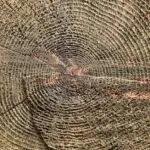
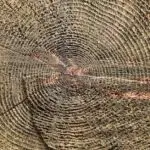
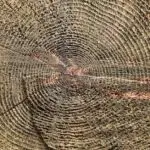
A cross section of a tree reveals various concentric layers, each with a specific function in the tree’s life and growth. Understanding these layers is important for knowing the properties of timber.
The main parts visible in a cross section from the center outwards are:
- Pith: The small, soft core at the very center of the trunk. It is the first formed tissue of the stem.
- Heartwood: The dead, inactive, and usually darker wood at the center of the tree. It provides structural strength and is more resistant to decay.
- Sapwood: The living, lighter coloured wood surrounding the heartwood. It transports water and nutrients (sap) from the roots to the leaves and stores food.
- Cambium Layer: A very thin layer of living cells located between the sapwood and the inner bark. It is responsible for the growth in diameter of the tree, producing new wood cells (xylem) inwards and new bark cells (phloem) outwards.
- Inner Bark (Phloem): A layer of living tissue that transports food (sugars) produced in the leaves to other parts of the tree, including the roots.
- Outer Bark: The outermost protective layer of the tree. It is dead tissue that shields the tree from physical damage, diseases, insects, and extreme weather conditions.
- Medullary Rays: Radial lines of cells that extend from the pith to the bark. They store food and transport sap horizontally across the trunk.
Functions of Tree Parts
Each part of a tree performs specific functions essential for its survival and growth, which directly or indirectly influence the characteristics of the timber produced.
The functions of the main tree parts are:
- Roots: Anchor the tree firmly in the ground and absorb water and dissolved mineral salts from the soil.
- Stem/Trunk: Supports the crown of the tree, transports water and nutrients between roots and leaves, and is the primary source of timber.
- Branches: Provide support for leaves, flowers, and fruits, and aid in the transport of water and nutrients to the leaves.
- Leaves: The primary sites for photosynthesis, where sunlight is converted into food (sugars) for the tree.
- Bark: Protects the internal living tissues of the tree from mechanical injury, pests, diseases, and environmental stresses.
- Cambium: Facilitates secondary growth, leading to an increase in the girth (diameter) of the stem and roots by producing new xylem (wood) and phloem (bark) cells.
- Sapwood: Actively transports water and minerals from the roots upwards to the leaves and also stores starch.
- Heartwood: Primarily provides mechanical support and strength to the tree. It is also more durable due to the presence of extractives.
Tree Structure Identification
Identifying the different parts of a tree, both externally and in cross-section, is fundamental to understanding timber. This involves recognizing the bark, branches, and leaves externally, and the pith, heartwood, sapwood, cambium, and bark layers internally.
Teaching Methods/Instructional Techniques
Discussion, Lecture, Demonstration, Question and Answer, Visual Aids
Instructional Procedures
Step 1: Introduction
Time: 5 minutes
Teaching Skill: Set Induction
Teacher’s Activity: The teacher greets the pupils and asks them to mention different parts of a plant they know. The teacher then relates their answers to the structure of a tree, focusing on the trunk as the source of timber.
Pupils’ Activity: Pupils respond by mentioning parts of a plant like roots, stem, leaves, and flowers.
Learning Point: Pupils recall prior knowledge and are introduced to the lesson topic.
Step 2: Cross Section of a Tree
Time: 10 minutes
Teaching Skill: Explanation/Demonstration
Teacher’s Activity: The teacher displays a tree stump cross section or a chart showing one. The teacher sketches a cross section on the marker board, labels the parts (pith, heartwood, sapwood, cambium, inner bark, outer bark, medullary rays), and explains each layer.
Pupils’ Activity: Pupils observe the tree stump/chart, copy the sketch, and listen attentively to the explanations.
Learning Point: Pupils learn about the internal structure of a tree and its various layers.
Step 3: Functions of Tree Parts
Time: 10 minutes
Teaching Skill: Discussion/Elaboration
Teacher’s Activity: The teacher discusses the specific functions of each identified part of the tree (roots, stem, leaves, bark, cambium, sapwood, heartwood), emphasizing their importance to the tree’s life and the quality of timber.
Pupils’ Activity: Pupils contribute to the discussion, ask questions, and take notes.
Learning Point: Pupils understand the role of each tree part and how it relates to timber properties.
Step 4: Tree Structure Identification
Time: 7 minutes
Teaching Skill: Practical Application/Observation
Teacher’s Activity: The teacher guides pupils to identify the different parts on the actual tree stump cross section or detailed charts. The teacher asks pupils to point out specific layers.
Pupils’ Activity: Pupils actively participate by pointing out and identifying the various tree structures as instructed by the teacher.
Learning Point: Pupils gain practical skills in identifying tree components.
Step 5: Evaluation/Review
Time: 5 minutes
Teaching Skill: Questioning/Assessment
Teacher’s Activity: The teacher evaluates the learning by asking the following questions:
- Define the term ‘timber’.
- List four main layers visible in a cross section of a tree.
- State two functions of the cambium layer.
- Explain the difference between heartwood and sapwood.
Pupils’ Activity: Pupils answer orally and in writing.
Learning Point: Pupils demonstrate understanding of the lesson.
Step 6: Conclusion
Time: 3 minutes
Teaching Skill: Summarization
Teacher’s Activity: The teacher summarizes the key points of the lesson, reiterating the importance of understanding timber growth structure in furniture making. The teacher then gives homework: “Draw a well-labeled cross section of a tree and briefly explain the function of each part.”
Pupils’ Activity: Pupils listen to the summary and copy the homework assignment.
Learning Point: Pupils consolidate their learning and are given an assignment to reinforce understanding.
Lesson Keywords
- Timber – Wood from trees used for building or making objects.
- Cross Section – A cut made across the grain of a tree trunk, revealing its internal layers.
- Pith – The soft core at the center of a tree trunk.
- Heartwood – The dead, strong, inner wood of a tree.
- Sapwood – The living, outer wood of a tree that transports sap.
- Cambium – The growth layer between the bark and wood.
- Bark – The protective outer covering of a tree trunk.
- Medullary Rays – Radial lines of cells in a tree trunk that store and transport food horizontally.
Differentiation
For pupils who are visual learners, the teacher will use more diagrams, charts, and the actual tree stump cross section. For those who learn by doing, the teacher will encourage them to sketch and label the parts themselves. Pupils who grasp concepts quickly can be asked to research different types of timber and their structures.
Note for teachers using this lesson plan
Ensure the tree stump cross section is clear and has visible layers. Encourage pupils to ask questions and share their observations. Emphasize the practical relevance of this knowledge to furniture making.
Community Join the conversation Open discussion +