

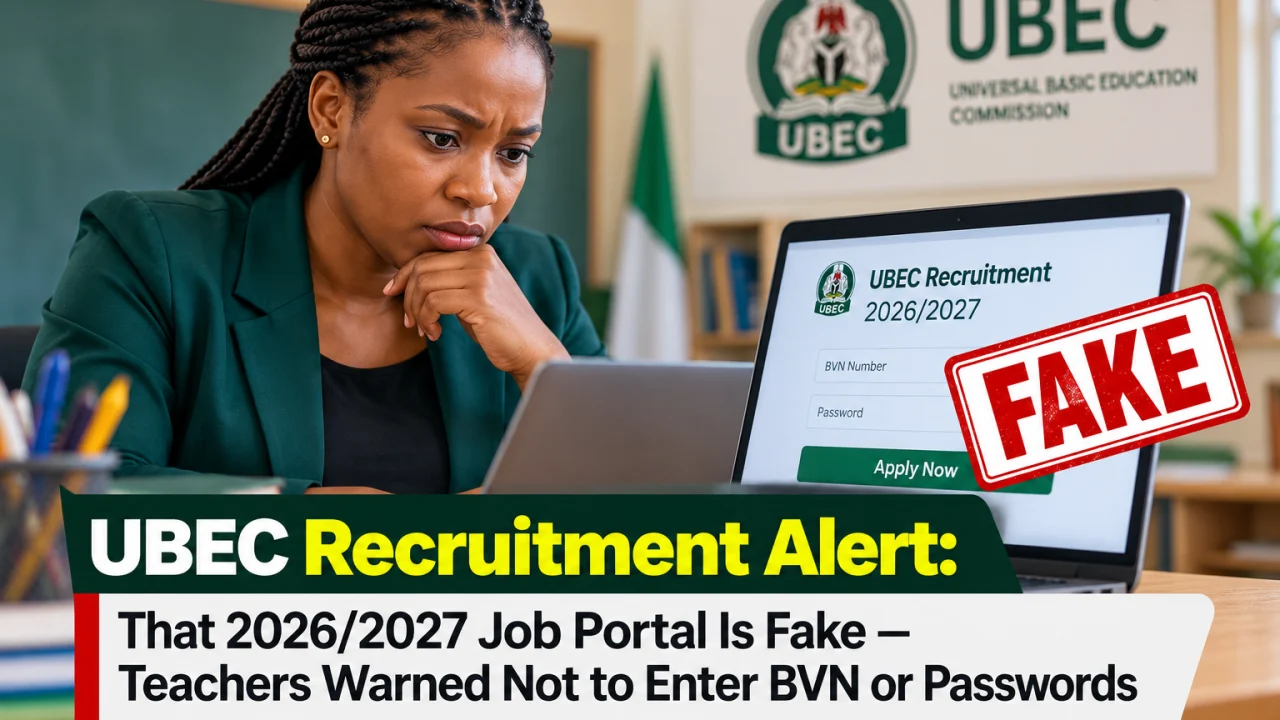
Teachers and job seekers are being warned not to submit personal or financial information to a website advertising a supposed Universal Basic Education Commission recruitment exercise. UBEC says the circulating advert is false and has identified the website behind it as part of a UBEC recruitment scam.
The Commission says social-media posts claiming that applications are open for a “UBEC 2026/2027 recruitment exercise” are unauthorised. It specifically named ubeconline.com as a phishing website and said the domain is not affiliated with UBEC.
UBEC’s warning is particularly important for teachers because fake recruitment notices often spread quickly through WhatsApp groups, Facebook pages and teacher communities. A message can look convincing simply because it carries a government logo, promises vacancies nationwide or is forwarded by someone known to the recipient.
What UBEC Says Is Fake — and Where Real Recruitment Will Appear
UBEC says it has not opened a 2026/2027 recruitment portal. Applicants should therefore treat any current website claiming to collect UBEC recruitment applications as suspicious unless the Commission itself announces the exercise through its recognised channels.
The correct official website is ubec.gov.ng. UBEC also lists its verified social-media presence as Facebook: ubecabujaubec and Instagram/X: @ubecnigeria.
The Commission says it will never demand payment, a processing fee or sensitive financial credentials such as a BVN or password as a condition for employment. That point should be treated as a basic fraud test whenever a supposed government-recruitment page asks applicants to pay before an application can proceed.
A genuine recruitment process may require normal identification and qualification information, but job seekers should always confirm that the form is being hosted on or clearly linked from an official government domain before uploading certificates, NIN information, passport photographs or contact details.
What to Do If You Already Used the Fake Portal
Anyone who has already submitted details should first identify exactly what information was exposed. If the same password used on the fake site is also used for email, banking, social media or other important accounts, change those passwords immediately and avoid reusing the new password elsewhere.
If banking credentials, card information or other financial details were supplied, the affected person should contact the bank through an official channel and monitor the account closely. If only a phone number and email were provided, be alert for follow-up messages designed to continue the scam by requesting money, OTPs or additional identity documents.
A BVN should not be casually shared in response to a recruitment advert. Anyone who submitted highly sensitive identity information should be particularly cautious about subsequent calls or messages claiming to be from a bank, government agency or recruitment officer.
Schools and teacher associations can also help by slowing the spread of fake vacancies. Before forwarding a recruitment notice into a staff group, an administrator should check the agency’s official website. The extra two minutes can prevent dozens of teachers from handing personal information to a phishing operation.
The current UBEC recruitment scam is also a reminder that a polished-looking website is not proof of legitimacy. The domain itself matters. For UBEC information, the Commission has told the public to use its official portal and verified social accounts.
Until UBEC publishes a genuine recruitment announcement, teachers should disregard any form claiming that the Commission is presently accepting applications for 2026/2027 employment.




Community Join the conversation Open discussion +