

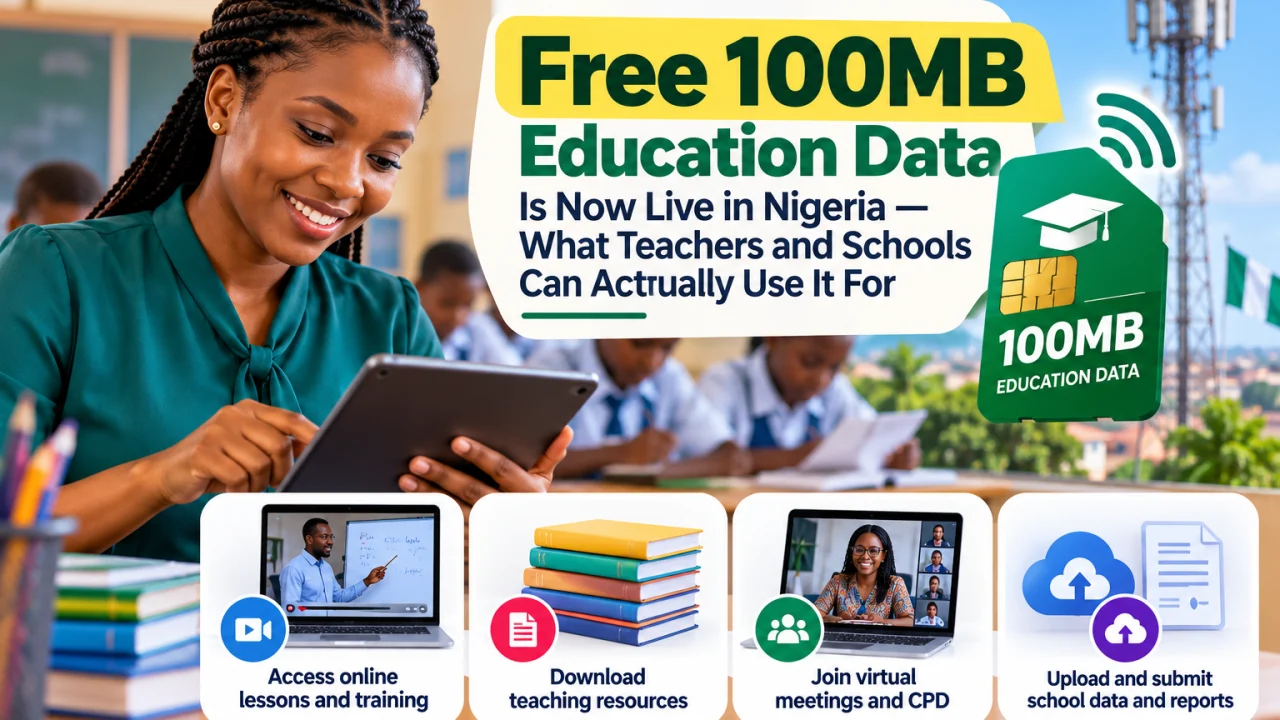
Nigeria’s new free education data programme is now live, but schools should understand one crucial detail before telling pupils and parents that government is giving everyone free internet: the allowance is zero-rated education access, not ordinary mobile data that can be spent on any website or social-media app.
Under the initiative launched by the Nigerian Communications Commission in partnership with the Association of Licensed Telecommunications Operators of Nigeria, eligible users can receive up to 100MB of free data per day for access to designated educational platforms.
At the full allowance, that equals about 700MB a week, roughly 3GB a month and up to 36.5GB over a year. The programme began its operational rollout on October 1.
What the 100MB Can — and Cannot — Be Used For
The allowance applies only when an eligible learner is accessing a platform that has been approved and whitelisted under the initiative. A student cannot receive the 100MB and then spend it freely on entertainment, general browsing or unrelated apps.
The categories the NCC says can qualify include Learning Management Systems, digital libraries, educational repositories, teacher-development platforms and technical or vocational training platforms. Several platforms have already been assessed and whitelisted, and the list is expected to expand over time.
For teachers, that means the scheme could become genuinely useful when assignments, reading materials, revision resources or online lessons are hosted on participating platforms. A homework link placed on an ordinary non-whitelisted site may still consume the learner’s normal data even if the content itself is educational.
The 100MB limit is also more useful for some activities than others. Text pages, PDFs and educational searches generally consume far less data than video. Audio lessons use more, while high-resolution video can exhaust the daily allowance quickly. Schools planning digital homework should therefore think about file size and delivery format rather than assume every kind of online lesson is equally affordable.
The NCC says participating platforms are being encouraged to optimise content for lower data consumption, including reducing unnecessary advertising and designing services so the 100MB carries as much useful learning content as possible.
How Platforms Get Into the Free-Data Ecosystem
The programme is governed jointly by the NCC and the Federal Ministry of Education. Educational platforms must be approved and whitelisted before traffic to them can benefit from the zero-rated allowance.
The framework also requires participating platforms to meet relevant telecommunications, cybersecurity, consumer-protection, child-protection and data-protection expectations. That is particularly important for school platforms handling children’s names, contact details, progress records or learning analytics.
For proprietors and education-technology providers, the opportunity is potentially significant. A school using its own LMS or digital resource library should follow the NCC’s official announcements as the whitelisting process expands rather than simply advertise itself as “free data” without approval.
The NCC estimates that 100MB can support several hours of text-heavy learning activity, while audio or richer media will use the allowance faster. The regulator says usage, service availability, complaints, network performance and compliance will be monitored as the programme develops.
Schools can follow the programme through the NCC’s official zero-rated education announcement. That page is more reliable than messages claiming that users should dial an unknown code or submit personal details to a third-party website to “activate” free data.
The free education data initiative will only become educationally meaningful if schools use it intelligently. Teachers need to know which resources are actually whitelisted, platforms need to keep pages light, and parents need clear guidance that the allowance is restricted to approved learning content.
If those pieces work together, the programme could lower one of the most persistent barriers to digital learning in Nigerian homes: the recurring cost of accessing schoolwork online.




Community Join the conversation Open discussion +