

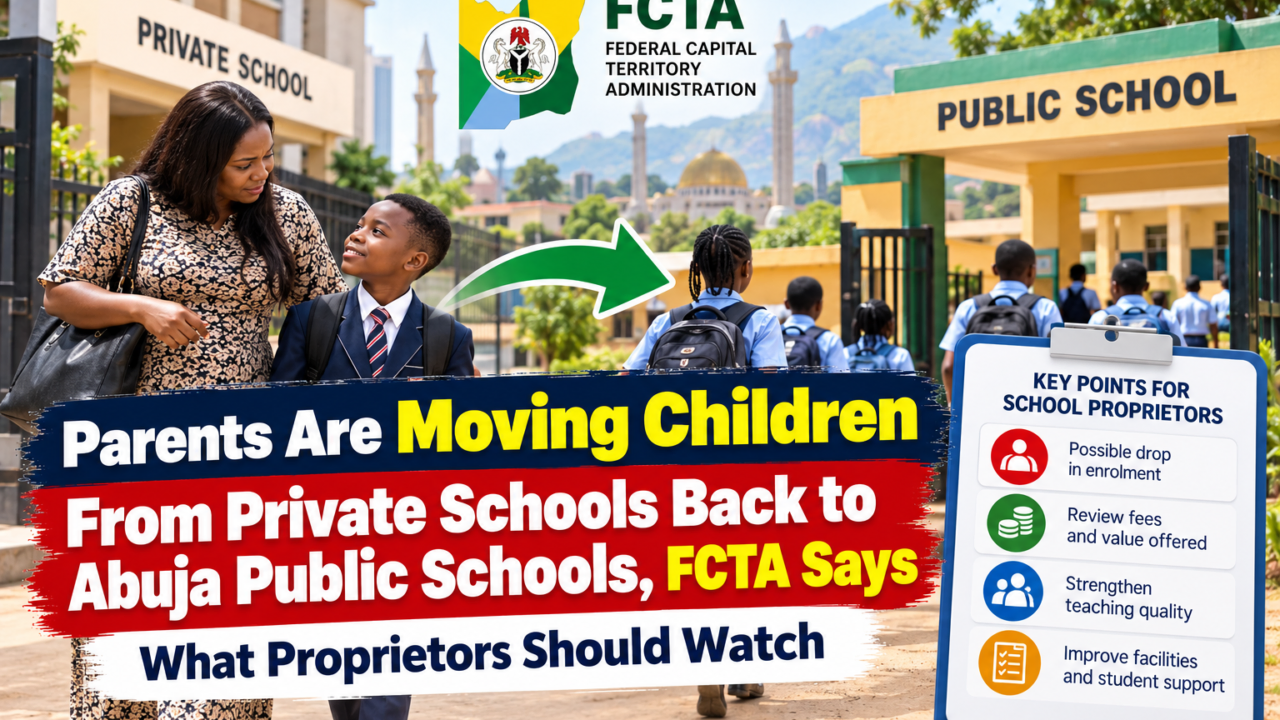
The Federal Capital Territory Administration says enrolment in Abuja public schools is rising sharply, and it has offered a striking explanation: some parents are withdrawing their children from private schools and moving them into government schools.
FCT Education Secretariat Mandate Secretary Dr Danlami Hayyo made the claim after the FCTA Executive Council approved contracts for the procurement and distribution of examination materials to public primary, junior secondary and senior secondary schools across the territory.
According to Hayyo, the additional materials are needed partly because of the increase in FCT public school enrolment. He linked the shift to infrastructure improvements across the public-school system and said parents who previously used private schools are returning their children to public schools.
Infrastructure Is Only Part of the Story
The FCTA’s explanation reflects one side of the change. Public-school renovation can certainly influence parent decisions when classrooms, roads, furniture, sanitation and learning facilities improve. But household economics also matter.
Parents in the FCT have complained this year about rising private-school tuition and additional charges for books, uniforms, transport, development levies and other services. For a family with two or three children, even a moderate increase per child can turn school choice into a major monthly cash-flow decision.
That means a movement from private to public schools should not automatically be interpreted as parents deciding that public schools are academically superior. For some families it may be a positive choice driven by visible improvements; for others it may be a financial adjustment forced by the broader cost of living.
The current claim also needs more detailed public data. The FCTA has said enrolment is increasing, but a stronger assessment would show the scale of the increase by education level, area council, school and year. That would help determine whether the movement is widespread across Abuja or concentrated in particular communities.
The FCT Education Secretariat is responsible for public basic and secondary education through agencies that include the Universal Basic Education Board, Secondary Education Board, Education Resource Centre and Department of Quality Assurance. Its official information can be accessed through the FCT Education Secretariat page.
What Private-School Proprietors Should Learn From the Shift
For private schools, the lesson should not be to panic or immediately cut fees. It is to understand why parents stay, why they leave and what they believe they are paying for.
A proprietor who responds to rising costs by adding fees without clearly explaining the value behind them may discover that parents are comparing the school not only with another private school but with a renovated public school that costs far less.
Schools should be able to explain their value in concrete terms: teacher quality and stability, pupil safety, class size, learning outcomes, communication with parents, special educational support, extracurricular opportunities, examination preparation, transport reliability and the quality of the daily school experience.
Fee transparency matters too. Parents are more likely to resent a school where tuition appears manageable but repeated compulsory charges emerge during the term. A written annual or termly fee schedule gives families a clearer basis for planning and reduces the feeling that they are constantly being billed unexpectedly.
Retention data can reveal problems before they become a crisis. Proprietors should track how many pupils leave each term, the classes with the highest withdrawals and the reasons parents give. If parents repeatedly cite cost, transport, teacher turnover or poor communication, the pattern is more useful than assuming every departure is caused by the economy.
Public schools also face challenges when enrolment rises rapidly. More pupils can mean pressure on classrooms, toilets, teachers, examination materials and supervision. The FCTA’s decision to procure more examination materials is itself evidence that increasing access has operational consequences.
The reported rise in FCT public school enrolment is therefore not a simple victory for one sector over another. It is a signal that families are actively reconsidering the balance between cost and value.
For private-school owners, the safest response is to make the value of the school visible and defensible. For public-school managers, the challenge is to make sure rising enrolment does not erode the improvements that attracted families in the first place.




Community Join the conversation Open discussion +