

Class: Pre-School Level 4
Term: Second Term
Week: 8
Age: 5 years
Duration: 30 minutes
Subject: Civic Education
Curriculum Theme: Civic Education
Previous Lesson: Good Manners
Topic: OBEDIENCE: MEANING AND IMPORTANCE
Subject Matter: GOOD BEHAVIOUR – Obedience – Meaning of Obedience – Importance of Obedience. Weekly focus: Obedience: Meaning and Importance.
Specific Objectives
By the end of the lesson, pupils should be able to:
Cognitive Domain
- Explain the meaning of obedience in simple terms.
- List at least two reasons why obedience is important.
Affective Domain
- Show willingness to obey parents, teachers, and elders.
- Participate actively in discussions about good behaviour.
Psychomotor Domain
- Demonstrate simple acts of obedience by following instructions.
- Point to pictures showing obedient behaviour.
Social Domain
- Interact respectfully with peers and adults during activities.
Reference Materials
- NAPPS National Unified Teaching Scheme for Pre-School Level 4
- Relevant Early Childhood Care and Education resources
Instructional Materials
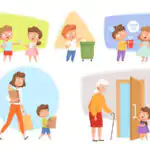
- Posters and Charts showing children obeying and disobeying
- Pictures illustrating different scenarios of obedience (e.g., helping parents, listening to teachers, waiting for turn)
- Storybook with a theme of obedience
- Flashcards with simple instructions (e.g., “Sit down,” “Stand up,” “Clap your hands”)
Rationale for the Lesson
Understanding obedience is crucial for 5-year-olds as it lays the foundation for good behaviour, safety, and respectful interactions within the family, school, and wider community. This lesson helps children learn to follow rules and listen to adults, which promotes a harmonious environment and aids their learning and development.
Prerequisite/Previous Knowledge
Pupils are familiar with basic rules at home and school and have been taught about other good behaviours like greeting and sharing.
Lesson Content/Board Summary
OBEDIENCE: MEANING AND IMPORTANCE
What is Obedience?
Obedience means listening to and following the instructions or rules given by parents, teachers, and other adults. It means doing what you are told to do, especially when it is for your own good or the good of others.
- Listening to Mummy and Daddy.
- Listening to your teacher.
- Following rules at home and at school.
- Doing what elders tell you to do.
Why is Obedience Important?
Obedience is very important because:
- It keeps you safe: When you obey, you avoid danger (e.g., not playing with fire, not running into the road).
- It helps you learn: Listening to teachers helps you learn new things.
- It shows respect: Obeying adults shows that you respect them.
- It makes people happy: When you obey, your parents and teachers are happy.
- It brings peace: When everyone obeys rules, there is peace and order.
Key Words
- Obedience – Listening and following rules.
- Listen – To hear and pay attention to what someone says.
- Rules – Things we must do or not do to stay safe and be good.
- Respect – Showing care and politeness to others, especially adults.
What the Teacher Should Show or Draw
- Display posters or charts showing children obeying (e.g., a child helping a parent, a child sitting quietly in class, a child waiting for their turn).
- Display pictures of children *not* obeying (e.g., a child running away from a parent, a child shouting in class) and discuss the consequences.
Obedience Song
Tune: “Twinkle, Twinkle Little Star”
Listen, listen, every day,
To what Mummy and Daddy say.
Listen to your teachers too,
They help keep you safe and new.
Obey the rules, be good and kind,
Happiness you will always find.
Actions:
- “Listen, listen”: Cup hands to ears.
- “Mummy and Daddy say”: Point to self, then forward.
- “Teachers too”: Point to teacher.
- “Safe and new”: Hug self.
- “Obey the rules”: Nod head.
- “Good and kind”: Thumbs up.
- “Happiness you will always find”: Smile and clap.
How to use the rhyme: Sing the song together with actions after explaining the meaning and importance of obedience. Repeat it several times to help pupils remember the message.
Watch and Practise
The teacher will show a short video about the importance of obedience and following rules for children.
Teaching Methods/Instructional Techniques
Play-based Learning, Demonstration, Guided Practice, Songs and Rhymes, Storytelling, Picture Talk, Question and Answer, Role-play, Repetition, Practical Activity.
Instructional Procedures
Step 1: Introduction
Time: 3 minutes
Teaching Skill: Engagement/Recall
Teacher’s Activity: The teacher greets the pupils and leads them in a simple “Good Morning” song. The teacher then asks pupils about rules they follow at home or in school.
Pupils’ Activity: Pupils respond to greetings, sing along, and share simple rules they know.
Learning Point: Pupils recall prior knowledge of rules and good behaviour.
Step 2: Meaning of Obedience
Time: 5 minutes
Teaching Skill: Explanation/Picture Talk
Teacher’s Activity: The teacher introduces the topic “Obedience.” Using pictures and simple language, the teacher explains that obedience means listening to and following instructions from parents, teachers, and elders. The teacher gives simple examples like “When Mummy says ‘eat your food,’ you eat it.”
Pupils’ Activity: Pupils listen attentively, look at the pictures, and repeat the word “Obedience.” They may share their own examples of listening.
Learning Point: Pupils understand the simple meaning of obedience.
Step 3: Importance of Obedience
Time: 5 minutes
Teaching Skill: Discussion/Problem-solving
Teacher’s Activity: The teacher discusses why obedience is important, linking it to safety, learning, and making people happy. The teacher uses questions like, “What happens if you don’t listen when Mummy says ‘don’t touch the hot pot’?”
Pupils’ Activity: Pupils listen, answer questions, and contribute ideas about why it’s good to obey.
Learning Point: Pupils identify reasons why obedience is important.
Step 4: Rhyme Reinforcement
Time: 4 minutes
Teaching Skill: Song/Movement
Teacher’s Activity: The teacher introduces the “Obedience Song” (as provided in the Lesson Content/Board Summary) and leads the pupils in singing it with actions. The teacher repeats the song several times.
Pupils’ Activity: Pupils sing along with the teacher and perform the actions.
Learning Point: Pupils reinforce the concept of obedience through song and movement.
Step 5: Practical Application and Role-play
Time: 6 minutes
Teaching Skill: Demonstration/Guided Practice
Teacher’s Activity: The teacher gives simple instructions using flashcards (e.g., “Sit down,” “Stand up,” “Clap your hands”) and encourages pupils to follow them. The teacher then sets up simple role-play scenarios, such as “Teacher asks you to pack toys,” or “Mummy asks you to bring her bag.”
Pupils’ Activity: Pupils follow the teacher’s instructions. They participate in the role-play, demonstrating obedient actions.
Learning Point: Pupils practice demonstrating obedience by following instructions and through role-play.
Step 6: Video Reinforcement
Time: 3 minutes
Teaching Skill: Visual Learning
Teacher’s Activity: The teacher plays the selected short video on obedience for children. The teacher encourages pupils to watch and identify obedient actions in the video.
Pupils’ Activity: Pupils watch the video and point out examples of obedience they see.
Learning Point: Pupils reinforce their understanding of obedience through visual examples.
Step 7: Evaluation/Review
Time: 4 minutes
Teaching Skill: Questioning/Assessment
Teacher’s Activity: The teacher checks pupils’ understanding through short questions and practical tasks.
- What does obedience mean?
- Show me with your hands what “listen” means.
- Why is it important to obey your Mummy and Daddy? (Give one reason)
- Point to the picture that shows a child obeying.
Pupils’ Activity: Pupils respond orally and demonstrate the required skill where appropriate.
Learning Point: Pupils demonstrate understanding of the lesson.
Step 8: Conclusion
Time: 1 minute
Teaching Skill: Summary/Encouragement
Teacher’s Activity: The teacher praises the pupils for their participation and reminds them to always be obedient at home and at school. The teacher ends the lesson with a “thank you” song.
Pupils’ Activity: Pupils respond to praise and sing the closing song.
Learning Point: Pupils are encouraged to practice obedience in their daily lives.
Lesson Keywords
- Obedience – Listening and following rules given by adults.
- Listen – To hear and pay attention to what someone says.
- Rules – Important instructions that help us stay safe and behave well.
- Respect – Showing that you value and care for others, especially adults.
Differentiation
- Support: For pupils who struggle, the teacher will use more visual cues (pictures), simpler instructions, and one-on-one repetition. Peer support can also be encouraged.
- Extension: For pupils who grasp the concept quickly, the teacher can ask them to give more examples of obedience at home or school, or discuss simple consequences of disobedience.
Note for teachers using this lesson plan
Before the lesson, ensure you have a variety of clear pictures or posters depicting both obedient and disobedient actions. The key idea for children to grasp is that obedience involves listening and following instructions from trusted adults, and that this keeps them safe and happy. Emphasize positive reinforcement when pupils demonstrate obedience. During the role-play, keep scenarios simple and relatable to their daily lives. Repeat the song and key phrases often to aid memory. Observe pupils’ actions during practical tasks and role-play to assess their understanding, as this is often a better indicator than verbal responses at this age. Encourage pupils to seek help from an adult if they are unsure about an instruction or a rule.
Community Join the conversation Open discussion +