

Class: Senior Secondary School 1 (SS1 / SSS 1)
Term: 1st Term
Week: 12
Age: 15 years
Duration: 45 minutes
Subject: Refrigeration And Air Conditioning
Curriculum Theme: Trade
Previous Lesson: Temperature And Its Measurement: Types of Thermometer and Applications.
Topic: Temperature and its measurement: Temperature scales, conversion
Subject Matter: Temperature scales, Celsius scale, Fahrenheit scale, temperature conversion
Specific Objectives
By the end of the lesson, pupils should be able to:
Cognitive Domain:
- Define temperature and state its common units.
- Identify and describe different temperature scales, including Celsius and Fahrenheit.
- State the formulas for converting between Celsius and Fahrenheit scales.
Affective Domain:
- Appreciate the importance of accurate temperature measurement in refrigeration and air conditioning.
- Show interest in solving temperature conversion problems.
Psychomotor Domain:
- Convert given temperatures from Celsius to Fahrenheit and vice versa.
- Demonstrate the correct use of a thermometer to read temperature.
Social Domain:
- Work collaboratively to solve practical temperature conversion examples.
Reference Materials
The following resources were used in planning this lesson:
- 9 Years Basic Education Curriculum for Senior Secondary Schools.
- State Unified Scheme of Work for Refrigeration and Air Conditioning (SSS 1).
- Introductory Technology for Senior Secondary Schools 1 by J.O. Oriaifo.
- https://www.education.gov.ng/curriculum/
- https://www.waec.org/syllabus
Instructional Materials
The teacher will teach this lesson with the aid of:
- A conversion chart for temperature scales.
- A calculator.
- A laboratory thermometer (Celsius and Fahrenheit).
- A chart board displaying conversion formulas.
- Whiteboard or chalkboard, and markers or chalk.
Rationale for the Lesson
Understanding temperature and its measurement is important for pupils in refrigeration and air conditioning. It helps them to accurately monitor and control equipment, ensuring proper system operation and comfortable environments. This knowledge is essential for practical work and problem-solving in the trade.
Prerequisite/Previous Knowledge
Pupils are assumed to have basic knowledge of heat, energy, and simple measurements from their junior secondary school science classes.
Lesson Content/Board Summary
Temperature and its Measurement
What is Temperature?
Temperature is a measure of the degree of hotness or coldness of a body. It indicates the average kinetic energy of the particles within a substance.
Temperature Scales
A temperature scale is a system for measuring temperature. It defines specific points, such as the freezing and boiling points of water, and divides the interval between them into degrees.
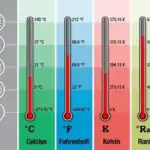
Common temperature scales include:
- Celsius Scale
- Fahrenheit Scale
- Kelvin Scale (Absolute Scale)
Celsius Scale (Centigrade Scale)
The Celsius scale is widely used globally, especially for scientific and everyday measurements. It is named after Anders Celsius.
Characteristics of the Celsius scale:
- The freezing point of water is 0°C.
- The boiling point of water is 100°C.
- The interval between freezing and boiling points is divided into 100 equal parts (degrees).
Fahrenheit Scale
The Fahrenheit scale is primarily used in the United States and some other countries. It is named after Daniel Gabriel Fahrenheit.
Characteristics of the Fahrenheit scale:
- The freezing point of water is 32°F.
- The boiling point of water is 212°F.
- The interval between freezing and boiling points is divided into 180 equal parts (degrees).
Temperature Conversion Formulas
Conversion between Celsius and Fahrenheit scales is often required in refrigeration and air conditioning.
The formulas are:
- To convert Celsius (°C) to Fahrenheit (°F):
F = (C × 9/5) + 32 - To convert Fahrenheit (°F) to Celsius (°C):
C = (F – 32) × 5/9
Steps for Temperature Conversion
To convert temperature from one scale to another, follow these steps:
- Identify the given temperature and its scale.
- Identify the target temperature scale.
- Select the correct conversion formula.
- Substitute the given temperature value into the formula.
- Perform the calculation carefully to get the converted temperature.
Importance of Temperature Measurement in Refrigeration and Air Conditioning
Accurate temperature measurement is important for:
- Monitoring and controlling the operating conditions of refrigerators, freezers, and air conditioners.
- Diagnosing faults in cooling systems.
- Ensuring food preservation and safety in cold storage units.
- Maintaining comfortable indoor environments.
- Checking the efficiency and performance of refrigeration equipment.
Teaching Methods/Instructional Techniques
Discussion, Lecture, Demonstration, Question and Answer, Visual Aids
Instructional Procedures
Step 1: Introduction
Time: 5 minutes
Teaching Skill: Set Induction
Teacher’s Activity: The teacher greets the pupils and asks them what they understand by “hotness” and “coldness,” and how these are measured. The teacher then introduces the topic of temperature and its measurement, linking it to everyday experiences and the subject of Refrigeration and Air Conditioning.
Pupils’ Activity: Pupils respond to the questions and listen attentively to the introduction.
Learning Point: Pupils are prepared for the lesson and recall prior knowledge related to the topic.
Step 2: Presentation of Temperature
Time: 5 minutes
Teaching Skill: Explanation/Definition
Teacher’s Activity: The teacher defines temperature, explaining it as the degree of hotness or coldness of a body. The teacher also explains that temperature is measured using a thermometer.
Pupils’ Activity: Pupils listen, take notes, and ask questions for clarification.
Learning Point: Pupils understand the definition of temperature.
Step 3: Introduction of Temperature Scales
Time: 5 minutes
Teaching Skill: Elucidation/Listing
Teacher’s Activity: The teacher explains that different scales are used to measure temperature and introduces the common scales: Celsius, Fahrenheit, and Kelvin. The teacher displays a chart showing these scales.
Pupils’ Activity: Pupils observe the chart, listen, and identify the different temperature scales.
Learning Point: Pupils identify common temperature scales.
Step 4: Explanation of Celsius Scale
Time: 7 minutes
Teaching Skill: Description/Illustration
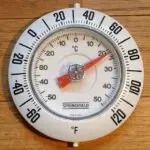
Teacher’s Activity: The teacher describes the Celsius scale, stating its freezing point (0°C) and boiling point (100°C) of water. The teacher shows a thermometer marked in Celsius and explains its use.
Pupils’ Activity: Pupils observe the thermometer, listen to the explanation, and take notes.
Learning Point: Pupils understand the characteristics of the Celsius scale.
Step 5: Explanation of Fahrenheit Scale
Time: 7 minutes
Teaching Skill: Description/Comparison
Teacher’s Activity: The teacher describes the Fahrenheit scale, stating its freezing point (32°F) and boiling point (212°F) of water. The teacher compares it with the Celsius scale and shows a thermometer marked in Fahrenheit.
Pupils’ Activity: Pupils observe, listen, and note the key differences and similarities between Celsius and Fahrenheit scales.
Learning Point: Pupils understand the characteristics of the Fahrenheit scale.
Step 6: Explanation of Temperature Conversion
Time: 10 minutes
Teaching Skill: Demonstration/Application
Teacher’s Activity: The teacher introduces the formulas for converting Celsius to Fahrenheit and Fahrenheit to Celsius. The teacher demonstrates conversion with simple examples on the board, encouraging pupils to use their calculators.
Example 1: Convert 25°C to °F.
F = (25 × 9/5) + 32 = (5 × 9) + 32 = 45 + 32 = 77°F
Example 2: Convert 68°F to °C.
C = (68 – 32) × 5/9 = 36 × 5/9 = 4 × 5 = 20°C
Pupils’ Activity: Pupils copy the formulas, follow the examples, and practice solving conversion problems with the teacher.
Learning Point: Pupils learn how to apply conversion formulas.
Step 7: Evaluation/Review
Time: 5 minutes
Teaching Skill: Questioning/Assessment
Teacher’s Activity: The teacher evaluates the learning by asking the following questions:
- Define temperature.
- Mention two common temperature scales.
- State the freezing point of water in Celsius and Fahrenheit scales.
- State the formula for converting temperature from Celsius to Fahrenheit.
- Convert 30°C to Fahrenheit.
Pupils’ Activity: Pupils answer orally and in writing.
Learning Point: Pupils demonstrate understanding of the lesson.
Step 8: Conclusion
Time: 1 minute
Teaching Skill: Summarization
Teacher’s Activity: The teacher summarizes the key points of the lesson, reiterating the importance of temperature measurement and conversion in Refrigeration and Air Conditioning. The teacher assigns homework: “Convert 95°F to Celsius and 10°C to Fahrenheit.”
Pupils’ Activity: Pupils listen to the summary and copy the homework.
Learning Point: The lesson is concluded, and pupils are given a task to reinforce their learning.
Lesson Keywords
- Temperature – The degree of hotness or coldness of a body.
- Celsius Scale – A temperature scale where water freezes at 0°C and boils at 100°C.
- Fahrenheit Scale – A temperature scale where water freezes at 32°F and boils at 212°F.
- Conversion – The process of changing a value from one unit or scale to another.
- Thermometer – An instrument used for measuring temperature.
Differentiation
For pupils who grasp concepts quickly, the teacher will provide more complex conversion problems or introduce the Kelvin scale and its conversions. For pupils who need additional support, the teacher will provide simplified examples, one-on-one guidance, and allow more time for practice with the conversion chart and calculator.
Note for teachers using this lesson plan
Ensure that all instructional materials, especially the conversion chart and thermometers, are clearly visible and accessible to all pupils. Encourage active participation and allow pupils to work in pairs or small groups for conversion exercises to foster collaborative learning. Emphasize the practical relevance of temperature measurement in real-world scenarios related to refrigeration and air conditioning.

Community Join the conversation Open discussion +