

Class: Senior Secondary School 1 (SS1, SS 1, SSS1, SSS 1)
Term: 3rd Term
Week: 9
Age: 15 years
Duration: 45 minutes
Subject: Music
Curriculum Theme: Music
Previous Lesson: Nigerian and Western Dance Styles: Traditional and Social Dance Features.
Topic: Pre-colonial African Music (Nigerian). Nigerian Traditional Instruments.
Subject Matter: Pre-colonial African music in Nigeria, Nigerian traditional instruments, listing indigenous instruments, ensemble performance using traditional instruments.
Specific Objectives
By the end of the lesson, pupils should be able to:
Cognitive Domain:
- Define pre-colonial Nigerian music.
- List at least ten indigenous Nigerian musical instruments.
- Identify the main classifications of traditional musical instruments.
Affective Domain:
- Appreciate the cultural significance of pre-colonial Nigerian music.
- Show interest in learning about and preserving traditional Nigerian musical heritage.
Psychomotor Domain:
- Correctly identify different traditional Nigerian musical instruments when presented with samples or pictures.
- Participate in a simple ensemble performance using traditional instruments as guided.
Social Domain:
- Collaborate effectively with peers during an ensemble performance.
Reference Materials
The following resources were used in planning this lesson:
- Senior Secondary Education Curriculum for Music.
- State Unified Scheme of Work for Senior Secondary Schools.
- Comprehensive Music for Senior Secondary Schools by A.O. Adegoke.
- Online resources on Nigerian traditional music and instruments.
Instructional Materials
The teacher will teach this lesson with the aid of:
- Samples or pictures of indigenous Nigerian musical instruments (e.g., Gangan, Sekere, Ogene, Flute, Kakaki).
- Drums and shakers for practical demonstration.
- An open space suitable for ensemble practice.
Rationale for the Lesson
Understanding pre-colonial Nigerian music helps pupils appreciate the rich cultural heritage and diversity of their country’s musical traditions. This lesson enables pupils to connect with their roots and recognize the importance of preserving indigenous musical instruments and practices in contemporary society.
Prerequisite/Previous Knowledge
Pupils are assumed to have basic knowledge of music elements and a general awareness of Nigerian cultural practices.
Lesson Content/Board Summary
Pre-colonial African Music in Nigeria and Traditional Instruments
Introduction to Pre-colonial Nigerian Music
Pre-colonial Nigerian music refers to the musical practices that existed in various Nigerian communities before the arrival of colonial powers. This music was deeply integrated into the daily lives, rituals, and social functions of the people.
The following are characteristics of pre-colonial Nigerian music:
- It was largely an oral tradition, passed down through generations.
- It was functional, often serving specific purposes like religious ceremonies, festivals, work, and social gatherings.
- It was communal, involving active participation from the community.
- It was diverse, reflecting the various ethnic groups and their unique cultures.
- It often combined music with dance, drama, and storytelling.
Nigerian Traditional Musical Instruments
Nigerian traditional instruments are classified based on how they produce sound. The main classifications are:
- Aerophones: Instruments that produce sound by vibrating a column of air. Examples include:
- Flute (e.g., Oja from Igbo, Sarewa from Hausa)
- Trumpet (e.g., Kakaki from Hausa)
- Horn (e.g., Odu from Igbo)
- Chordophones: Instruments that produce sound from the vibration of a string or strings. Examples include:
- Lute (e.g., Goge from Hausa, Goje from Yoruba)
- Zither (e.g., Molo from Hausa)
- Membranophones: Instruments that produce sound from the vibration of a stretched membrane (animal skin). Examples include:
- Talking Drum (e.g., Gangan, Dundun from Yoruba)
- Bata Drum (from Yoruba)
- Udu (from Igbo)
- Idiophones: Instruments that produce sound from the vibration of their own body, without the use of strings, membranes, or air. Examples include:
- Shaker (e.g., Sekere from Yoruba, Maraca)
- Slit Drum (e.g., Ekwe from Igbo)
- Bell (e.g., Ogene from Igbo, Agogo from Yoruba)
- Xylophone (e.g., Akpele from Igbo)
At least ten indigenous Nigerian musical instruments include: Gangan, Sekere, Ogene, Oja, Kakaki, Goge, Bata Drum, Ekwe, Udu, Molo.
Ensemble Performance with Traditional Instruments
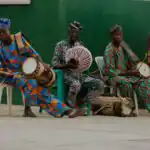
An ensemble in traditional Nigerian music refers to a group of musicians performing together using various indigenous instruments. The performance is usually coordinated, with each instrument playing a specific role (e.g., lead rhythm, accompaniment, melodic line) to create a harmonious and rhythmic sound. Ensemble performances are common in festivals, ceremonies, and social events.
Teaching Methods/Instructional Techniques
Discussion, Lecture, Demonstration, Question and Answer, Visual Aids, Practical Activity.
Instructional Procedures
Step 1: Introduction
Time: 5 minutes
Teaching Skill: Set Induction
Teacher’s Activity: The teacher greets the pupils and asks them to recall any traditional musical instruments they have seen or heard played in their communities or during cultural events. The teacher then introduces the topic: Pre-colonial African Music (Nigerian) and Nigerian Traditional Instruments.
Pupils’ Activity: Pupils respond to the teacher’s questions and listen attentively to the topic introduction.
Learning Point: Pupils connect with the topic through their prior experiences and are prepared for the lesson.
Step 2: Explanation of Pre-colonial Nigerian Music
Time: 10 minutes
Teaching Skill: Explanation/Lecture
Teacher’s Activity: The teacher defines pre-colonial Nigerian music and explains its characteristics, emphasizing its functional, communal, and diverse nature. The teacher uses examples from different Nigerian ethnic groups.
Pupils’ Activity: Pupils listen, take notes, and ask questions for clarification.
Learning Point: Pupils understand the definition and key features of pre-colonial Nigerian music.
Step 3: Identification of Traditional Instruments
Time: 10 minutes
Teaching Skill: Demonstration/Identification
Teacher’s Activity: The teacher displays samples or pictures of various indigenous Nigerian musical instruments (e.g., Gangan, Sekere, Ogene, Oja, Kakaki). The teacher names each instrument and briefly explains its origin or use.
Pupils’ Activity: Pupils observe the instruments, identify them by name, and note their features.
Learning Point: Pupils identify and recognize several indigenous Nigerian musical instruments.
Step 4: Discussion of Instrument Classification
Time: 5 minutes
Teaching Skill: Classification/Explanation
Teacher’s Activity: The teacher explains the four main classifications of traditional musical instruments (aerophones, chordophones, membranophones, idiophones) and guides pupils to classify the previously identified instruments into their respective categories.
Pupils’ Activity: Pupils participate in classifying the instruments and consolidate their understanding of instrument types.
Learning Point: Pupils understand how traditional instruments are classified.
Step 5: Ensemble Performance Introduction
Time: 5 minutes
Teaching Skill: Explanation/Preparation
Teacher’s Activity: The teacher explains what an ensemble performance is in the context of traditional Nigerian music and describes the roles different instruments play within an ensemble. The teacher prepares pupils for a practical session.
Pupils’ Activity: Pupils listen and prepare for the practical activity, understanding the concept of an ensemble.
Learning Point: Pupils grasp the concept and importance of ensemble playing in traditional music.
Step 6: Ensemble Practice
Time: 5 minutes
Teaching Skill: Practical/Demonstration
Teacher’s Activity: The teacher distributes available instruments (e.g., drums, shakers) or guides pupils to use imaginary instruments. The teacher leads a simple rhythmic ensemble practice, demonstrating basic patterns.
Pupils’ Activity: Pupils participate in the ensemble practice, attempting to play the instruments or mimic the actions as guided by the teacher.
Learning Point: Pupils gain practical experience in ensemble performance and collaboration.
Step 7: Evaluation/Review
Time: 5 minutes
Teaching Skill: Questioning/Assessment
Teacher’s Activity: The teacher evaluates the learning by asking the following questions:
- Define pre-colonial Nigerian music.
- List five characteristics of pre-colonial Nigerian music.
- Mention five indigenous Nigerian musical instruments and state their classification.
- Explain the meaning of an ensemble performance in traditional music.
Pupils’ Activity: Pupils answer orally and in writing.
Learning Point: Pupils demonstrate understanding of the lesson.
Step 8: Conclusion
Time: 5 minutes
Teacher’s Activity: The teacher summarizes the key points of the lesson, reiterating the importance of Nigerian traditional music and instruments. The teacher encourages pupils to explore more about their local musical heritage and assigns homework to research another five indigenous instruments.
Pupils’ Activity: Pupils listen to the summary and note down the homework assignment.
Learning Point: Pupils consolidate their learning and are encouraged to continue their exploration of traditional music.
Lesson Keywords
- Pre-colonial music – Music created and performed before the influence of colonial powers.
- Indigenous instruments – Musical instruments native to a particular region or culture.
- Aerophones – Instruments that produce sound by vibrating a column of air (e.g., flute, trumpet).
- Chordophones – Instruments that produce sound from vibrating strings (e.g., lute, zither).
- Membranophones – Instruments that produce sound from a vibrating stretched membrane (e.g., drums).
- Idiophones – Instruments that produce sound from the vibration of their own body (e.g., shakers, bells).
- Ensemble – A group of musicians performing together.
Differentiation
For pupils who grasp concepts quickly, the teacher can encourage them to identify instruments from different ethnic groups or to lead a section of the ensemble practice. For pupils who need more support, the teacher can provide simplified explanations, visual aids, or pair them with a peer for collaborative learning during instrument identification.
Note for teachers using this lesson plan
Teachers should adapt the lesson to suit the specific needs and resources available in their school environment. Emphasize practical engagement with instruments where possible to enhance learning. Encourage pupils to bring pictures or information about instruments from their own communities.


Community Join the conversation Open discussion +