

Class: Primary 6
Term: 2nd Term
Week: 1
Age: 11 years
Duration: 45 minutes
Subject: English Language Studies
Curriculum Theme: English Language Studies
Previous Lesson: .
Topic: Aural identification of vowels, synonyms, newspaper comprehension on national issues, letter types and informal letter concept
Subject Matter: Speech — aural identification of vowel sounds /æ/, /a:/, /ↄ:/, /ʌ/, Vocabulary Development — word formation through synonyms and sentence use, Comprehension — reading newspapers on important national issues, Writing/Continuous Writing — simple compositions for different purposes and letter types with focus on informal letters
Specific Objectives
By the end of the lesson, pupils should be able to:
Cognitive Domain:
- Identify the vowel sounds /æ/, /a:/, /ↄ:/, /ʌ/ when pronounced.
- Define synonyms and give examples.
- Explain the importance of reading newspapers for national issues.
- Identify different types of letters and explain the concept of an informal letter.
Affective Domain:
- Appreciate the importance of correct pronunciation in communication.
- Show interest in expanding their vocabulary through synonyms.
- Value reading newspapers to stay informed about national events.
- Develop a positive attitude towards writing informal letters for personal communication.
Psychomotor Domain:
- Produce the vowel sounds /æ/, /a:/, /ↄ:/, /ʌ/ correctly.
- Form sentences using synonyms effectively.
- Read and extract key information from newspaper articles on national issues.
- Outline the features of an informal letter.
Social Domain:
- Share information and discuss national issues from newspaper readings with classmates.
- Engage in peer-to-peer activities to practice pronunciation and vocabulary.
Reference Materials
The following resources were used in planning this lesson:
- 9 Years Basic Education Curriculum for Primary Schools.
- State Unified Scheme of Work for Primary 6 English Language.
- New Oxford Primary English Course for Primary 6.
- Oral English manual.
- Essay manual.
- Textbook and workbook.
- Links for Reference materials: https://nigeriancurriculum.com/primary-6-english-language-studies-curriculum/
Instructional Materials
The teacher will teach this lesson with the aid of:
- English Language Textbook for Primary 6.
- English Language Workbook for Primary 6.
- Oral English manual.
- Sound recorder/audio player with examples of vowel sounds.
- Essay manual.
- Old newspapers with articles on national issues.
- Whiteboard and markers.
Rationale for the Lesson
This lesson helps pupils to improve their pronunciation and expand their vocabulary, which are important for clear communication. It also encourages them to read newspapers to understand national issues, making them more informed citizens, and teaches them how to write informal letters for personal use.
Prerequisite/Previous Knowledge
Pupils have basic knowledge of English sounds, words, and simple sentence construction. They can also read short passages and identify main ideas.
Lesson Content/Board Summary
English Language Studies
Speech: Aural Identification of Vowel Sounds (/æ/, /a:/, /ↄ:/, /ʌ/)
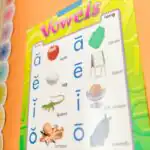
Vowel sounds are speech sounds produced with an open vocal tract, allowing air to flow out freely without obstruction. Identifying these sounds correctly is important for clear pronunciation.
The following are some common vowel sounds:
- /æ/ (as in ‘cat’, ‘man’): This is a short ‘a’ sound. The mouth is usually wide open, and the tongue is flat.
- /a:/ (as in ‘car’, ‘father’): This is a long ‘a’ sound. The mouth is open, and the tongue is low and back.
- /ↄ:/ (as in ‘ball’, ‘walk’): This is a long ‘o’ sound. The lips are rounded, and the tongue is low and back.
- /ʌ/ (as in ‘cup’, ‘sun’): This is a short ‘u’ sound. The mouth is slightly open, and the tongue is central.
Vocabulary Development: Synonyms
Synonyms are words that have similar or nearly the same meaning as another word. Using synonyms helps to make writing and speaking more varied and interesting.
Examples of synonyms:
- Happy – Joyful
- Big – Large
- Start – Begin
- Quick – Fast
- Beautiful – Pretty
Using synonyms in sentences:
- The boy was happy. The boy was joyful.
- That is a big house. That is a large house.
Comprehension: Reading Newspapers on National Issues
Newspapers are important sources of information about current events and issues affecting the country. Reading newspapers helps pupils to:
- Stay informed about national events.
- Improve reading comprehension skills.
- Expand vocabulary.
- Develop critical thinking about societal issues.
An important national issue is the fight against counterfeiting of drugs and regulated products. This involves government agencies working to stop the production and sale of fake goods, especially medicines, to protect the health and safety of citizens.
Writing/Continuous Writing: Letter Types and Informal Letters
A letter is a written message from one person to another. Letters are used for various purposes, including personal communication, official requests, and sharing information.
The two main types of letters are:
- Formal Letters: Written for official purposes, often to people in positions of authority or to organizations.
- Informal Letters: Written to friends, family members, or close acquaintances for personal communication.
Informal Letters:
An informal letter is a personal letter written to someone you know well. It uses a casual and friendly tone. The main purpose is to share news, ask about someone’s well-being, or invite them to an event.
Key features of an informal letter:
- Sender’s Address: Your address, usually at the top right corner.
- Date: The date the letter is written, placed below the sender’s address.
- Salutation: A friendly greeting, e.g., “Dear [Name of friend/family member]”.
- Body: The main content of the letter, written in paragraphs, discussing personal matters.
- Complimentary Close: A friendly closing phrase, e.g., “Yours sincerely,” “Lots of love,” “Best regards.”
- Signature: Your first name or full name, written below the complimentary close.
Teaching Methods/Instructional Techniques
Discussion, Lecture, Demonstration, Question and Answer, Visual Aids
Instructional Procedures
Step 1: Introduction
Time: 5 minutes
Teaching Skill: Set Induction
Teacher’s Activity: The teacher greets the pupils and introduces the day’s lesson by asking them about sounds they hear and words that mean the same thing. The teacher also asks if anyone has read a newspaper recently or written a letter to a friend.
Pupils’ Activity: Pupils respond to the teacher’s questions and share their experiences.
Learning Point: Pupils are prepared for the lesson and connect new information to prior knowledge.
Step 2: Aural Identification of Vowel Sounds
Time: 10 minutes
Teaching Skill: Demonstration/Drilling
Teacher’s Activity: The teacher pronounces each vowel sound (/æ/, /a:/, /ↄ:/, /ʌ/) clearly, providing example words for each. The teacher then guides the pupils to produce the sounds correctly, correcting any errors. A sound recorder may be used to play examples.
Pupils’ Activity: Pupils listen attentively, repeat the sounds and words after the teacher, and practice pronouncing them individually and in groups.
Learning Point: Pupils learn to identify and correctly pronounce the target vowel sounds.
Step 3: Vocabulary Development — Synonyms
Time: 8 minutes
Teaching Skill: Explanation/Activity
Teacher’s Activity: The teacher defines synonyms and provides several examples. The teacher then guides pupils to identify synonyms for given words and to use them in simple sentences on the board.
Pupils’ Activity: Pupils identify synonyms, contribute examples, and form sentences using the identified synonyms.
Learning Point: Pupils understand what synonyms are and how to use them to enrich their language.
Step 4: Comprehension — Reading Newspapers on National Issues
Time: 10 minutes
Teaching Skill: Guided Reading/Discussion
Teacher’s Activity: The teacher displays old newspapers and explains the importance of reading them for information on national issues like fighting counterfeiting of drugs. The teacher guides pupils to read selected headlines or short articles and discuss key points.
Pupils’ Activity: Pupils bring old newspapers, read headlines or short articles, identify national issues, and share important information they found with the class.
Learning Point: Pupils develop an understanding of national issues and improve their reading comprehension.
Step 5: Writing/Continuous Writing — Letter Types and Informal Letter Concept
Time: 7 minutes
Teaching Skill: Explanation/Questioning
Teacher’s Activity: The teacher introduces the concept of letters and explains the two main types: formal and informal. The teacher then focuses on informal letters, explaining their purpose and general idea.
Pupils’ Activity: Pupils listen to the explanation, ask questions for clarification, and discuss the differences between formal and informal letters.
Learning Point: Pupils understand the concept of letters and the specific purpose of informal letters.
Step 6: Features of an Informal Letter
Time: 5 minutes
Teaching Skill: Explanation/Illustration
Teacher’s Activity: The teacher explains and writes the key features of an informal letter (sender’s address, date, salutation, body, complimentary close, signature) on the board, illustrating with a simple example.
Pupils’ Activity: Pupils copy the features into their notebooks and ask questions about each part.
Learning Point: Pupils learn the correct structure and components of an informal letter.
Step 7: Evaluation/Review
Time: 5 minutes
Teaching Skill: Questioning/Assessment
Teacher’s Activity: The teacher evaluates the learning by asking the following questions:
- Pronounce the vowel sounds /æ/, /a:/, /ↄ:/, /ʌ/ correctly.
- What are synonyms?
- Give two examples of synonyms and use them in sentences.
- Mention two reasons why reading newspapers is important.
- State the main purpose of an informal letter.
- List three features of an informal letter.
Pupils’ Activity: Pupils answer orally and in writing.
Learning Point: Pupils demonstrate understanding of the lesson.
Step 8: Conclusion
Time: 2 minutes
Teaching Skill: Summarization
Teacher’s Activity: The teacher briefly summarizes the key points of the lesson, emphasizing the importance of clear pronunciation, rich vocabulary, being informed citizens, and effective personal communication. The teacher assigns homework: write an informal letter to a friend describing a recent event.
Pupils’ Activity: Pupils listen to the summary and copy down the homework assignment.
Learning Point: Pupils consolidate their learning and apply it to a practical task.
Home Task: Write four correct English sentences that demonstrate the main language skill in Aural identification of vowels, synonyms, newspaper comprehension on national issues, letter types….
Lesson Keywords
- Vowel Sounds – Speech sounds produced with an open vocal tract.
- Synonyms – Words with similar or nearly the same meaning.
- Comprehension – The ability to understand what is read or heard.
- National Issues – Important problems or topics affecting a whole country.
- Letter Types – Different categories of written messages (e.g., formal, informal).
- Informal Letter – A personal letter written to friends or family.
- Counterfeiting – The illegal act of making exact copies of something, often to deceive.
Differentiation
For pupils who grasp concepts quickly, the teacher will encourage them to find more synonyms and use them in complex sentences, or to identify and discuss other national issues from the newspaper. For pupils needing extra support, the teacher will provide additional drills for vowel sounds, simpler synonym pairs, and more direct guidance in identifying key information from newspaper articles and structuring an informal letter.
Note for teachers using this lesson plan
Ensure you have access to a sound recorder or can clearly model the vowel sounds. Encourage pupils to bring old newspapers from home to make the comprehension section more interactive. Emphasize the practical application of writing informal letters for personal communication. Provide constructive feedback on pronunciation and written work.



Community Join the conversation Open discussion +