

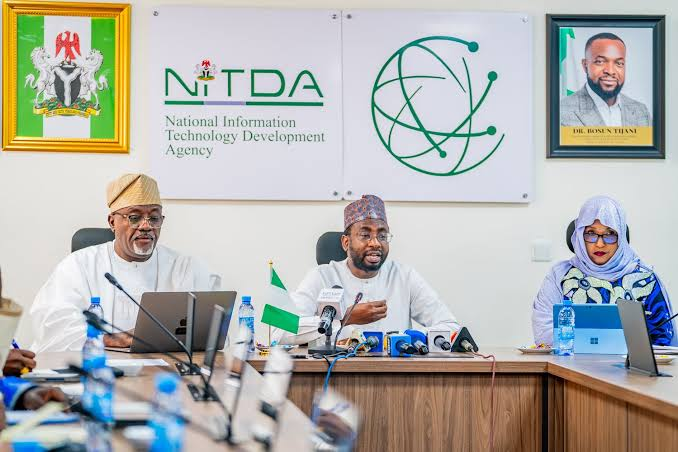
The National Information Technology Development Agency has warned Nigerians against entering sensitive personal or organisational information into public artificial-intelligence platforms, as the use of tools such as ChatGPT, Gemini, Claude, Copilot and Meta AI expands across schools, workplaces and homes.
In its NITDA AI warning, the agency said users were increasingly turning to AI systems for schoolwork, business tasks, job applications, health questions and other everyday activities without always understanding what may happen to information entered into the platforms.
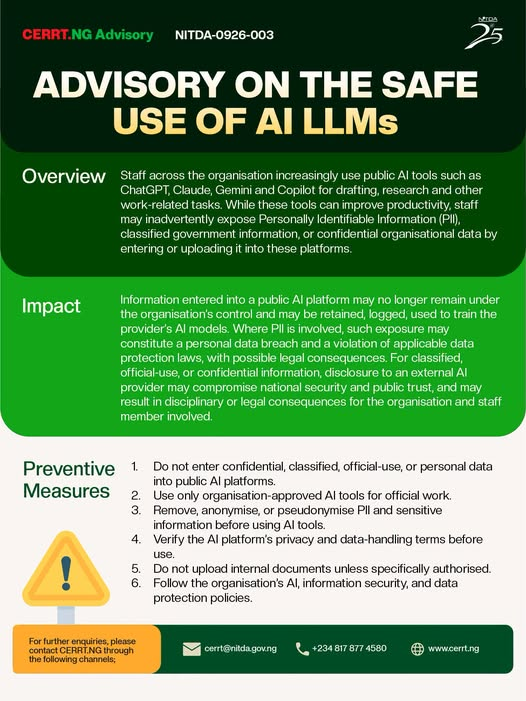
NITDA specifically cautioned against sharing identification numbers such as NIN and BVN, bank information, photographs, medical results and other sensitive personal data.
The agency said information submitted to an AI service may be retained or logged and, depending on the provider and account settings, may be used in ways that place the information outside the user’s direct control.
It warned that leaked or improperly exposed personal information could contribute to identity theft, impersonation or financial fraud.
NITDA also raised a second risk that is particularly relevant to education: AI systems can produce answers that sound confident even when they are inaccurate, incomplete or outdated. The agency said users should verify AI-generated information before relying on it in academic, medical, legal or financial decisions.
The regulator advised users to remove, anonymise or pseudonymise personally identifiable information before submitting material to AI tools and to review the privacy and data-handling terms of the service being used.
It also told users not to upload internal documents unless they have been specifically authorised to do so.
Although the advisory was issued to the general public rather than schools alone, its scope directly covers common school uses of AI. Pupil records, identifiable assessment spreadsheets, medical information, safeguarding reports, staff files and parent details can all contain the kinds of personal or internal information NITDA says should not be casually uploaded to public AI services.
The agency went beyond individual behaviour and called on organisations to establish AI governance or AI transformation policies that identify approved tools, permitted uses, data-handling rules and who is responsible for AI-related decisions.
That recommendation is significant for schools where teachers may already be using different AI services independently for lesson planning, report writing, assessment design or administrative work even when the school has no formal policy.
NITDA’s public message reduced the guidance to three basic rules: do not share sensitive data with AI, anonymise prompts and verify AI answers. Its campaign slogan is “Think Before You Prompt.”
The advisory does not ban the use of AI for education or work. It instead places responsibility on users and organisations to decide what information is safe to submit and to avoid treating an AI platform as a private filing cabinet for confidential records.




Community Join the conversation Open discussion +