

Class: Senior Secondary School 1 (SS1, SS 1, SSS1, SSS 1)
Term: 3rd Term
Week: 2
Age: 15 years
Duration: 45 minutes
Subject: Government
Curriculum Theme: Government
Previous Lesson: Citizenship.
Topic: Political Party
Subject Matter: meaning of political party, organisation of political party, types of political parties, functions of political party
Specific Objectives
By the end of the lesson, pupils should be able to:
Cognitive Domain:
- Define political party.
- Describe the organisation/structure of a political party.
- Identify types of political parties.
- List and explain functions of political parties.
- Mention examples of political parties in Nigeria.
Affective Domain:
- Show respect for differing political opinions and choices.
- Demonstrate interest in peaceful political participation and democratic values.
Psychomotor Domain:
- Draw a simple organisational chart of a political party.
- Sort given examples into correct types of political parties using a class chart.
Social Domain:
- Work cooperatively in groups to discuss party functions and present findings.
- Participate in a guided class discussion without harassment or insults.
Reference Materials
The following resources were used in planning this lesson:
- 9 Years Basic Education Curriculum
- State Unified Scheme of Work
- Anyaele, J. U. Comprehensive Government for Senior Secondary Schools (relevant edition)
- Britannica: Political Party (Definition, Types, Functions)
- International IDEA: Political Parties (Overview and Resources)
- UNDP Democratic Governance Reader (Political Parties and Democracy)
Instructional Materials
The teacher will teach this lesson with the aid of:
- Charts of party structures and party systems
- Election posters and sample campaign materials
- Newspaper samples (political news pages)
- Flashcards showing party names and symbols
- Whiteboard/marker or chalkboard/chalk
Rationale for the Lesson
Political parties influence how leaders are chosen and how government policies are made. Understanding political parties helps pupils to follow elections, make informed choices, and participate responsibly in society.
Prerequisite/Previous Knowledge
Pupils have basic knowledge of government, elections, leadership, and voting from previous lessons and civic activities.
Lesson Content/Board Summary
Political Party
Meaning of Political Party
A political party is an organised group of people with similar political ideas that seeks to win elections and control government in order to carry out its policies.
Organisation of a Political Party
A political party is organised with leaders and offices at different levels to plan activities, select candidates, and manage members.
The following are common organs/units in the organisation of a political party:
- National executive committee (top leadership and decision-making)
- State executive committee (party leadership at state level)
- Local government/ward executives (grassroots organisation and mobilisation)
- Party congress/convention (meeting where major decisions and elections of party officers may occur)
- Party secretariat (administrative office for records, communication, and coordination)
- Party caucus/committees (special groups for planning, discipline, finance, and campaigns)
Types of Political Parties
Political parties can be classified based on the number of major parties or the way they operate in a state.
The following are types of political parties (party systems):
- One-party system (only one legal party or one dominant party controls politics)
- Two-party system (two major parties dominate politics and alternate in power)
- Multi-party system (many parties compete for power and may form coalitions)
Functions of Political Parties
Political parties perform key roles in democratic government and political development.
The following are functions of political parties:
- Recruitment and training of leaders (prepares candidates for public offices)
- Contest elections (presents candidates and campaigns for votes)
- Formation of government (party with majority forms government or joins coalition)
- Policy formulation (develops programmes and manifestos to guide governance)
- Political education (educates citizens on governance, rights, and responsibilities)
- Representation of interests (channels the needs of groups and regions to government)
- Link between government and the people (helps communication and feedback)
- Opposition and accountability (criticises government policies and checks abuses)
Examples of Political Parties in Nigeria
Political parties in Nigeria participate in elections and present candidates for offices.
The following are examples of political parties in Nigeria:
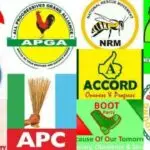
- All Progressives Congress (APC)
- People’s Democratic Party (PDP)
- Labour Party (LP)
- New Nigeria Peoples Party (NNPP)
- All Progressives Grand Alliance (APGA)
Differences Between a Political Party and a Pressure Group
A political party aims to win elections and control government, while a pressure group seeks to influence government decisions without contesting elections as a party.
Teaching Methods/Instructional Techniques
Discussion, Lecture, Demonstration, Question and Answer, Visual Aids
Instructional Procedures
Step 1: Introduction
Time: 5 minutes
Teaching Skill: Set Induction
Teacher’s Activity: The teacher displays election posters/newspaper headlines and asks pupils what elections are and why people join groups to contest elections. The teacher introduces the topic as political parties.
Pupils’ Activity: Pupils respond by describing elections and mentioning that candidates belong to parties.
Learning Point: Political parties are part of the electoral process and governance.
Step 2: Meaning of Political Party
Time: 7 minutes
Teaching Skill: Explanation
Teacher’s Activity: The teacher explains the meaning of political party and writes a clear definition on the board. The teacher gives simple examples of party activities such as campaigns and manifesto promises.
Pupils’ Activity: Pupils repeat the definition, copy it, and give examples of party activities they have seen or heard about.
Learning Point: A political party is an organised group seeking political power through elections.
Step 3: Organisation of a Political Party
Time: 7 minutes
Teaching Skill: Demonstration/Illustration
Teacher’s Activity: The teacher draws a simple party organisational chart (national, state, local/ward) and explains the roles of key organs such as executives, convention, secretariat, and committees.
Pupils’ Activity: Pupils draw the chart in their notebooks and identify each level and its role.
Learning Point: Political parties have structures that enable planning, coordination, and candidate selection.
Step 4: Types of Political Parties
Time: 7 minutes
Teaching Skill: Classification
Teacher’s Activity: The teacher explains one-party, two-party, and multi-party systems using a chart. The teacher guides pupils to mention countries where these systems have existed and links to general examples without debate.
Pupils’ Activity: Pupils classify the types and provide examples based on class discussion and prior knowledge.
Learning Point: Political party types can be grouped by how many parties compete for power in a country.
Step 5: Functions of Political Parties
Time: 5 minutes
Teaching Skill: Discussion
Teacher’s Activity: The teacher leads a discussion on functions of political parties and lists them on the board in points, explaining each briefly.
Pupils’ Activity: Pupils state functions and contribute examples such as opposition roles and political education.
Learning Point: Political parties recruit leaders, contest elections, form government, and ensure accountability.
Step 6: Political Parties in Nigeria
Time: 4 minutes
Teaching Skill: Questioning and Reinforcement
Teacher’s Activity: The teacher asks pupils to mention political parties in Nigeria and writes correct examples on the board. The teacher cautions on respectful discussion and focuses on identification only.
Pupils’ Activity: Pupils mention party names and copy the list.
Learning Point: Nigeria operates a multi-party system with several registered political parties.
Step 7: Evaluation/Review
Time: 5 minutes
Teaching Skill: Questioning/Assessment
Teacher’s Activity: The teacher evaluates the learning by asking the following questions:
- Define political party.
- State four organs/units in the organisation of a political party.
- List three types of political parties (party systems).
- Mention four functions of political parties.
Pupils’ Activity: Pupils answer orally and in writing.
Learning Point: Pupils demonstrate understanding of the lesson.
Step 8: Conclusion
Time: 5 minutes
Teaching Skill: Summary and Assignment
Teacher’s Activity: The teacher summarises the lesson using the board points and corrects misconceptions. The teacher gives an assignment to write short notes on two functions of political parties and list five political parties in Nigeria.
Pupils’ Activity: Pupils listen, ask brief questions, and copy the assignment.
Learning Point: Political parties are organised groups that contest elections and perform important roles in governance.
Lesson Keywords
- Political Party – an organised group seeking political power through elections.
- Manifesto – a written statement of a party’s plans and promises.
- Convention – a major party meeting for decisions and selection of leaders/candidates.
- Party System – the way parties are arranged in a country (one, two, or many).
- Opposition – parties that do not form government but check and criticise it.
Differentiation
Provide simplified notes and a partially completed party-structure chart for pupils who need support, while advanced pupils draft a short comparison of two-party and multi-party systems with examples.
Note for teachers using this lesson plan
Maintain neutrality and avoid campaigning or persuasion for any party. Keep discussions focused on definitions, structures, classifications, and functions, and enforce respectful language during pupil contributions.



Community Join the conversation Open discussion +