

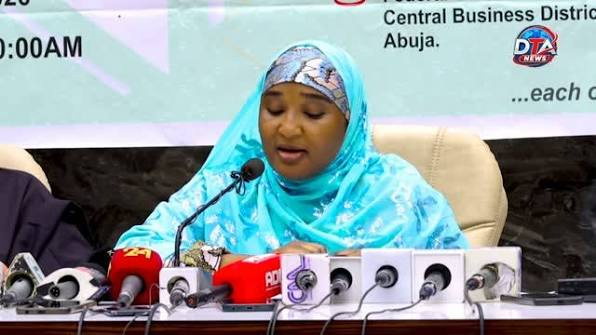
The Federal Government has warned that girls can effectively drop out of education while they are still physically attending school, saying bullying, ridicule, abuse and exclusion can gradually push learners out long before their names disappear from the attendance register.
The warning was given in Abuja by the Minister of State for Education, Prof. Suwaiba Sa’id Ahmad, at the National Trainers’ Workshop on Safe Learning Environment, Gender-Responsive Technology and ICT Skills for Educators in Teacher Training Institutions in Nigeria.
Ahmad, represented by the ministry’s Director of Colleges of Education, Dr Uchenna Uba, said physical attendance should not be treated as sufficient evidence that a child is safe, included or benefiting from education.
She described how a girl may continue to attend class while repeatedly being ignored, laughed at when she speaks or made to feel unsafe, eventually withdrawing from participation even though she remains enrolled. “If we count only enrolment, we may miss that girl entirely,” the minister said.
The girls silently dropping out warning comes as the ministry begins training 45 master trainers drawn from 15 teacher-training colleges. The trainers are expected to take the programme back to their institutions and reach about 500 teacher educators.
The three-day training covers gender-responsive teaching, safe learning environments, prevention and response to school-related gender-based violence and the use of digital technology in teaching.
Ahmad said the Federal Ministry of Education has introduced a National Policy on Anti-Bullying in Nigerian Schools and implementation guidelines, but argued that the impact of such policies will ultimately depend on what teachers and other adults do when a child is bullied, excluded or reports abuse.
She also pointed to the conditions under which teachers themselves work, including overcrowded classrooms, limited teaching materials and heavy workloads, saying policy documents alone cannot solve school-safety problems if teachers are not prepared to put them into practice.
The minister cited UNICEF data indicating that 74 per cent of Nigerian children aged seven to 14 lacked basic reading and mathematics skills in 2024, using the figure to argue that enrolment numbers alone do not capture whether children are actually learning.
The workshop is part of a wider project funded by the Government of Japan and implemented with the Federal Ministry of Education, UNESCO’s International Institute for Capacity Building in Africa and the African Union. The project focuses on continuous, inclusive and safe access to quality education for girls in West Africa.
The same partnership supplied ICT equipment to 15 Nigerian Colleges of Education earlier this year, including laptops, tablets, desktop computers, smart boards, projectors, printers and backup storage. The current workshop is intended to ensure that the equipment is paired with training on how teachers use technology and create safer, more inclusive classrooms.
The 15 beneficiary institutions include Federal Colleges of Education in Kontagora, Zaria, Yola and other locations, as well as state colleges in Kano, Sokoto, Adamawa, Taraba, Enugu and the FCT. The project began in 2024 and is also being implemented in Burkina Faso, Cameroon, Chad, Mali and Mauritania.
Japan’s Deputy Head of Mission in Nigeria, Hitoshi Kozaki, told participants that the value of the intervention would depend on how the institutions use the equipment and training, while the Provost of the Federal College of Education (Technical), Asaba, Dr James Olisa, speaking for the Committee of Provosts, said the programme had arrived at a time when teacher-training institutions were under pressure to prepare educators for rapidly changing classrooms.
The Federal Government’s message from the workshop is therefore broader than school attendance: keeping girls enrolled is not enough if fear, humiliation or exclusion has already pushed them out of meaningful participation in learning.




Community Join the conversation Open discussion +