

Class: Senior Secondary School 2 (SS2 / SSS 2)
Term: 1st Term
Week: 9 – 10
Age: 16 years
Duration: 45 minutes
Subject: Chemistry
Curriculum Theme: Acids, Bases, and Salts
Previous Lesson: Mass-Volume Relationships: Mass-Volume Calculations and SI Units.
Topic: ACID, BASE REACTIONS
Subject Matter: Meaning of acid-base reactions (neutralization where acid reacts with base to form salt and water), common indicators and their pH ranges, simple acid-base titrations.
Specific Objectives
By the end of the lesson, pupils should be able to:
Cognitive Domain:
- Define acid-base reaction and neutralization.
- State common acid-base indicators and their corresponding pH ranges.
- Explain the principle and process of simple acid-base titration.
Affective Domain:
- Appreciate the importance of accurate measurements in chemical experiments.
- Develop an interest in practical chemistry, particularly titration.
Psychomotor Domain:
- Prepare standard solutions accurately.
- Set up titration apparatus correctly.
- Carry out simple acid-base titrations to obtain concordant readings.
- Perform calculations from titration data to determine unknown concentrations.
Social Domain:
- Collaborate effectively when working in groups during practical sessions.
- Communicate observations and results clearly.
Reference Materials
The following resources were used in planning this lesson:
- Senior Secondary Schools Education Curriculum
- State Unified Scheme of Work
- New School Chemistry for Senior Secondary Schools by Osei Yaw Ababio
Instructional Materials
The teacher will teach this lesson with the aid of:
- Distilled water or deionized water
- Titration apparatus (burette, conical flask, pipette, retort stand, beaker)
- White tile
- Indicator (e.g., phenolphthalein, methyl orange)
- Weighing balance
- Acids (e.g., HCl, H₂SO₄)
- Bases (e.g., NaOH, Na₂CO₃)
- Petri-dish
- Practical notebooks
- Measuring cylinder
- Funnel
Rationale for the Lesson
This lesson helps pupils understand how acids and bases react to form neutral substances. It enables them to apply this knowledge in practical situations like titrations, which are important for determining unknown concentrations in various chemical processes.
Prerequisite/Previous Knowledge
Pupils should have prior knowledge of acids, bases, salts, pH scale, and basic laboratory safety rules.
Lesson Content/Board Summary
ACID, BASE REACTIONS
Meaning of Acid-Base Reactions (Neutralization)
An acid-base reaction is a chemical reaction between an acid and a base. When an acid reacts completely with a base, it is called neutralization. In neutralization, the properties of both the acid and the base are destroyed, forming a salt and water.
General equation:
Acid + Base → Salt + Water
Example: HCl(aq) + NaOH(aq) → NaCl(aq) + H₂O(l)
Common Indicators and their pH Ranges
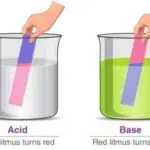
Indicators are substances that show different colours in acidic and basic solutions. They are used to determine the endpoint of a titration.
- Litmus: Red in acid, Blue in base. pH range: 5.0 – 8.0
- Methyl Orange: Red in acid, Yellow in base. pH range: 3.1 – 4.4
- Phenolphthalein: Colourless in acid, Pink in base. pH range: 8.3 – 10.0
Simple Acid-Base Titrations
Titration is a quantitative chemical analysis method used to determine the concentration of an identified analyte (a substance being analyzed). In acid-base titration, a solution of known concentration (standard solution) is used to determine the concentration of an unknown solution.
Apparatus for Titration:
- Burette: Used to deliver variable, accurate volumes of a liquid.
- Pipette: Used to measure and transfer a fixed, accurate volume of a liquid.
- Conical Flask: Used to hold the solution being titrated.
- Retort Stand and Clamp: Used to hold the burette vertically.
- White Tile: Placed under the conical flask to make the colour change of the indicator more visible.
- Funnel: Used to transfer liquids into the burette without spilling.
Procedure for Acid-Base Titration:
- Rinse the burette with the acid and fill it with the acid. Ensure there are no air bubbles in the nozzle. Record the initial burette reading.
- Rinse the pipette with the base and use it to transfer a known volume (e.g., 25.0 cm³) of the base into a clean conical flask.
- Add 2-3 drops of an appropriate indicator (e.g., phenolphthalein for strong acid-strong base titration) to the base in the conical flask.
- Place the conical flask on a white tile under the burette.
- Slowly add the acid from the burette into the conical flask, swirling continuously, until the indicator changes colour permanently (the endpoint).
- Record the final burette reading. The difference between the initial and final readings is the titre value.
- Repeat the titration until at least two concordant titre values (readings within ±0.1 cm³) are obtained.
- Calculate the average titre.
Calculations in Titration:
The relationship between the concentration and volume of acid and base at the endpoint is given by the formula:
(C_A * V_A) / n_A = (C_B * V_B) / n_B
Where:
- C_A = Concentration of acid (mol/dm³)
- V_A = Volume of acid used (cm³)
- n_A = Mole ratio of acid from the balanced equation
- C_B = Concentration of base (mol/dm³)
- V_B = Volume of base used (cm³)
- n_B = Mole ratio of base from the balanced equation
NOTE: When converting from smaller units to larger units divide, but when converting from larger units to smaller units multiply. (1 dm³ = 1000 cm³)
Worked Examples:
Example 1: 25.0 cm³ of 0.1 M sodium hydroxide solution was completely neutralized by 20.0 cm³ of hydrochloric acid. Calculate the concentration of the hydrochloric acid.
Solution:
Step 1: Write the balanced chemical equation.
HCl(aq) + NaOH(aq) → NaCl(aq) + H₂O(l)
Step 2: Identify knowns and unknowns.
- Acid (HCl): V_A = 20.0 cm³, C_A = ? M, n_A = 1
- Base (NaOH): V_B = 25.0 cm³, C_B = 0.1 M, n_B = 1
Step 3: Apply the titration formula.
(C_A * V_A) / n_A = (C_B * V_B) / n_B
(C_A * 20.0) / 1 = (0.1 * 25.0) / 1
Step 4: Solve for C_A.
20.0 * C_A = 2.5
C_A = 2.5 / 20.0
C_A = 0.125 M
Therefore, the concentration of hydrochloric acid is 0.125 M.
Example 2: In a titration, 22.5 cm³ of 0.05 M H₂SO₄ neutralized 25.0 cm³ of a potassium hydroxide (KOH) solution. Determine the concentration of the KOH solution.
Solution:
Step 1: Write the balanced chemical equation.
H₂SO₄(aq) + 2KOH(aq) → K₂SO₄(aq) + 2H₂O(l)
Step 2: Identify knowns and unknowns.
- Acid (H₂SO₄): V_A = 22.5 cm³, C_A = 0.05 M, n_A = 1
- Base (KOH): V_B = 25.0 cm³, C_B = ? M, n_B = 2
Step 3: Apply the titration formula.
(C_A * V_A) / n_A = (C_B * V_B) / n_B
(0.05 * 22.5) / 1 = (C_B * 25.0) / 2
Step 4: Solve for C_B.
1.125 = (C_B * 25.0) / 2
1.125 * 2 = C_B * 25.0
2.25 = 25.0 * C_B
C_B = 2.25 / 25.0
C_B = 0.09 M
Therefore, the concentration of potassium hydroxide solution is 0.09 M.
Teaching Methods/Instructional Techniques
Discussion, Lecture, Demonstration, Question and Answer, Visual Aids
Instructional Procedures
Step 1: Introduction
Time: 5 minutes
Teaching Skill: Set Induction
Teacher’s Activity: The teacher greets the pupils and reviews the previous lesson on acids, bases, and salts. The teacher then introduces the topic “Acid-Base Reactions” by asking pupils what happens when an acid and a base are mixed.
Pupils’ Activity: Pupils respond to the teacher’s questions and recall previous knowledge.
Learning Point: Pupils are prepared for the new lesson by linking it to prior knowledge.
Step 2: Meaning of Acid-Base Reactions and Neutralization
Time: 7 minutes
Teaching Skill: Explanation/Definition
Teacher’s Activity: The teacher defines acid-base reactions and explains the concept of neutralization, providing examples of balanced chemical equations.
Pupils’ Activity: Pupils listen attentively, ask questions for clarity, and copy notes from the board.
Learning Point: Pupils understand the definition and significance of neutralization reactions.
Step 3: Common Indicators and their pH Ranges
Time: 7 minutes
Teaching Skill: Listing/Explanation
Teacher’s Activity: The teacher presents common acid-base indicators, their colour changes in acidic and basic media, and their respective pH ranges using a chart or board summary.
Pupils’ Activity: Pupils observe the chart, note down the indicators and their properties, and ask questions.
Learning Point: Pupils identify appropriate indicators for different acid-base titrations.
Step 4: Introduction to Titration and Apparatus
Time: 7 minutes
Teaching Skill: Explanation/Identification
Teacher’s Activity: The teacher introduces the concept of titration, its purpose, and displays the necessary apparatus (burette, pipette, conical flask, retort stand, white tile), explaining the function of each.
Pupils’ Activity: Pupils observe the apparatus, listen to the explanations, and identify each piece of equipment.
Learning Point: Pupils understand what titration is and can identify the apparatus used.
Step 5: Demonstration of Titration Process
Time: 7 minutes
Teaching Skill: Demonstration
Teacher’s Activity: The teacher demonstrates the step-by-step procedure for performing a simple acid-base titration, emphasizing safety precautions and proper techniques.
Pupils’ Activity: Pupils observe the demonstration carefully, noting the techniques and safety measures.
Learning Point: Pupils learn the correct procedure for carrying out titration.
Step 6: Titration Calculations
Time: 5 minutes
Teaching Skill: Problem Solving/Application
Teacher’s Activity: The teacher explains the formula for titration calculations and works through the provided examples on the board, guiding pupils on how to determine unknown concentrations.
Pupils’ Activity: Pupils follow the calculations, ask questions, and copy the worked examples into their notebooks.
Learning Point: Pupils can apply the formula to solve titration problems.
Step 7: Evaluation/Review
Time: 5 minutes
Teaching Skill: Questioning/Assessment
Teacher’s Activity: The teacher evaluates the learning by asking the following questions:
- Define acid-base neutralization.
- State two common acid-base indicators and their colour changes in acidic and basic solutions.
- List three apparatus used for acid-base titration.
- If 20.0 cm³ of 0.15 M NaOH neutralizes 15.0 cm³ of H₂SO₄, calculate the concentration of the H₂SO₄. (H₂SO₄ + 2NaOH → Na₂SO₄ + 2H₂O)
Pupils’ Activity: Pupils answer orally and in writing.
Learning Point: Pupils demonstrate understanding of the lesson.
Step 8: Conclusion
Time: 2 minutes
Teaching Skill: Summarization
Teacher’s Activity: The teacher summarizes the key points of the lesson, reiterating the importance of acid-base reactions and titration. The teacher assigns homework for pupils to practice titration calculations.
Pupils’ Activity: Pupils listen to the summary and copy down the assigned homework.
Learning Point: Pupils consolidate their understanding and are encouraged to practice further.
Lesson Keywords
- Acid-base reaction – A chemical reaction between an acid and a base.
- Neutralization – The reaction between an acid and a base to form a salt and water.
- Titration – A quantitative analytical method to determine the concentration of an unknown solution using a solution of known concentration.
- Indicator – A substance that changes colour in response to a chemical change, used to signal the endpoint of a reaction.
- Endpoint – The point in a titration where the indicator changes colour, signaling the completion of the reaction.
- Standard solution – A solution of accurately known concentration.
Differentiation
For pupils who grasp concepts quickly, the teacher can provide more complex titration problems or ask them to research different types of titrations (e.g., redox titration). For pupils needing more support, the teacher can provide simplified examples, additional guidance during practical setup, and step-by-step calculation templates.
Note for teachers using this lesson plan
Ensure all titration apparatus are clean and dry before use. Emphasize safety precautions such as wearing safety goggles during practicals and handling acids/bases carefully. Encourage pupils to repeat titrations to achieve concordant results, which is key to accuracy in practical chemistry.


Community Join the conversation Open discussion +