

Class: Primary 4
Term: 1st Term
Week: 8
Age: 9 years
Duration: 45 minutes
Subject: English Language Studies
Curriculum Theme: English Language Studies
Previous Lesson: Vowel Discrimination, Adjectives, Letter Reading and Informal Composition.
Topic: Essential English Language Skills
Subject Matter: Speech: Discriminating vowel sounds; Grammatical Accuracy: Understanding clauses; Reading: Narrative passage reading; Writing: Composition writing.
Specific Objectives
By the end of the lesson, pupils should be able to:
Cognitive Domain:
- Identify different vowel sounds in words.
- Define a clause and differentiate between independent and dependent clauses.
- State the main characteristics of a narrative passage.
- List the key parts of a composition.
Affective Domain:
- Appreciate the importance of clear pronunciation in communication.
- Show interest in learning grammatical structures like clauses.
- Enjoy reading narrative passages.
- Develop confidence in expressing ideas through writing compositions.
Psychomotor Domain:
- Articulate various vowel sounds correctly.
- Construct simple sentences using different types of clauses.
- Read a given narrative passage with appropriate intonation.
- Write a short, coherent composition on a given topic.
Social Domain:
- Participate actively in discussions about vowel sounds and grammar.
- Collaborate with peers during reading and writing activities.
- Share their written compositions with the class.
- Listen respectfully to others’ reading and ideas.
Reference Materials
The following resources were used in planning this lesson:
- 9 Years Basic Education Curriculum (Primary 4 English Language)
- State Unified Scheme of Work for Primary 4 English Language
- New Oxford Primary English Course for Primary 4
- https://www.education.gov.ng
- https://www.waecdirect.org
Instructional Materials
The teacher will teach this lesson with the aid of:
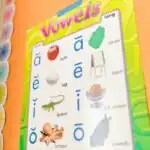
- Charts displaying vowel sounds.
- Textbooks with examples of clauses and narrative passages.
- Whiteboard/chalkboard and markers/chalk.
- Pupils’ notebooks.
Rationale for the Lesson
This lesson helps pupils develop fundamental English language skills that are important for clear communication and academic success. Understanding vowel sounds improves speaking, while learning about clauses enhances sentence construction and comprehension. Reading narratives broadens imagination and vocabulary, and composition writing enables pupils to express their thoughts effectively.
Prerequisite/Previous Knowledge
Pupils are expected to have basic knowledge of the English alphabet, simple words, sentence structure, and have read simple stories before.
Lesson Content/Board Summary
Essential English Language Skills
Discriminating Vowel Sounds
Vowel sounds are speech sounds produced with an open vocal tract, allowing air to flow out freely without obstruction. They are the core of syllables.
The following are examples of discriminating vowel sounds:
- Long /i:/ as in ‘sheep’ versus Short /ɪ/ as in ‘ship’.
- Long /u:/ as in ‘pool’ versus Short /ʊ/ as in ‘pull’.
- Long /ɑ:/ as in ‘car’ versus Short /ʌ/ as in ‘cut’.
- Long /ɜ:/ as in ‘bird’ versus Short /ə/ as in ‘teacher’.
Understanding Clauses
A clause is a group of words that contains a subject and a verb. Clauses can be part of a sentence or a complete sentence on their own.
The following are types of clauses:
- Independent Clause: This is a clause that can stand alone as a complete sentence because it expresses a complete thought.
Example: She smiled.
- Dependent Clause: This is a clause that cannot stand alone as a complete sentence because it does not express a complete thought. It needs an independent clause to make sense. Dependent clauses often begin with words like ‘because’, ‘although’, ‘when’, ‘if’, ‘who’, ‘which’.
Example: Because she was happy. (Needs an independent clause like ‘She smiled because she was happy.’)
Narrative Passage Reading
A narrative passage is a story that tells a sequence of events. It aims to entertain, inform, or teach a lesson.
The following are key elements of a narrative passage:
- Characters: The people or animals in the story.
- Setting: The time and place where the story happens.
- Plot: The sequence of events in the story, including the problem and its solution.
- Theme: The main message or idea of the story.
Composition Writing
Composition writing is the art of expressing thoughts, ideas, and information in a written form to create a coherent piece of text.
The following are essential parts of a composition:
- Introduction: The beginning of the composition that introduces the topic.
- Body Paragraphs: The main part of the composition where ideas are developed with details and examples.
- Conclusion: The end of the composition that summarizes the main points and provides a final thought.
Teaching Methods/Instructional Techniques
Discussion, Lecture, Demonstration, Question and Answer, Visual Aids
Instructional Procedures
Step 1: Introduction
Time: 5 minutes
Teaching Skill: Set Induction
Teacher’s Activity: The teacher greets the pupils and asks them about the importance of speaking clearly and writing well. The teacher then introduces the topic by explaining that today’s lesson will focus on different important aspects of English language skills: pronunciation, grammar, reading, and writing.
Pupils’ Activity: Pupils respond to the teacher’s questions and listen attentively to the introduction.
Learning Point: Pupils are prepared for the lesson and understand its relevance.
Step 2: Discriminating Vowel Sounds
Time: 10 minutes
Teaching Skill: Explanation/Demonstration
Teacher’s Activity: The teacher displays charts of vowel sounds and demonstrates the pronunciation of contrasting vowel pairs (e.g., ‘sheep’ vs. ‘ship’, ‘pool’ vs. ‘pull’). The teacher explains how to differentiate between them.
Pupils’ Activity: Pupils listen, observe the teacher’s mouth movements, and practice pronouncing the vowel sounds individually and in chorus.
Learning Point: Pupils learn to identify and articulate different vowel sounds correctly.
Step 3: Understanding Clauses
Time: 10 minutes
Teaching Skill: Explanation/Illustration
Teacher’s Activity: The teacher explains what a clause is, using simple sentences on the board. The teacher then explains the difference between independent and dependent clauses with clear examples, asking pupils to identify them.
Pupils’ Activity: Pupils listen to the explanation, copy notes, and participate in identifying clauses in example sentences.
Learning Point: Pupils understand the concept of clauses and can distinguish between independent and dependent clauses.
Step 4: Narrative Passage Reading
Time: 7 minutes
Teaching Skill: Guided Reading
Teacher’s Activity: The teacher presents a short, age-appropriate narrative passage from their textbook or a chart. The teacher reads it aloud first, modeling good pronunciation and intonation, then guides pupils to read it individually or in small groups. The teacher asks questions about the characters, setting, and plot.
Pupils’ Activity: Pupils listen, read the passage, and answer questions about its elements.
Learning Point: Pupils improve their reading fluency and comprehension of narrative texts.
Step 5: Introduction to Composition Writing
Time: 5 minutes
Teaching Skill: Brainstorming/Guidance
Teacher’s Activity: The teacher briefly explains what composition writing is and discusses the basic parts (introduction, body, conclusion). The teacher gives a simple topic (e.g., “My Best Friend” or “A Day at the Market”) and encourages pupils to brainstorm ideas for each part.
Pupils’ Activity: Pupils listen, contribute ideas, and think about how they would structure a composition on the given topic.
Learning Point: Pupils understand the structure and basic requirements of composition writing.
Step 6: Evaluation/Review
Time: 5 minutes
Teaching Skill: Questioning/Assessment
Teacher’s Activity: The teacher evaluates the learning by asking the following questions:
- Give two examples of contrasting vowel sounds.
- What is a clause?
- State one difference between an independent clause and a dependent clause.
- Mention two elements found in a narrative passage.
- List the three main parts of a written composition.
Pupils’ Activity: Pupils answer orally and in writing.
Learning Point: Pupils demonstrate understanding of the lesson.
Step 8: Conclusion
Time: 3 minutes
Teaching Skill: Summarization
Teacher’s Activity: The teacher summarizes the key points of the lesson, emphasizing the importance of mastering these language skills for effective communication. The teacher assigns homework: “Write five sentences, each containing an independent clause. Also, write a short paragraph describing your favorite animal, ensuring it has an introduction, body, and conclusion.”
Pupils’ Activity: Pupils listen to the summary and copy the homework assignment.
Learning Point: Pupils consolidate their learning and are given tasks to practice the skills learned.
Home Task: Write four correct English sentences that demonstrate the main language skill in Essential English Language Skills.
Lesson Keywords
- Vowel Sounds – Speech sounds made with an open mouth, like ‘a’, ‘e’, ‘i’, ‘o’, ‘u’.
- Clause – A group of words with a subject and a verb.
- Independent Clause – A clause that can stand alone as a complete sentence.
- Dependent Clause – A clause that cannot stand alone as a complete sentence.
- Narrative Passage – A story that tells a sequence of events.
- Composition – A piece of writing that expresses thoughts and ideas.
Differentiation
For pupils who grasp concepts quickly, the teacher will encourage them to identify more complex clauses or read longer narrative passages. For those needing more support, the teacher will provide additional examples, phonetic drills for vowel sounds, or simpler composition topics, and offer one-on-one guidance.
Note for teachers using this lesson plan
This lesson plan covers multiple aspects of English language studies. Teachers should be flexible and allocate more time to areas where pupils show greater difficulty. It is acceptable to focus on one or two subject matters more deeply if time is limited, or to spread these topics across multiple lessons for thorough understanding. Encourage active participation and provide constructive feedback on pronunciation and writing.


Community Join the conversation Open discussion +