


Choosing teaching materials is one of the quiet decisions that can make or break a lesson. In many Nigerian classrooms, teachers are working with large class sizes, limited budgets, mixed ability levels, short lesson periods and sometimes no functional laboratory or projector. Yet pupils still need to see, touch, practise, discuss and connect what they learn to real life.
The good news is that effective teaching materials do not always have to be expensive. A bottle of dirty water can teach filtration. Bottle tops can teach place value. A newspaper article can teach comprehension, civic awareness and vocabulary. The real skill is knowing which material fits the subject, the lesson objective, the learners’ level and the classroom reality.
This guide gives Nigerian teachers, school heads and education practitioners a practical way to select, adapt and create subject-specific materials without wasting money on resources that look attractive but do not improve learning.
Start With the Lesson Objective, Not the Material
A common mistake is to start with the available material and force it into the lesson. A better approach is to ask: “What exactly should learners know, do, explain, calculate, classify, read, write or demonstrate by the end of this lesson?”
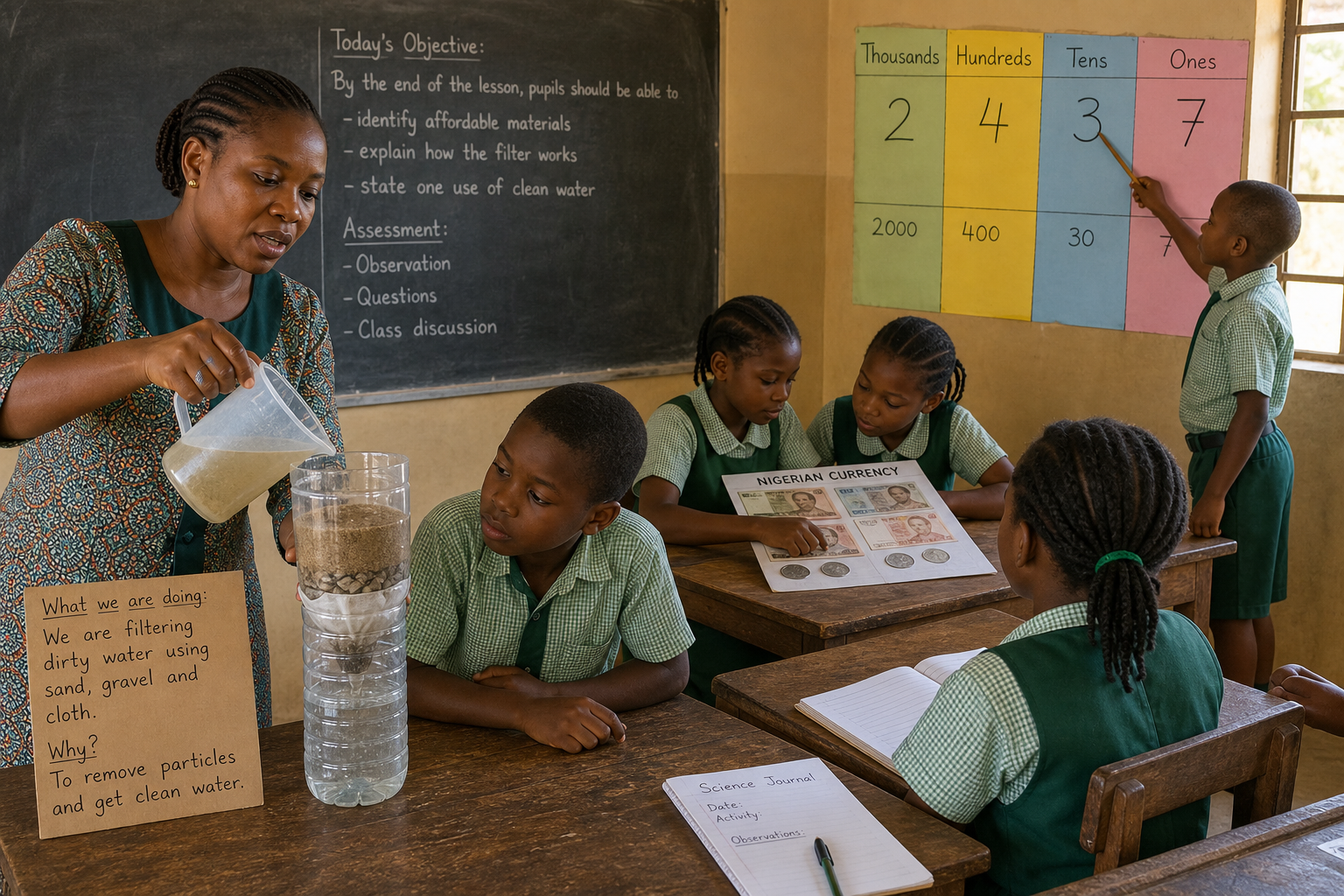
For example, if the objective is for Primary 4 pupils to identify sources of water, a picture chart may be enough. But if the objective is for JSS 1 students to explain filtration, they need a simple demonstration using sand, gravel, cloth, water and a container. The material should serve the learning goal, not decorate the classroom.
If you need help aligning resources with objectives, this guide on writing effective instructional objectives will help you plan with more clarity before selecting materials.
A Simple Test for Choosing Teaching Materials
Before buying, printing or preparing any resource, use this quick classroom test:
| Question | Why It Matters | Example |
|---|---|---|
| Does it match the lesson objective? | A beautiful material is useless if it does not teach the target skill. | Fraction circles are useful for equivalent fractions, but not enough for long division. |
| Is it age-appropriate? | Materials should match learners’ reading level, maturity and attention span. | Primary pupils need more visuals and handling; senior students can use charts, maps and texts more independently. |
| Can most learners see, hear or use it? | In a crowded class, tiny materials may not work unless learners use them in groups. | A small thermometer may need group rotation, while a large drawn diagram can serve the whole class. |
| Is it affordable or reusable? | Low-cost classrooms need materials that can serve many lessons. | Cardboard number cards can be reused for counting, place value, ordering and mental maths. |
| Does it fit the Nigerian curriculum? | Materials should support the topics pupils are expected to learn and be assessed on. | Use local government maps, Nigerian currency, local market examples and familiar community issues. |
| Can it be adapted? | The best materials can be modified for different classes and ability groups. | A short passage can be used for vocabulary, comprehension, grammar and summary writing. |
Teachers can also check curriculum expectations through the NERDC Basic Education Curriculum resources when planning for Nigerian primary and junior secondary classes.
Science Materials: Let Learners Observe, Handle and Explain
Science becomes easier when pupils can see a process or handle an object. In Nigerian schools where standard laboratories may be unavailable, teachers can still use simple visual aids, improvised models and safe demonstrations.
| Material | Best For | Where It May Fail | Nigerian Fit and Adaptation |
|---|---|---|---|
| Flip charts and wall charts | Body systems, plants, animals, weather, safety signs and classification topics. | They can become passive if learners only copy without discussion. | Use manila paper, markers and locally drawn examples. Ask pupils to label, compare and explain, not just look. |
| Improvised models | Solar system, digestive system, water cycle, simple machines and plant parts. | Poorly made models can confuse learners if parts are wrongly labelled. | Use cardboard, clay, bottle covers, broomsticks, cartons and old containers. Label clearly and keep proportions simple. |
| Real objects and specimens | Leaves, seeds, rocks, soil, local crops, insects, magnets, simple tools and household materials. | Some items may be unsafe, dirty or distracting if not controlled. | Use familiar objects from the school compound, market or home. Set safety rules before handling. |
| Simple experiments | Evaporation, filtration, floating and sinking, magnetism, germination and mixtures. | Can waste time if materials are not prepared before class. | Test the activity before the lesson. Use group roles: observer, recorder, handler and reporter. |
| PhET simulations | Science and maths concepts that are difficult to demonstrate physically. | Requires device access and may not be ideal where there is no power or internet. | Use one phone, laptop or projector when available. Let pupils predict before showing the simulation. See PhET Interactive Simulations. |
Classroom example: To teach “separating mixtures” in Basic Science, a teacher can bring muddy water, clean cloth, sand, small stones and a transparent bottle. Pupils observe, predict, filter and discuss what changed. This is more meaningful than copying “filtration is the process of separating insoluble solids from liquids” without seeing it happen.
For more ideas on teaching creatively with little, see making learning meaningful even with limited resources.
English Materials: Give Learners Texts They Can Read, Hear and Use
English teaching materials should expose learners to good language, but they must also be readable, culturally relatable and useful for speaking, listening, reading and writing. A difficult passage may impress the teacher, but if most learners cannot decode it, the lesson becomes punishment instead of learning.
| Material | Best For | Where It May Fail | Pricing Caveat and Adaptation |
|---|---|---|---|
| Readers and graded storybooks | Reading fluency, vocabulary, comprehension and storytelling. | One copy for the whole class limits participation. | Build a small class library gradually. Let pupils read in pairs or groups. Rotate books weekly. |
| Novels, drama texts and anthologies | Upper primary, junior secondary and senior secondary literature lessons. | Some texts may be too expensive or too advanced for the class level. | Choose curriculum-relevant texts and use extracts when full copies are not available. |
| Newspapers, flyers and notices | Reading real-life English, summary, vocabulary, advert analysis and civic topics. | Some content may not be child-friendly. | Select safe sections before class. Remove inappropriate adverts or stories. |
| Word cards and sentence strips | Phonics, spelling, sentence building, grammar and vocabulary practice. | Can become boring if pupils only repeat words mechanically. | Use old cartons, paper cut-outs and markers. Turn them into games: match, arrange, replace, correct and classify. |
| Open digital story resources | Supplementary reading, listening, story retelling and language exposure. | Internet and device access may be limited. | Download or print selected stories when possible. Try African Storybook, Global Digital Library and British Council LearnEnglish Kids. |
Practical scenario using lesson planning resources: A Primary 5 teacher preparing a comprehension lesson on “Clean Water” can use a short passage from a reader, a newspaper clipping about community sanitation, a word bank on the board and a picture of a borehole or stream. The same lesson planning resources can support vocabulary, comprehension questions, group discussion and a short writing task: “How can our community keep water clean?”
When choosing English materials, also consider the learning domains. A reading lesson should not only test memory; it can include speaking, listening, writing, values, cooperation and critical thinking. This connects well with integrating multiple learning domains in Nigerian classrooms.
Mathematics Materials: Move From Concrete to Pictures to Symbols
Many pupils fear Mathematics because they meet symbols before they understand the idea. Good maths materials help learners touch, group, count, compare, measure, draw and then calculate.
| Material | Best For | Where It May Fail | Nigerian Fit and Adaptation |
|---|---|---|---|
| Counters | Counting, addition, subtraction, multiplication, division, odd and even numbers. | Small counters can cause noise or distraction if rules are unclear. | Use bottle tops, seeds, stones, sticks or buttons. Keep them in labelled containers. |
| Place value cards | Ones, tens, hundreds, thousands, expanded form and number comparison. | May not help if pupils only read numbers without building them. | Make cards from cardboard. Let pupils physically form numbers like 3,482 using thousands, hundreds, tens and ones cards. |
| Fraction circles and strips | Fractions, equivalent fractions, comparison and basic operations. | Ready-made sets may be costly or too few for large classes. | Cut circles or strips from cardboard. Use different shapes but label parts clearly. |
| Measuring tools | Length, mass, capacity, perimeter, area and data collection. | Standard tools may be unavailable or insufficient. | Use rulers, ropes, cups, bottles, tins and handmade metre strips. Compare informal and standard units. |
| Digital practice tools | Extra practice, remediation and self-paced learning. | They may not match Nigerian schemes exactly and require device access. | Use selectively for reinforcement. Khan Academy Math can support extra practice, especially for upper primary and secondary learners. |
Classroom example: To teach equivalent fractions, give each group paper strips divided into halves, thirds, quarters and eighths. Let pupils place 1⁄2 beside 2⁄4 and 4⁄8. After seeing the relationship, they can now write the symbolic statement: 1⁄2 = 2⁄4 = 4⁄8.
For Mathematics, the best materials are not always the most colourful. The best ones are the ones pupils can use to discover a pattern, explain their reasoning and solve problems independently.
Social Studies and Civic Education: Use the Community as a Classroom
Social Studies, Civic Education and related subjects become powerful when learners connect classroom ideas to family, school, community, government, culture, safety and national life. Materials should therefore be local, current and discussion-friendly.
| Material | Best For | Where It May Fail | Adaptation for Nigerian Classrooms |
|---|---|---|---|
| Maps | States, geopolitical zones, local government areas, natural resources and transport. | Old maps may show outdated boundaries or poor details. | Use current maps where possible. Ask pupils to locate their state, neighbouring states and key places. |
| Pictures and posters | Culture, occupation, family roles, safety, environment and national symbols. | Generic foreign pictures may not reflect pupils’ realities. | Use Nigerian markets, farms, schools, roads, festivals, leaders, currency and community scenes. |
| Newspaper reports and radio news summaries | Current affairs, citizenship, elections, public health, security and civic responsibility. | Some reports may be politically sensitive or emotionally disturbing. | Select age-appropriate stories and guide discussion carefully. |
| Role play and case studies | Conflict resolution, leadership, rights and duties, honesty, cooperation and community service. | Can become unserious if not guided with clear questions. | Use familiar situations: class prefect election, sanitation duty, lost property, bullying or queue management. |
Classroom example: For a lesson on “rights and responsibilities,” the teacher can present a case: “A pupil has the right to learn, but keeps disturbing others during lessons.” Pupils discuss both the right and the responsibility. This can also open a meaningful conversation on behaviour, empathy and classroom discipline. Teachers may find this related reflection on responding compassionately when students misbehave helpful.
Digital and Offline-Friendly Resources: Use Technology Wisely
Digital tools can support teaching, but they should not replace teacher judgment. In many Nigerian schools, internet access, electricity and device availability are inconsistent. So the best digital resources are those that can be downloaded, reused, projected, printed, shared in small groups or used by the teacher for preparation.
| Resource | Best Use | Possible Limitation | How to Use Sensibly |
|---|---|---|---|
| UNESCO Open Educational Resources | Understanding and finding openly licensed educational materials. | Some resources may not be directly aligned to Nigerian schemes. | Use as a guide for adapting free resources legally and responsibly. |
| African Storybook | Early literacy, story reading and African language exposure. | Teachers still need to select stories by level and topic. | Choose short stories, print one copy per group, and add vocabulary tasks. |
| Global Digital Library | Free reading resources and early learning support. | Device and internet access may limit use. | Download or project selected books where possible. |
| PhET | Interactive science and mathematics simulations. | Not a replacement for local examples and hands-on work. | Use for concepts that are hard to observe directly, then connect back to real objects. |
| Khan Academy | Additional practice, especially in Mathematics and some science topics. | May not follow Nigerian curriculum sequence exactly. | Use for revision, remediation and enrichment, not as the only scheme of work. |
Digital resources should be treated like a toolbox. A teacher still decides what to use, what to skip, what to simplify and what to localise.
How to Adapt Materials for Low-Resource Classrooms
Low-resource teaching does not mean poor teaching. It means the teacher must be more intentional. Many effective materials can be created from the local environment if the teacher plans early.
- Use local objects: Bottle tops, seeds, stones, sticks, cartons, ropes, fabric pieces, old newspapers, food packs and empty containers can serve different subjects.
- Make one material serve many lessons: Number cards can teach counting, place value, ordering, addition, subtraction and mental maths.
- Use group stations: If materials are few, divide the class into groups and rotate activities.
- Draw boldly: A clear board diagram can be more useful than a small printed picture nobody can see.
- Let pupils contribute safe materials: Pupils can bring leaves, clean containers, newspapers or bottle covers when guided properly.
- Store and label materials: A school can create a simple resource corner using cartons, shelves or plastic containers.
- Share across classes: School heads can encourage teachers to build a common teaching materials bank by subject or class level.
For teachers who want more practical classroom ideas, these Nigerian classroom ideas can support creative planning without expensive resources.
A Material Selection Template for Teachers
Before using any teaching material, fill this simple template in your lesson note or planning book:
| Planning Question | Teacher’s Response |
|---|---|
| Subject and topic | Example: Basic Science — Filtration |
| Class level | Example: JSS 1 |
| Main objective | Example: Students should explain and demonstrate filtration. |
| Material needed | Example: Dirty water, clean cloth, sand, gravel, bottle, bowl. |
| How learners will use it | Example: Groups will observe, filter, record changes and report. |
| Possible problem | Example: Water may spill or groups may crowd around one bottle. |
| Solution | Example: Prepare two stations and assign group roles. |
| Assessment link | Example: Learners explain filtration and mention one daily-life use. |
Common Mistakes to Avoid
- Buying before planning: Do not buy charts, models or apps before checking whether they fit your scheme, class and objectives.
- Using materials only for display: A material should help pupils think, practise, explain or solve, not just decorate the board.
- Choosing foreign examples only: Learners understand faster when examples come from Nigerian homes, markets, farms, roads, schools and communities.
- Ignoring class size: A material that works for 15 pupils may fail in a class of 60 unless you use groups or stations.
- Overloading one lesson: Too many materials can distract learners. Choose what directly supports the objective.
- Not checking safety: Science and real-object lessons must avoid sharp, toxic, dirty, electrical or unsafe materials.
A Practical Action Plan for Nigerian Teachers and School Heads
Choosing teaching materials should become a school habit, not a last-minute rush. Teachers can start small, while school heads can support by creating a simple resource system.
For teachers: Pick one topic each week and improve it with one stronger material. Do not try to transform every lesson at once. Start with the topics pupils usually find difficult.
For school heads: Create a subject-based resource box. For Mathematics, keep counters, rulers, fraction strips, number cards and measuring containers. For Science, keep magnets, bottles, funnels, charts, seeds, soil samples and simple models. For English, keep readers, flashcards, sentence strips, newspapers and picture prompts. For Social Studies, keep maps, posters, case cards and local pictures.
For departments or grade teams: Meet twice a term to review what worked, what failed and what should be improved. Consistent use matters more than occasional display. This is why the quiet strength of consistent teachers is so important in real classrooms.
Quick-Start Checklist
- Identify the topic learners usually struggle with.
- Write the exact lesson objective.
- Choose one material that directly supports that objective.
- Check whether learners will see it, touch it, discuss it or practise with it.
- Use local or low-cost alternatives where possible.
- Prepare the material before the lesson begins.
- Plan how groups will use it if the class is large.
- Ask learners to explain what the material helped them understand.
- Store the material for reuse.
- Review and improve it before teaching the topic again.
In the end, choosing teaching materials is not about having the most expensive classroom. It is about making wise, curriculum-aware decisions that help learners understand better. A Nigerian teacher with clear objectives, local creativity and carefully selected materials can turn even a modest classroom into a place where pupils see meaning in what they learn.




Community Join the conversation Open discussion +