


Imagine you’re leading your class on a learning journey, but neither you nor your students know the destination. Sounds chaotic, right? This is exactly what happens when teachers skip one of the most crucial elements of effective teaching – writing clear instructional objectives.
Instructional objectives represent one of the most critical components in effective teaching and lesson planning. As educators, we must understand that successful instruction requires clear direction – both for ourselves and our students. When a teacher has a comprehensive understanding of where the learning journey begins and where it should conclude, the entire educational process becomes more focused and purposeful.
Consider a teacher named Lillian, leading her class on a field trip. His success as a guide depends entirely on his familiarity with the destination and the various landmarks along the way. Even in challenging conditions, such as traveling at night, his knowledge of the route ensures he can confidently recognize when the destination has been reached. This same principle applies to classroom instruction.

An instructional objective serves as the educational destination – a specific learning outcome that must be achieved within a designated timeframe. For any instructional journey to be successful, both the teacher and students must clearly understand the intended destination and the means of reaching it. When this fundamental understanding is absent, both parties often experience frustration and disappointment with the learning process.
Defining Instructional Objectives
An instructional objective represents an intended result of instruction – a specific performance that teachers expect learners to demonstrate before being considered competent in a particular area. More precisely, it describes a definite and measurable change in student behavior resulting from instructional activities.
Instructional objectives are known by various terms throughout educational literature, including performance objectives, behavioral objectives, specific objectives, expressive objectives, and learning objectives. These terms are generally used interchangeably within educational contexts.
According to educational research, instructional objectives specify unambiguously the particular behavior, skill, or knowledge that students must acquire after completing designated learning activities. These objectives are typically derived from curriculum standards and organized within appropriate timeframes suitable for the target learners.
An effective instructional objective describes a desired learning outcome expressed in terms of observable student behavior or performance. The key principle is that learners should demonstrate capabilities they did not possess prior to the instructional experience. The observed behaviors following instruction represent either entirely new competencies or extensions of existing knowledge and skills.
Essential Questions for Instructional Planning
During the lesson planning process, teachers should systematically address four fundamental questions that provide instructional direction:
- Where are the students coming from? – This involves assessing students’ prior knowledge, skills, and experiences relevant to the new learning objectives.
- Where are the students going? – This defines the specific learning outcomes and competencies students should achieve by the lesson’s conclusion.
- How are they going to get there? – This encompasses the instructional strategies, activities, and resources that will facilitate student learning.
- How will you know when they have arrived? – This addresses the assessment methods and criteria used to determine whether students have successfully achieved the stated objectives.

Comprehensive answers to these questions create an instructional roadmap that guides the lesson’s rationale, effective teaching and learning.
Distinguishing Between Instructional Outcomes and Objectives
Many teachers confuse instructional outcomes with instructional objectives, but understanding the difference is important for effective lesson planning.
While both instructional outcomes and objectives play important roles in educational planning, teachers must understand their distinct differences. This difference significantly impacts instructional design and implementation.
Instructional outcomes help teachers determine what content and skills are worth learning. They represent broader educational goals and general learning expectations.
Instructional objectives provide teachers with the framework for designing effective instruction and creating definite pathways for student learning. They expand upon outcomes by specifying the conditions under which learning behaviors will occur and establishing criteria that indicate when specific knowledge, skills, and attitudes have been successfully acquired.
Practical Examples:
Example 1:
- Instructional Outcome: Students will separate mixtures of chemical compounds.
- Instructional Objective: Given a mixture of chemical compounds and appropriate laboratory equipment, students will correctly separate the components using suitable techniques within a 45-minute laboratory period.
Example 2:
- Instructional Outcome: Students should be able to design controlled experiments in biology.
- Instructional Objective: Given a biological problem and hypothesis during a class assessment, students will design a controlled experiment that includes a proper control group unaffected by the independent variable, an appropriate dependent variable, and at least three extraneous variables held constant across all experimental groups, completing the design within 30 minutes with 85% accuracy.

The critical difference lies in specificity. Instructional objectives must include both conditions (what is provided to students) and standards (how success is measured). Without these elements, statements remain at the outcome level rather than functioning as true objectives.
Characteristics of Effective Instructional Objectives
Well-written instructional objectives possess several essential characteristics that distinguish them from vague educational statements:
Specificity: They describe exactly what learners are expected to demonstrate, leaving no ambiguity about expected performance.
Outcome-based focus: They state what learners should accomplish after instruction is completed, rather than describing the instructional process itself.
Measurability: They describe learning outcomes that can be objectively observed, measured, and evaluated.
Student behavior emphasis: They focus on learner actions and performances rather than teacher activities.
Performance description: They provide clear descriptions of the competencies learners must exhibit to be considered proficient.

The Importance of Stating Instructional Objectives
Instructional objectives serve multiple crucial functions in the educational process, each contributing to more effective teaching and learning outcomes.
Selection of Appropriate Instructional Materials
Well-defined instructional objectives guide teachers in selecting media, materials, and resources that will most effectively facilitate student learning. When objectives clearly specify expected outcomes, choosing relevant content and teaching methods becomes a systematic process rather than guesswork.
Determination of Evaluation Methods
Assessment and evaluation should always align directly with stated instructional objectives. Tests and examinations function as learning milestones that indicate whether teachers and students have successfully achieved course objectives. Without clearly stated and understood objectives, assessments often become misleading, irrelevant, unfair, or uninformative.
Test items must be designed to measure when important instructional outcomes have been accomplished. This can only be achieved intelligently when those outcomes have been explicitly defined through proper objectives.
Student Guidance and Organization
Instructional objectives eliminate guesswork for students by clearly communicating expectations. They provide learners with a framework for organizing their efforts toward accomplishing specific goals. Research consistently demonstrates that students at all educational levels perform better when they have clear objectives serving as advance organizers for their learning activities.

Additional Benefits
Beyond these primary functions, instructional objectives provide several additional advantages:
- Feedback provision: They offer clear benchmarks for measuring progress as objectives are accomplished.
- Accountability enhancement: They provide visibility into decisions made by both teachers and learners during the instructional process.
- Careful planning promotion: They require thoughtful consideration of what should be accomplished through instruction.
- Independent learning facilitation: They enhance the possibility of creating focused self-directed learning materials.
- Colleague communication: They clearly communicate instructional content to other educators, promoting collaboration and teamwork.
- Competency demonstration: They facilitate situations where students must demonstrate specific competencies.
- Priority clarification: They force teachers to carefully consider what content and skills are most important.
- Goal alignment: They help bridge the gap between broad institutional goals and specific classroom instruction.
- Self-assessment guidance: They guide learners toward effective self-evaluation practices.
- Instructional organization: They make teaching more directed and systematic.
Historical Development and The Mager Model
The concept of instructional objectives gained prominence through the work of educational researchers Ralph Tyler and Robert F. Mager during the 1960s and early 1970s. During this period, many public school teachers began incorporating instructional objectives as essential components of daily lesson planning.
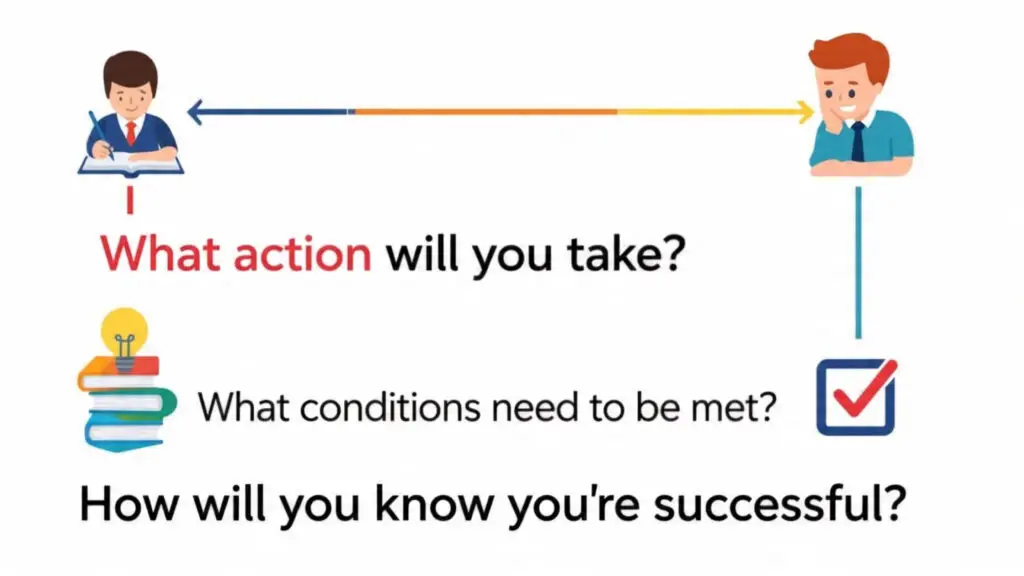
Robert Mager’s model for writing behavioral objectives became widely adopted through numerous teacher workshops and training programs. The Magerian model specified that effective instructional objectives should contain three essential components:
Component 1: Measurable Action Verb
The objective must include a verb that describes observable, measurable student behavior. Examples include analyze, demonstrate, solve, create, compare, and evaluate.
Component 2: Specification of Conditions
The objective should clearly state what will be provided to the learner during performance. This might include materials, resources, time limitations, or environmental conditions.
Component 3: Criteria for Success
The objective must contain specific standards that define acceptable performance levels. This could include accuracy percentages, time limits, or quality specifications.
Mager’s influence convinced many educators of the necessity for stating instructional objectives in behavioral, measurable terms. This approach ensures that learning outcomes can be objectively assessed and verified.
Practical Implementation in Nigerian Classrooms
The relevance of instructional objectives has become increasingly important in contemporary Nigerian education. As Lawrence , Simpson, and Rehn noted, “identifying learning objectives sharpens the focus of learning for students as they progress, and helps educators to assess the overall achievement of the learning objectives they identified as vital.”
Mathematics Example:
Given word problems involving percentage calculations and a calculator, students will solve five problems correctly, showing all computational steps, within 20 minutes.
English Language Example:
Using a provided essay prompt and writing materials, students will compose a 400-word expository essay that includes proper introduction, body paragraphs with supporting details, and conclusion, completing the task within 60 minutes.
Basic Science Example:
Given unlabeled specimens and a classification chart, students will correctly identify and categorize ten different plant types according to their botanical families with 90% accuracy.
Social Studies Example:
Using reference materials and a blank outline map of West Africa, students will accurately locate and label all ECOWAS member countries and their capitals within 30 minutes.

Conclusion
Mastering the art of writing effective instructional objectives represents a fundamental skill for every educator committed to excellence in teaching. These objectives serve as the foundation for focused instruction, meaningful assessment, and successful student learning outcomes.
When teachers clearly define where their students are going and establish specific criteria for arrival, the entire educational process becomes more purposeful and effective. Students benefit from clear expectations, teachers benefit from focused instruction, and the overall quality of education improves significantly.
The investment of time and effort required to develop well-written instructional objectives pays dividends through improved student performance, more effective use of instructional time, and greater satisfaction for both teachers and learners in the educational process.
For more practical teaching strategies and professional development resources, continue exploring our comprehensive guides designed specifically for Nigerian educators.




Community Join the conversation Open discussion +