

Note for teachers using this lesson plan
Prepare the board, mathematical instruments and any calculator, logarithm table, graph sheet or model required for the worked examples. Teach surface area and volume of a sphere with correct notation and orderly working, checking each stage before students proceed. By the end, students should be able to explain the method and solve representative problems accurately.
Class: Senior Secondary School 3 (SS3 / SSS 3)
Term: 2nd Term
Week: 4
Age: 17 years
Duration: 45 minutes
Subject: General Mathematics
Curriculum Theme: Geometry and Mensuration
Previous Lesson:
Topic: SURFACE AREA AND VOLUME OF SPHERE
Subject Matter: Volume of sphere, surface area of sphere, volume of hemisphere, surface area of hemisphere
Specific Objectives
By the end of the lesson, students should be able to:
Cognitive Domain:
- Define a sphere and a hemisphere.
- State the formulas for the volume and surface area of a sphere and a hemisphere.
- Calculate the volume of a sphere and a hemisphere given the radius or diameter.
- Calculate the surface area of a sphere and a hemisphere given the radius or diameter.
Affective Domain:
- Appreciate the practical applications of calculating volumes and surface areas of spheres and hemispheres in real life.
- Show interest in solving problems related to spheres and hemispheres.
Psychomotor Domain:
- Draw simple diagrams of spheres and hemispheres.
- Accurately apply the correct formulas to solve problems involving the volume and surface area of spheres and hemispheres.
Social Domain:
- Participate actively in class discussions and problem-solving activities.
- Collaborate with peers to solve complex problems related to the topic.
Reference Materials
The following resources were used in planning this lesson:
- FCT-ERC SS 3 Scheme of Work, September 2014 curriculum.
- Relevant State Unified Scheme of Work.
- A suitable General Mathematics textbook for SS 3.
Instructional Materials
The teacher will teach this lesson with the aid of:
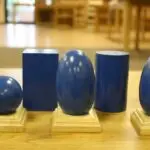
- A cone, a cylinder, and a sphere model for demonstration
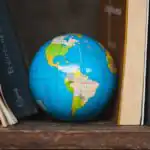
- A globe
- Chalkboard and chalk/marker and whiteboard
- Mathematical sets
Rationale for the Lesson
This lesson helps students understand how to calculate the space occupied by and the surface covering spherical and hemispherical objects. This knowledge is important for solving real-world problems involving spherical containers, sports balls, or architectural designs, enabling students to make practical calculations in various fields.
Prerequisite/Previous Knowledge
Students should have prior knowledge of basic geometric shapes, calculation of areas and volumes of simple shapes like circles, cylinders, and cones, and the use of the value of pi (π).
Lesson Content/Board Summary
SURFACE AREA AND VOLUME OF SPHERE
Introduction to Sphere and Hemisphere
A sphere is a perfectly round three-dimensional object where every point on its surface is equidistant from its center. A hemisphere is exactly half of a sphere, formed by cutting a sphere through its center.
Volume of a Sphere
The volume of a sphere is the amount of space it occupies. It is calculated using the radius of the sphere.
Formula:
V = (4/3)πr³
Where:
- V = Volume
- π (pi) ≈ 22/7 or 3.142
- r = radius of the sphere
Examples:
-
Calculate the volume of a sphere with a radius of 7 cm. (Take π = 22/7)
Solution:
Step 1: Write down the formula for the volume of a sphere.
V = (4/3)πr³
Step 2: Substitute the given values into the formula.
V = (4/3) × (22/7) × (7)³
V = (4/3) × (22/7) × (7 × 7 × 7)
V = (4/3) × 22 × 49
V = (88 × 49) / 3
V = 4312 / 3
Step 3: Calculate the volume.
V = 1437.33 cm³ (approximately)
-
The volume of a sphere is 38,808 cm³. Find its radius. (Take π = 22/7)
Solution:
Step 1: Write down the formula for the volume of a sphere.
V = (4/3)πr³
Step 2: Substitute the known volume into the formula.
38808 = (4/3) × (22/7) × r³
38808 = (88/21) × r³
Step 3: Isolate r³ by multiplying both sides by the reciprocal of (88/21).
r³ = 38808 × (21/88)
r³ = 441 × 21
r³ = 9261
Step 4: Find the cube root of the result to get r.
r = ³√9261
r = 21 cm
NOTE: Remember that the radius is half of the diameter (r = d/2).
Surface Area of a Sphere
The surface area of a sphere is the total area of its outer surface.
Formula:
A = 4πr²
Where:
- A = Surface Area
- π (pi) ≈ 22/7 or 3.142
- r = radius of the sphere
Examples:
-
Calculate the surface area of a sphere with a radius of 3.5 cm. (Take π = 22/7)
Solution:
Step 1: Write down the formula for the surface area of a sphere.
A = 4πr²
Step 2: Substitute the given values into the formula.
A = 4 × (22/7) × (3.5)²
A = 4 × (22/7) × (3.5 × 3.5)
A = 4 × (22/7) × 12.25
A = 4 × 22 × 1.75
Step 3: Calculate the surface area.
A = 88 × 1.75
A = 154 cm²
-
The surface area of a sphere is 616 cm². Find its diameter. (Take π = 22/7)
Solution:
Step 1: Write down the formula for the surface area of a sphere.
A = 4πr²
Step 2: Substitute the known surface area into the formula.
616 = 4 × (22/7) × r²
616 = (88/7) × r²
Step 3: Isolate r² by multiplying both sides by the reciprocal of (88/7).
r² = 616 × (7/88)
r² = 7 × 7
r² = 49
Step 4: Find the square root of r² to get r.
r = √49
r = 7 cm
Step 5: Calculate the diameter (d = 2r).
d = 2 × 7
d = 14 cm
Volume of a Hemisphere
The volume of a hemisphere is half the volume of a full sphere with the same radius.
Formula:
V = (1/2) × (4/3)πr³
V = (2/3)πr³
Where:
- V = Volume
- π (pi) ≈ 22/7 or 3.142
- r = radius of the hemisphere
Example:
Calculate the volume of a hemisphere with a radius of 6 cm. (Take π = 3.142)
Solution:
Step 1: Write down the formula for the volume of a hemisphere.
V = (2/3)πr³
Step 2: Substitute the given values into the formula.
V = (2/3) × 3.142 × (6)³
V = (2/3) × 3.142 × 216
V = 2 × 3.142 × 72
Step 3: Calculate the volume.
V = 452.3424 cm³ (approximately)
Surface Area of a Hemisphere
The total surface area of a hemisphere includes both its curved surface and its flat circular base.
Formula:
Total Surface Area = Curved Surface Area + Area of Circular Base
Curved Surface Area = (1/2) × 4πr² = 2πr²
Area of Circular Base = πr²
Total Surface Area (A) = 2πr² + πr² = 3πr²
Where:
- A = Total Surface Area
- π (pi) ≈ 22/7 or 3.142
- r = radius of the hemisphere
Example:
Find the total surface area of a hemisphere with a radius of 10 cm. (Take π = 3.142)
Solution:
Step 1: Write down the formula for the total surface area of a hemisphere.
A = 3πr²
Step 2: Substitute the given values into the formula.
A = 3 × 3.142 × (10)²
A = 3 × 3.142 × 100
Step 3: Calculate the total surface area.
A = 942.6 cm²
Quick Revision Table
| Area | Key Point |
|---|---|
| Introduction to Sphere and Hemisphere | A sphere is a perfectly round three-dimensional object where every point on its surface is equidistant from its center. A hemisphere is exactly… |
| Volume of a Sphere | The volume of a sphere is the amount of space it occupies. It is calculated using the radius of the sphere. Formula: V = (4/3)πr³ Where: V =… |
| Surface Area of a Sphere | The surface area of a sphere is the total area of its outer surface. Formula: A = 4πr² Where: A = Surface Area π (pi) ≈ 22/7 or 3.142 r = radius… |
| Volume of a Hemisphere | The volume of a hemisphere is half the volume of a full sphere with the same radius. Formula: V = (1/2) × (4/3)πr³ V = (2/3)πr³ Where: V = Volume… |
| Surface Area of a Hemisphere | The total surface area of a hemisphere includes both its curved surface and its flat circular base. Formula: Total Surface Area = Curved Surface… |
Teaching Methods/Instructional Techniques
Discussion, Lecture, Demonstration, Question and Answer, Visual Aids
Instructional Procedures
Step 1: Introduction and Recall
Time: 4 minutes
Teaching Skill: Set Induction
Teacher’s Activity: The teacher introduces the lesson by showing students models of a sphere, cone, and cylinder. The teacher asks students to identify the shapes and recall their properties, particularly focusing on the sphere.
Students’ Activity: Students identify the shapes and recall previous knowledge of 3D objects.
Learning Point: Prior sphere knowledge.
Step 2: Presentation of Volume of Sphere
Time: 5 minutes
Teaching Skill: Explanation/Demonstration
Teacher’s Activity: The teacher explains the concept of the volume of a sphere, derives the formula V = (4/3)πr³, and solves examples on the chalkboard, including how to find the radius if the volume is given. The teacher uses the sphere model to illustrate.
Students’ Activity: Students listen attentively, copy notes, and ask questions for clarification. They observe the demonstration.
Learning Point: Spherical geometry calculations.
Step 3: Presentation of Surface Area of Sphere
Time: 5 minutes
Teaching Skill: Explanation/Problem Solving
Teacher’s Activity: The teacher explains the concept of the surface area of a sphere, presents the formula A = 4πr², and solves examples on the chalkboard, including how to find the radius or diameter if the surface area is given.
Students’ Activity: Students pay attention, write down notes, and participate in solving the examples.
Learning Point: Spherical geometry calculations.
Step 4: Presentation of Volume of Hemisphere
Time: 5 minutes
Teaching Skill: Explanation/Derivation
Teacher’s Activity: The teacher introduces the concept of a hemisphere, explains that its volume is half that of a full sphere, and derives the formula V = (2/3)πr³. The teacher then solves a relevant example.
Students’ Activity: Students listen, understand the relationship between sphere and hemisphere volumes, and copy the example.
Learning Point: Spherical geometry calculations.
Step 5: Presentation of Surface Area of Hemisphere
Time: 5 minutes
Teaching Skill: Explanation/Application
Teacher’s Activity: The teacher explains that the total surface area of a hemisphere includes the curved surface and the flat circular base, deriving the formula A = 3πr². The teacher solves an example to illustrate.
Students’ Activity: Students follow the derivation and practice the example.
Learning Point: Spherical geometry calculations.
Step 6: Class Activity/Practice
Time: 5 minutes
Teaching Skill: Guided Practice
Teacher’s Activity: The teacher writes a few practice problems on the board covering both volume and surface area for spheres and hemispheres and guides students to solve them.
Students’ Activity: Students attempt to solve the problems in their notebooks, seeking assistance where needed.
Learning Point: Sphere problem-solving methods.
Step 7: Evaluation/Review
Time: 5 minutes
Teaching Skill: Questioning/Assessment
Teacher’s Activity: The teacher evaluates the learning by asking the following questions:
- Define a sphere and a hemisphere.
- State the formula for the volume of a sphere.
- State the formula for the total surface area of a hemisphere.
- Calculate the volume of a sphere with a radius of 3 cm. (Take π = 3.142)
Students’ Activity: Students answer orally and in writing, showing working or giving examples where the lesson requires it.
Learning Point: Sphere skills assessed.
Step 8: Note-Taking
Time: 8 minutes
Teaching Skill: Guided Writing
Teacher’s Activity: The teacher guides students to copy the essential Board Summary on sphere into their notebooks, drawing attention to the key rules, examples, diagrams or distinctions already taught.
Students’ Activity: Students copy the essential notes carefully into their notebooks and correct any errors in their earlier work.
Learning Point: Sphere notes recorded.
Step 9: Conclusion
Time: 3 minutes
Teaching Skill: Reinforcement/Summarization
Teacher’s Activity: The teacher summarizes the key formulas and concepts covered in the lesson. An assignment is given to reinforce learning. Assignment: 1. A spherical ball has a diameter of 14 cm. Calculate its volume and surface area. (Take π = 22/7) 2. A hemispherical bowl has a radius of 21 cm. Find its volume and total surface area. (Take π = 22/7)
Students’ Activity: Students listen to the summary.
Learning Point: Sphere concepts consolidated.
Continuous Assessment/Further Study
Type: Practice Exercise
Instruction: Complete the following tasks in your notebook. Show all mathematical working clearly.
- Calculate the surface area of a sphere of radius 7 cm.
- Calculate the volume of a sphere of radius 6 cm.
- Find the radius of a sphere whose surface area is given.
- Find the radius of a sphere whose volume is given.
- Compare the effect of doubling the radius on the surface area and volume of a sphere.
Lesson Keywords
- Sphere – A perfectly round three-dimensional object where every point on its surface is equidistant from its center.
- Hemisphere – Exactly half of a sphere, cut through its center.
- Volume – The amount of space a three-dimensional object occupies.
- Surface Area – The total area of the outer surface of a three-dimensional object.
- Radius (r) – The distance from the center of a sphere to any point on its surface.
- Diameter (d) – The distance across a sphere through its center (d = 2r).
- Pi (π) – A mathematical constant, approximately 3.142 or 22/7.
Differentiation
For students who grasp concepts quickly, the teacher will provide more complex problems involving composite shapes or real-world application scenarios. For students needing additional support, the teacher will provide simplified problems, offer guided step-by-step assistance, and encourage peer tutoring. Visual aids and hands-on manipulation of models will be used to cater to different learning styles.
Suggested Lesson Videos
Search YouTube for Surface Area and Volume of a Sphere General Mathematics SS 3

Community Join the conversation Open discussion +