


Abuja — Following the unveiling of Nigeria’s new national education curriculum, the Federal Ministry of Education has provided details on subjects and curriculum themes for Primary 1–6, Junior Secondary School (JSS) and Senior Secondary School (SSS) under the newly unveiled national education curriculum, effective from the 2025/2026 academic session. The comprehensive framework, developed by the Nigerian Educational Research and Development Council (NERDC) with support from UBEC, NSSEC, and NBTE, introduces a balance between academic subjects, vocational training, and digital literacy to improve quality learning.
Below is the complete breakdown of subjects for Primary 1–6, Junior Secondary, and Senior Secondary levels.
📚 Primary Curriculum
Primary 1–3 (Lower Primary)
Pupils will take a minimum of 9 subjects and a maximum of 10:
- English Studies
- Mathematics
- Nigerian Language (One)
- Basic Science
- Physical & Health Education
- Christian Religious Studies (CRS) or Islamic Studies (IS)
- Nigerian History
- Social and Citizenship Studies
- Cultural & Creative Arts (CCA)
- Arabic Language (Optional)
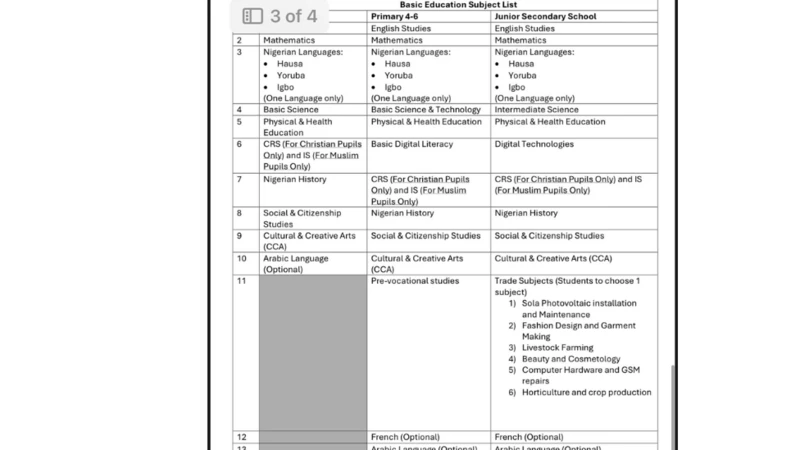
Primary 4–6 (Upper Primary)
Pupils will take a minimum of 11 subjects and a maximum of 12–13:
- English Studies
- Mathematics
- Nigerian Language (One)
- Basic Science & Technology
- Physical & Health Education
- Basic Digital Literacy
- Christian Religious Studies (CRS) or Islamic Studies (IS)
- Nigerian History
- Social and Citizenship Studies
- Cultural & Creative Arts (CCA)
- Pre-Vocational Studies (Now includes Entrepreneurial Studies)
- French (Optional)
- Arabic Language (Optional)
📘 Junior Secondary Curriculum (JSS 1–3)
Students must take a minimum of 12 subjects and a maximum of 13–14:
- English Studies
- Mathematics
- Nigerian Language (One)
- Intermediate Science
- Physical & Health Education
- Digital Technologies
- Christian Religious Studies (CRS) or Islamic Studies (IS)
- Nigerian History
- Social & Citizenship Studies
- Cultural & Creative Arts (CCA)
- Trade Subjects (Choose one):
- Solar Photovoltaic Installation & Maintenance
- Fashion Design & Garment Making
- Livestock Farming
- Beauty & Cosmetology
- Computer Hardware & GSM Repairs
- Horticulture & Crop Production
- Business Studies
- French (Optional)
- Arabic (Optional)
📗 Senior Secondary Curriculum
Senior Secondary students will study five compulsory core subjects, plus electives across four fields:
Core and Compulsory
- English Language
- General Mathematics
- One Trade Subject (see list below)
- Citizenship & Heritage Studies
- Digital Technologies
Science Subjects
Biology, Chemistry, Physics, Agriculture, Further Mathematics, Physical Education, Health Education, Foods & Nutrition, Geography, Technical Drawing.
Humanities Subjects
Nigerian History, Government, CRS, IS, Nigerian Language (One), French, Arabic, Visual Arts, Music, Literature-in-English, Home Management, Catering Craft.
Business Subjects
Accounting, Commerce, Marketing, Economics.
Trade Subjects (Choose one)
- Solar Photovoltaic Installation & Maintenance
- Fashion Design & Garment Making
- Livestock Farming
- Beauty & Cosmetology
- Computer Hardware & GSM Repairs
- Horticulture & Crop Production

🧭 Why This Matters
The new curriculum marks a major shift toward reducing overload, strengthening skills, and ensuring that Nigerian students graduate with both academic knowledge and practical competencies. Stakeholders note that the inclusion of digital literacy, vocational trades, and entrepreneurship better aligns learning with real-world needs.
Implementation begins in the 2025/2026 school session, with monitoring by the Ministry of Education to ensure smooth transition.


Community Join the conversation Open discussion +