

The Federal Ministry of Education has released the final list of ranked and approved textbooks for use in Nigerian schools between 2026 and 2028, with schools and education authorities urged to follow the new list when selecting and procuring books.
The FG approved textbooks 2026 list follows the completion of the first phase of the Federal Government’s national textbook ranking exercise and introduces a new tracking system aimed at improving transparency and accountability in the provision of instructional materials.
The first phase covers Primary 1, Primary 4, Junior Secondary School 1 (JSS 1) and Senior Secondary School 1 (SS 1).
This means school proprietors, administrators, teachers, procurement agencies and parents dealing with textbooks for these classes now have a final approved list to consult for the 2026–2028 period.
Every Approved Textbook Now Has a Unique Tracking Code
One of the major changes introduced by the Ministry is a unique Ranking/QR Tracking Code assigned to each approved textbook.
Alongside the code, the official list provides information including the textbook title, author or authors, publisher and year of publication.
According to the Ministry, the new identification system is intended to make approved instructional materials easier to identify and monitor and to strengthen accountability in their selection, procurement and use.
The additional work involved in generating and assigning unique codes to individual ranked textbooks also contributed to the time required to complete and validate the final lists.
The uploaded final document shows the system already in operation. Approved books are individually listed with their approval status and ranking codes rather than appearing simply as titles on a general recommendation list.
For example, the Primary 1 Mathematics section identifies each approved book by title, author, publisher, publication year, approval status and its own ranking code.
Schools Told to Use the Official List
The Federal Ministry of Education has specifically urged publishers, schools, education authorities, procurement agencies and other relevant stakeholders to consult the approved list when selecting or purchasing textbooks for the affected classes.
This makes the release particularly important for school heads preparing book lists or making bulk textbook purchases.
Rather than relying on old book lists, recommendations circulating on social media or claims that a particular publication has received approval, schools can check the final 2026–2028 list.
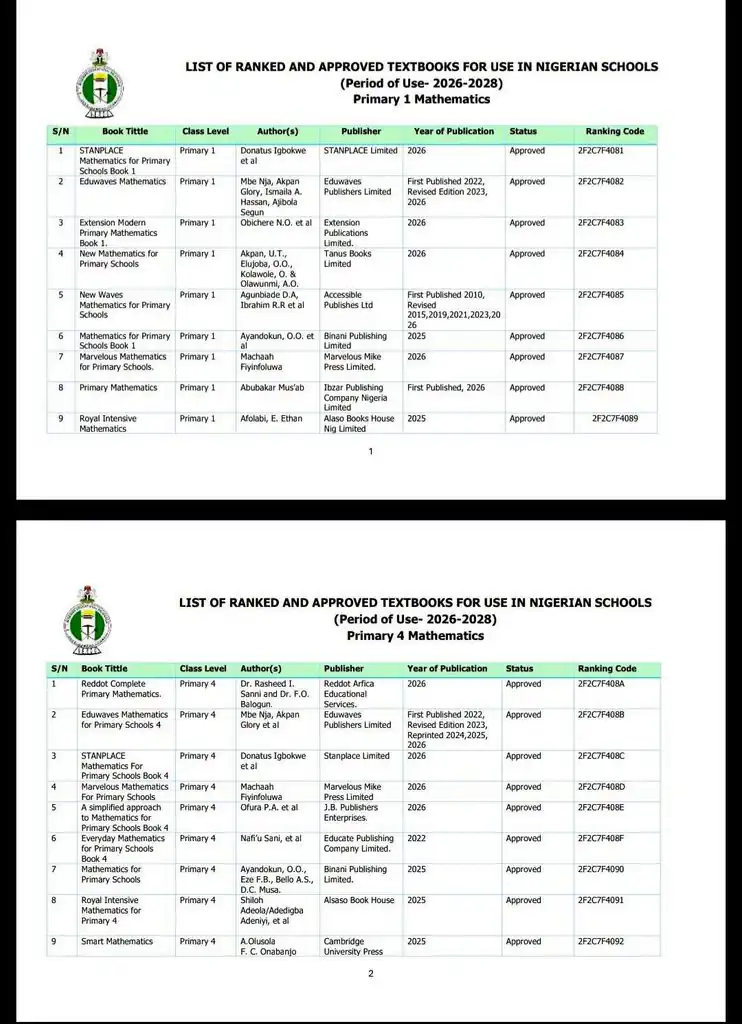
The document itself is extensive, covering approved titles across numerous subjects. Mathematics, for example, is separately presented for Primary 1, Primary 4 and JSS 1, with the JSS 1 section containing titles from several different publishers.
The same structure continues into subjects including English Studies, Social and Citizenship Studies, Basic Science, Digital Technologies, Business Studies and Nigerian History, among others.
Primary 2, Primary 5, JSS 2 and SS 2 Are Next
The Federal Government is not stopping with the four classes covered by the current release.
The textbook ranking programme is being implemented in phases, and preparations are expected to begin for a second round covering:
Primary 2, Primary 5, JSS 2 and SS 2.
The Ministry says the same identification and tracking measures will apply to textbooks approved during that phase.
This distinction is important for schools and parents. The current first-phase publication should not be interpreted as a complete list for every class in primary and secondary school.
Schools dealing with classes outside Primary 1, Primary 4, JSS 1 and SS 1 should therefore watch for subsequent releases from the Ministry.
Why the New Approved Textbook List Matters
The Ministry says the exercise is intended to ensure learners and teachers have access to quality, relevant and curriculum-aligned instructional materials while improving transparency and accountability in textbook provision.
The ranking exercise was conducted under the leadership of the Minister of Education, Dr. Maruf Tunji Alausa, and Minister of State for Education, Prof. Suwaiba Sa’id Ahmad, with the final list approved by the Minister of Education.
For teachers, the release provides a clearer reference for instructional materials approved for the affected classes.
For school heads and proprietors, it provides an important document to consult when preparing textbook lists and undertaking procurement.
For parents, it provides a basis for checking the books requested for children in the four affected class levels before purchasing them.
Publishers and booksellers will likewise need to pay attention not only to whether a title appears on the list but also to the identifying information and unique ranking code associated with the approved title.
Download the Full 2026–2028 Approved Textbook List
The complete document runs to 50 pages and contains the ranked and approved textbooks together with identifying information and Ranking/QR Tracking Codes.
Get it from here 👉 2026–2028 List of Ranked & Approved Textbooks for Nigerian Schools – Official PDF
The Federal Ministry of Education has encouraged stakeholders to adhere to the approved list when providing and using textbooks for the specified classes.
With the first phase now final, attention will next turn to Primary 2, Primary 5, JSS 2 and SS 2, which are scheduled to form the second round of the textbook ranking exercise.
For Nigerian schools currently reviewing their book lists, however, the message from the Ministry for the four classes already covered is clear: consult the final approved list before selecting or procuring textbooks for the 2026–2028 period.




Community Join the conversation Open discussion +